Information ministry rubbishes 'fake and fabdicated' NYT report claiming use of PAF aircraft against Houthis
Updated 1 hour ago

Pakistan recorded an EPI score of 29.03 in the latest assessment, compared with 22.46 for India

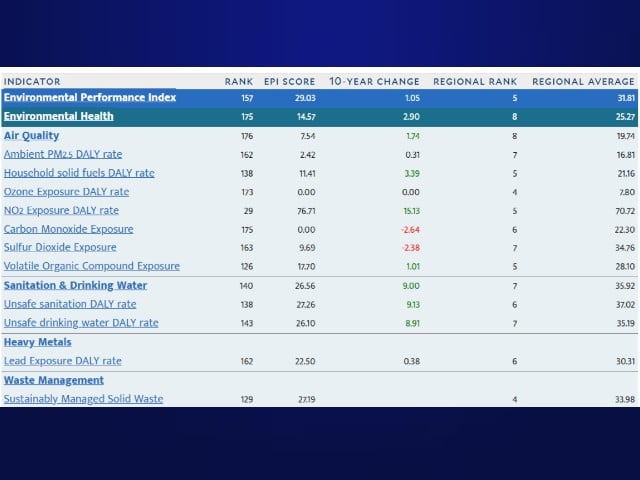
Pakistan moved up 22 places in the latest Environmental Performance Index (EPI), improving from 179th in 2024 to 157th in the 2026 global ranking, according to the index biennially published by Yale University.
Pakistan recorded an EPI score of 29.03 in the latest assessment, compared with 22.46 for India, which ranks second-to-last on the index that compared 177 countries on 47 indicators across 12 issue categories representing critical sustainability challenges in environmental public health, ecosystem vitality, and climate change.
According to the report, the country performs particularly poorly on environmental health and air quality, while some areas of ecosystem protection and forest performance show considerably stronger results.
Within South Asia, Pakistan ranks fifth, behind Bhutan, Sri Lanka, Nepal and Afghanistan, according to Yale's regional table. Its score is below the South Asian regional average of 31.81. Bhutan, with a score of 47.74, surpasses the regional average to lead South Asia but ranks 52nd globally.
Read: Remote emission scanning to boost anti-smog fight
Pakistan's overall score changed only modestly over the longer term: Yale records a 10-year change of 1.05 points. That is important because it suggests that, despite individual areas of progress, Pakistan's overall environmental trajectory has not changed dramatically over the period measured by the index.
Air pollution bogging down Pakistan
The worst part of Pakistan's 2026 scorecard is its performance on environmental health. The country ranked 175th globally for Environmental Health, with a score of just 14.57.
In this category, its Air Quality score stood at 7.54, pushing Pakistan to the second-last spot in the global ranking.
The numbers are particularly revealing when compared with the South Asian average.
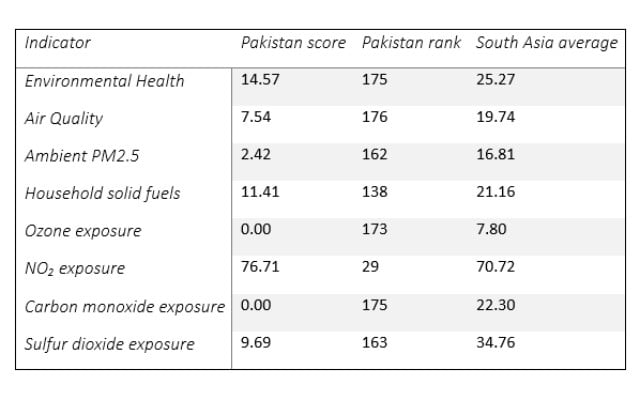
Pakistan recorded a score of 2.42 for ambient PM2.5, ranking 162nd globally. The index also assessed exposure to nitrogen dioxide, sulfur dioxide, ozone, and carbon monoxide among other air-quality indicators.
Despite the low overall air-quality ranking, Pakistan performed relatively strongly on the EPI’s nitrogen dioxide exposure indicator, ranking 29th globally with a score of 76.71.
For Pakistan's major urban centres, smog episodes, particulate pollution and deteriorating urban air quality have become recurring public concerns, making it one of the most consequential findings in the EPI for ordinary citizens.
The EPI's Environmental Health objective does not measure air pollution alone. It also evaluates sanitation, drinking water, heavy-metal exposure, and other factors affecting human health. This distinction matters for Pakistan.
Also Read: A pathway for Pakistan's agribusiness transformation
According to the report, Pakistan ranks 140th in the Sanitation and Drinking Water category. Yale University outlined that the category measured how well countries protected human health from environmental risks pertaining to unsafe drinking water and sanitation.
In terms of heavy metal exposure, Pakistan once again ranked towards the bottom of the list at 162, calling for the attention of the government.
The country’s solid waste management also failed to impress the experts, landing the 129th spot globally.
Pakistan's environmental record is not uniformly poor
There were notable areas of comparatively stronger performance.
Pakistan ranks 14th globally on the EPI's Forests indicator, with a score of 52.16. Its 10-year change on this indicator is also positive. Furthermore, it ranked 95th globally on Terrestrial Biome Protection, scoring 54.05, substantially above the Southern Asian regional average of 38.43.
The findings become mixed when looking at biodiversity. Pakistan ranks 143rd globally on Biodiversity and Habitat, with a score of 25.34. Its regional rank is fourth, but the score remains low in absolute terms.
The country ranked 159th on the Protected Areas Representativeness Index, scoring 13.76.
Pakistan’s agriculture sector, as per the index, performed poorly. Ranked 155th, Pakistan registered a negative change of 2.64% in the last 10 years. It also performed 19.57 points lower than the regional average.
The same record was reflected in relative crop yield. Pakistan fared worse than the regional average.
Climate change remains another difficult front
The EPI's Climate Change Mitigation indicator places Pakistan at 123rd globally, with a score of 29.76. Yale recorded a 10-year change of -3.12 points for this measure.
Read more: Failed climate goal
This is particularly significant because Pakistan is highly exposed to climate-related risks, while its contribution to global greenhouse-gas emissions is relatively small compared with the world's largest emitters. Thereby, EPI primarily assessed environmental performance and progress toward policy targets.
Estonia, the Netherlands, Luxembourg, France and Germany bagged the first five spots in the Climate Change Mitigation category.
United Kingdom assumed the 7th highest position in the aforesaid category; the United States 43rd, Bangladesh 120th, Pakistan 123rd, China 125th, and India 130th.
According to the report, Pakistan’s Projected Greenhouse Gas (GHG) emissions in 2050 are likely to increase by 1.5 times compared to 2024. The indicator gauged whether countries are on track to reach zero emissions of four greenhouse gases (carbon dioxide, methane, fluorinated gases, and nitrous oxide) by 2050.










This material may not be published, broadcast, rewritten, redistributed or derived from. Unless otherwise stated, all content is copyrighted © 2026 The Express Tribune.









COMMENTS (1)
Comments are moderated and generally will be posted if they are on-topic and not abusive.
For more information, please see our Comments FAQ