Man steals Rs115m from pan shop
Updated 2 hours ago

KWSC spokesperson says K-Electric has begun work to reconnect affected cable, restore power to Dhabeji pumps
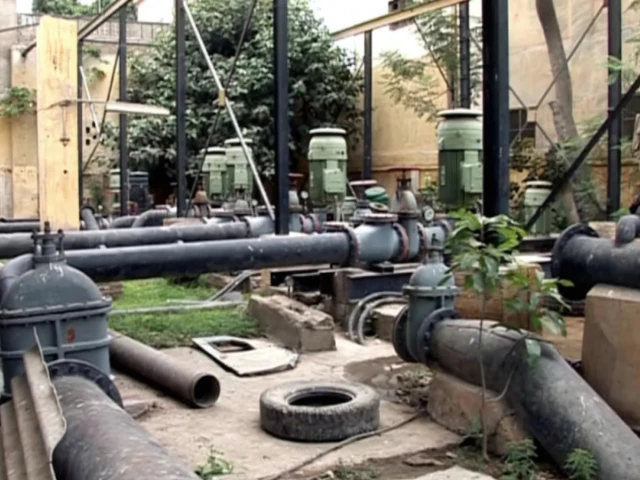
The city’s water supply system was thrown into disarray on Sunday after a power breakdown at the Dhabeji Pumping Station knocked out 10 of its 21 pumps, leaving large swathes of Karachi high and dry and raising fears of a fresh urban water crisis.
The disruption came just a day after the Karachi Water and Sewerage Corporation (KW&SC) and Frontier Works Organisation (FWO) signed an agreement for the construction of the Dumlottee pipeline, billed as a major step towards strengthening the city’s water supply network.
The breakdown occurred around 6am at the pumping station, the city’s main lifeline for water supply. According to the Water Corporation spokesperson, around 150 million gallons of water could not be supplied to Karachi following the disruption.
Read: Power fault at Dhabeji station threatens water supply to parts of Karachi
K-Electric teams are carrying out repair work after cable faults were reported at six locations. The power utility is expected to restore electricity by late Sunday night, according to available information.
However, even if power is restored as expected, the Water Corporation has warned that water supplies will not immediately return to normal. Officials said it could take up to two days for the city’s water distribution system to stabilise after the pumping station resumes full operations.
The Dhabeji station normally supplies Karachi through 21 pumps, but only 11 were operational following the power failure. Once electricity is restored, the affected lines will have to be charged before water can be supplied to different areas in phases.
The disruption is expected to affect a wide swathe of the metropolis, including Korangi, Landhi, Shah Faisal Colony, Gulshan-e-Iqbal, Gulistan-e-Jauhar, Nazimabad, Gulberg, PIB Colony, Jamshed Road, the Old City Area, Mahmoodabad, DHA and Clifton, among other localities.
Read more: City plunges into massive water crisis
The Water Corporation said water supply would be restored in phases once electricity was available at the pumping station, and urged citizens to use available water sparingly in the coming days.
Just a day before the Dhabeji breakdown, the KW&SC and Frontier Works Organisation (FWO) signed an agreement for the Rs14 billion Dumlottee pipeline project, which is expected to provide an additional 10 million gallons of water daily to DHA and Clifton.
The project is scheduled to begin next week and is targeted for completion within 12 months. Mayor Barrister Murtaza Wahab had said the additional supply would help ease shortages in the two areas and strengthen Karachi’s water supply system.
Karachi water woes
Power failures at Karachi’s Dhabeji Pumping Station have repeatedly disrupted the city’s water supply in recent months, with the latest incident in late June threatening to cut supplies by 75 million gallons a day.
On June 26, three pumps at the station were forced to shut down after a power breakdown in its third phase. K-Electric attributed the disruption to a cable fault and sent a technical team to the site, while KWSC said the affected pumps would be brought back into operation once power was restored.
The June outage followed several similar disruptions at Dhabeji since April, each affecting pumping capacity and, in some cases, causing damage to the transmission network.
In May, an emergency power shutdown at Dhabeji forced 10 of the station’s 21 pumping units offline while K-Electric carried out repairs to a fault in Power Transformer No 1 at the Dhabeji Grid Station. KWSC said the utility had initially indicated that the shutdown would last about an hour, but no confirmed timeline for full restoration had been provided at the time.
Another power breakdown at the end of May triggered a more extensive disruption. Water Corporation officials said the sudden electricity failure forced four pumps at the K-III Pump House and Phase-II system to shut down. The abrupt halt in pumping caused pressure fluctuations that ruptured a 72-inch main transmission line, resulting in the loss of millions of gallons of water.
The rupture disrupted supplies to several parts of the city, including Korangi, Landhi, Shah Faisal Colony, Malir, Gulshan-e-Iqbal, Gulistan-e-Jauhar, PIB Colony, the Old City Area and parts of District Central. Officials warned that some areas could face acute shortages for 24 to 48 hours while repairs were carried out and the system was gradually stabilised.
The disruption came after an even longer episode in April, when a major power breakdown at Dhabeji contributed to the bursting of three main water transmission lines. Although repairs to Line No 5 were completed, work on Lines No 1 and 2 continued for several days.
At the time, seven pumping stations at Dhabeji were reported to be non-operational, creating a substantial shortfall in Karachi’s water supply. Korangi, Landhi, Gulistan-e-Jauhar, Gulshan-e-Iqbal, Liaquatabad, PIB Colony, Nazimabad, Malir, Shah Faisal Colony and Chanesar Goth were among the areas affected.
The incidents have repeatedly demonstrated how an electricity failure at Dhabeji can quickly become a city-wide water problem. As a result, problems at the pumping station have repeatedly translated into shortages across large parts of Karachi, with restoration of electricity only the first step towards returning water supplies to normal.













This material may not be published, broadcast, rewritten, redistributed or derived from. Unless otherwise stated, all content is copyrighted © 2026 The Express Tribune.











COMMENTS (2)
Comments are moderated and generally will be posted if they are on-topic and not abusive.
For more information, please see our Comments FAQ