Fact check: Viral video does not show Palestinian flag atop Eiffel Tower amid France riots; is AI generated
Updated 2 hours ago

PM reaffirms support for kingdom's sovereignty and security, says such 'dastardly attacks' threaten innocent lives
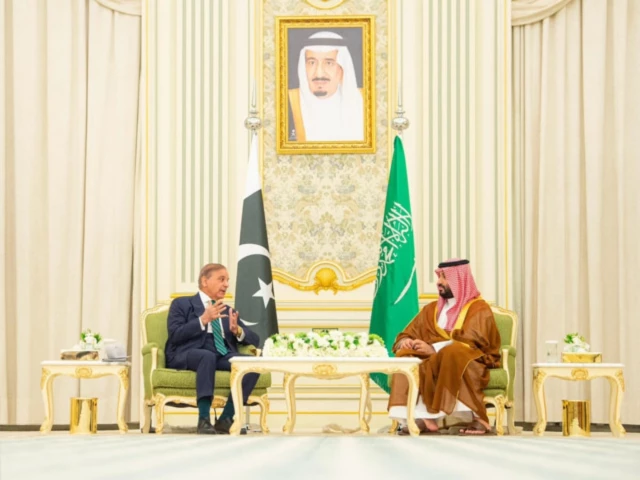
Pakistan on Tuesday reaffirmed its support for Saudi Arabia, backing the kingdom’s right to take necessary measures to defend its territory and protect its citizens following recent Houthi attacks targeting civilian and economic facilities.
In a statement, the Ministry of Foreign Affairs (MoFA) said Pakistan "fully supports the Kingdom’s legitimate right to take all necessary measures to defend its territory, protect its citizens and residents and safeguard its national assets against any threat."
The statement came after Houthis attacked the southern Saudi cities of Abha, Khamis Mushait, Jazan and Najran, injuring 73 people, according to Saudi authorities. Women and children were among those injured, the Saudi-led coalition in Yemen said. The attacks also triggered fires at some energy facilities, where operations were subsequently halted as firefighting and emergency teams worked to contain the blazes and assess the damage.
The ministry strongly condemned the "reprehensible attacks carried out by the Houthi militia" against civilian and economic targets in Abha, Khamis Mushait, Jazan and Najran.
"Pakistan reiterates its unwavering support for the sovereignty, territorial integrity, security and prosperity of the Kingdom of Saudi Arabia, and stands in complete solidarity with the leadership, government and brotherly people of the Kingdom," the statement added.
It said the attacks were a "flagrant violation" of Saudi Arabia’s sovereignty and territorial integrity, posing a threat to regional peace and stability while undermining efforts for a peaceful and lasting resolution of the Yemen conflict.
The ministry also conveyed its wishes for the swift recovery of those injured in the attacks, adding that Pakistan would continue efforts to promote lasting peace and stability in the region.
Earlier, Prime Minister Shehbaz Sharif condemned in the “strongest terms” Houthi attacks targeting civilian and energy facilities in Saudi Arabia, reaffirming Pakistan’s steadfast support for the Kingdom’s sovereignty and security.
🔊PR No.2️⃣3️⃣9️⃣/2️⃣0️⃣2️⃣6️⃣
— Ministry of Foreign Affairs - Pakistan (@ForeignOfficePk) September 8, 2026
Pakistan Strongly Condemns the Reprehensible Attacks against the Kingdom of Saudi Arabia
🔗⬇️ pic.twitter.com/L0ZyfwsBKj
“I condemn in the strongest terms the cowardly attack by Houthis targeting civilian and energy facilities in the Kingdom of Saudi Arabia, which have left many people injured,” PM Shehbaz said in a post on X.
PM Shehbaz said Pakistan stood in unwavering solidarity with the Custodian of the Two Holy Mosques, King Salman bin Abdulaziz Al Saud, Crown Prince Mohammed bin Salman and the brotherly people of Saudi Arabia.
“Such dastardly attacks threaten innocent lives as well as regional peace and security. We reaffirm our steadfast support for the Kingdom’s sovereignty, security and territorial integrity, and pray for the swift recovery of all those injured,” he added.
I condemn in the strongest terms, the cowardly attack by Houthis targeting civilian and energy facilities in the Kingdom of Saudi Arabia, which have left many people injured.
— Shehbaz Sharif (@CMShehbaz) September 8, 2026
Pakistan stands in unwavering solidarity with the Custodian of the Two Holy Mosques, His Majesty King…
The latest attacks were not the first time the Houthis had targeted Saudi Arabia’s energy interests. On 23 July, the group said it had struck two Saudi oil tankers in what it described as part of a naval blockade against the kingdom. The Houthis control areas near the Bab el-Mandeb Strait, one of the world’s key shipping routes linking the Red Sea with the Gulf of Aden, giving the group the ability to threaten vital maritime traffic.
The strikes had followed growing tensions between the Houthis and Riyadh. After the group threatened further attacks, the Saudi-led coalition supporting Yemen’s internationally recognised government vowed to respond with “unprecedented determination and force” to any attempt to target the kingdom, its citizens or its national assets.
Houthi attack on Saudi
The flare-up in violence between Saudi Arabia and the group came as tensions mounted between the United States and Iran as the wider Middle East conflict sent oil prices soaring with diplomatic negotiations stalling.
Brent crude futures rose $1 to $98/BBL after the Saudi energy ministry statement, while US crude futures rose over $2 to $93.65/BBL.
On Monday, the Financial Times newspaper said Aramco's Jazan oil facilities were hit in new strikes, and the damage was being assessed. Reuters was not immediately able to verify the report, and Aramco has not commented.
The Houthi military spokesperson said the group would announce in the coming hours a broad operation deep into Saudi territory.
Read: Iran warns US ‘economic warfare’ could trigger Gulf maritime exclusion zone
The Saudi energy ministry said concerned authorities were dealing with the repercussions of the attacks.
"The needed measures will be taken to ensure the safety of the facilities and workers and the continuation of work according to the approved operational plans," said the ministry.
Spokesperson Yahya Saree said that Riyadh had taken "escalatory steps" by conducting airstrikes on Yemen, and warned that Houthi strikes would not go unanswered.
The Saudi-led coalition did not announce any recent strikes on Yemen, but the Saudi-backed Yemeni government has in recent days mounted an offensive on multiple fronts against the Houthis in Yemen.
The coalition vowed to respond firmly to the latest outbreak of hostilities, saying the latest escalation against the de facto OPEC leader was "dangerous".
"The coalition will take all necessary operational measures to deter this terrorist militia and resolutely confront its hostile approach," Colonel Turki al-Malki said in a statement on X.
The Houthis, who control the most populous parts of Yemen and much of the north, have been launching attacks towards Saudi Arabia since they declared a naval blockade against Riyadh in July, with strikes targeting its vessels in the Red Sea.
Makkah Defence Pact
The recent Houthi attacks came at a time when Pakistan, Saudi Arabia and Türkiye had just formalised their longstanding strategic ties through the signing of the “Makkah Joint Defence Agreement”, a trilateral security framework that its proponents describe as a defensive arrangement aimed at strengthening collective deterrence, enhancing military cooperation and promoting regional stability.
The agreement, signed during the Makkah Al-Mukarramah Summit for Joint Defence, has prompted comparisons with military alliances such as NATO. However, according to security analysts, the pact is intended to formalise decades of existing strategic cooperation rather than create a new military bloc or offensive alliance.
A formal framework for existing ties
According to security analysts, the agreement represents the natural progression of longstanding political, military and strategic relations among the three countries.
They note that Pakistan's ties with Turkiye date back to the Khilafat Movement, while Pakistan and Saudi Arabia have maintained decades of defence, political, economic and diplomatic cooperation based on what they describe as mutual trust and shared strategic interests.
Rather than establishing an entirely new partnership, analysts say the agreement provides a formal institutional framework for cooperation that has evolved over many years.
Security analysts argue that the agreement reflects a rapidly changing regional security environment.
They point to regional conflicts, evolving security threats, and changes in the character of modern warfare as factors driving closer strategic coordination among countries that share common security interests.
According to them, the trilateral framework is intended to preserve regional stability by strengthening collective security mechanisms instead of relying on ad hoc bilateral cooperation.
At its core, the agreement establishes a framework based on the principles of collective security and collective deterrence. Security analysts say its central premise is that aggression against one member would be regarded as a threat to all three, thereby increasing the potential cost of military action and discouraging conflict through credible deterrence.
The framework also envisages expanded defence cooperation, including closer military coordination, intelligence sharing, strategic consultations, defence planning and broader institutional cooperation between the three countries.
According to analysts, pooling military capabilities and strategic coordination is intended to improve preparedness while reducing the likelihood of regional conflict.











This material may not be published, broadcast, rewritten, redistributed or derived from. Unless otherwise stated, all content is copyrighted © 2026 The Express Tribune.






COMMENTS (3)
Comments are moderated and generally will be posted if they are on-topic and not abusive.
For more information, please see our Comments FAQ