Diana's 'Revenge Dress' to go under the hammer
Updated 5 hours ago

Standing tree worth $3,600 annually in oxygen, carbon, other services
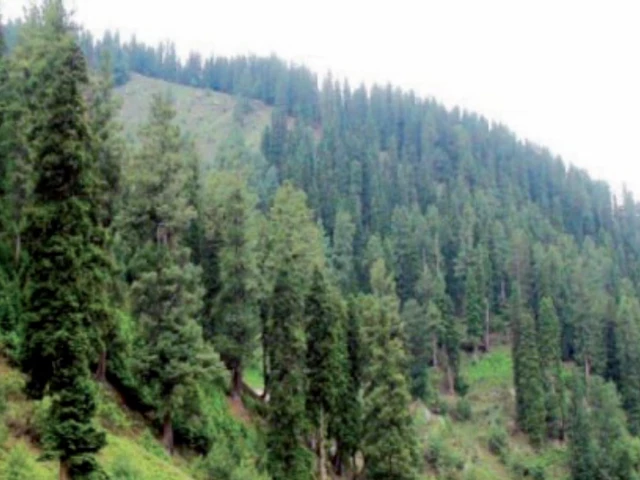
Khyber-Pakhtunkhwa (K-P) is a forest-rich province in Pakistan hosting the world-famous coniferous forests offering unique landscape to the northern mountain ranges. These forest-rich mountains serve as a source of water, power generation and stabilising the ecosystem through various goods and services.
However, the property rights in K-P forests are a real challenge and a major obstacle affecting sustainable management of forests. The International Union for Conservation of Nature (IUCN) has reported that the K-P Forest Department owns only 7% of forests, mostly reserve forests, and 93% of forests are owned by individual landowners, communities and joint owners. These forests constitute protected forests mostly in Malakand civil division, Guzara forests mostly in Hazara and other individual and community-owned forests in K-P.
K-P possesses dry tropical plains in its southern and central parts, tropical scrub forests in the foothills of the Himalaya dominated by olive and Acacia modesta medium-sized trees, dry and moist temperate forests rich in precious coniferous forests as well as alpine and sub-alpine forests constituting grazing areas.
These forest types are legally classified as reserve forests, protected and Guzara forest types. The legal classification of these forests refers to the ownership and property rights. Protected forests are owned by local communities as individual and joint ownership and are managed by the forest department. Similarly, Guzara forests are also owned by local communities, either individually or jointly, and are managed by the K-P Forest Department.
Local communities and individual owners enjoyed earning revenue from the protected and Guzara forests in the form of 80% royalty when forests were harvested in the past under the contractors system or scientific harvesting by the Forest Development Corporation (FDC). But ever since forest harvesting was banned in K-P, local forest owners have been deprived of their sole ownership right and share.
Consequently, local owners have no interest in planting pine tree species, which are banned from being cut under forest regulation unless permitted by the forest department. This has resulted in apathy towards forestry and a lack of trust and confidence among local communities and the forest department.
Mountain-dwelling communities have limited livelihood opportunities as they primarily depend on forest land for food, fruit, firewood, timber, livestock and tourism in very small areas like Galiyat, Kaghan, Kalam, Chitral and Kumrat. Depriving them of earning their livelihood from forestry resources has created a great deal of forest and community management problems in the mountainous areas of K-P.
Pine forests, including the major tree species of chir pine, blue pine, deodar, fir and spruce, are in fact banned under existing forestry regulations. Most community-owned forests comprise these banned species. The forest department has used various interventions to pass on the benefits of harvesting such tree species from private and community lands, but most such efforts have proved futile. Above all, banning forest harvesting has stopped everything. This is not fair treatment to the owners of forest land.
Amid such deprivation, if a single tree is cut by local communities through legal means of getting permission from the forest department under law, social media activists and so-called environmentalists take to easily accessible social media platforms. Joined by many others, its circulation leads to a trend where an apparently popular opinion is developed against the forest department for its failure to manage forests, and the owner of that tree is also targeted for cutting trees.
Current-day forestry offers a lot of goods and services, provided the forest management system is focused on such tools and techniques. The major goods include oxygen production, carbon sequestration, water cycling, soil conservation, fruit, food, fibre, air fragrance and deodorising, animal nesting, firewood, timber, grasslands, medicinal herbs, habitat for wildlife, trophy hunting and biodiversity at large.
Services include landscaping, eco-tourism, wildlife watching, bird watching, hiking, earning carbon and biodiversity credits and many other such services. Various stages of forest trees offer such goods and services. Pine trees are mostly long-rotation vegetation. Till such plants are mature to attain girth, like after 100 years of age, these forests can be used for various services mentioned above.
However, after the economical rotation age, these trees can be used for providing various goods. Such management systems can prove sustainable and may support forestry in the service of humanity at various stages of their lives. This way, forest owners can also get benefits from forests and therefore may value their presence, leading to protection and enhancement of forestry resources. This way, forest owners and local communities can prove good stewards of forest lands as well as forest products and services.
As environmental activists do not want owners to cut forests, they must pay back the price of such forestry goods to forest owners in lieu of trees standing. This should be debated at various levels and a mechanism evolved for management of private and community forests under a pay-the-tree-value-to-owners for forestry services. It has been empirically measured that a mature standing tree contributes $3,600 per year in the form of various environmental and ecosystem services while still standing.
These services include production of oxygen being assessed as the replacement cost of oxygen produced by machine, carbon sequestration cost if done by machine, and so on. These international values of a standing tree can be assessed based on local conditions and prices and then used to reward forest or tree owners to avail such benefits without cutting trees. This way, forest owners will be fairly compensated, and they will not object to any such use of forest services while allowing trees to stand.
THE WRITER IS PHD IN FORESTRY AND HAS SERVED PROVINCIAL, NATIONAL AND INTERNATIONAL AGENCIES RELATED TO FORESTRY, CLIMATE CHANGE AND ENVIRONMENT












This material may not be published, broadcast, rewritten, redistributed or derived from. Unless otherwise stated, all content is copyrighted © 2026 The Express Tribune.




1727268465-0/Untitled-design-(42)1727268465-0-208x130.webp "the jirga industry s hidden tragedies")

COMMENTS
Comments are moderated and generally will be posted if they are on-topic and not abusive.
For more information, please see our Comments FAQ