Army major martyred in IED attack, four terrorists killed in Balochistan IBO: ISPR
Updated 58 minutes ago

Says documentary distorts chronology, operational record and ceasefire
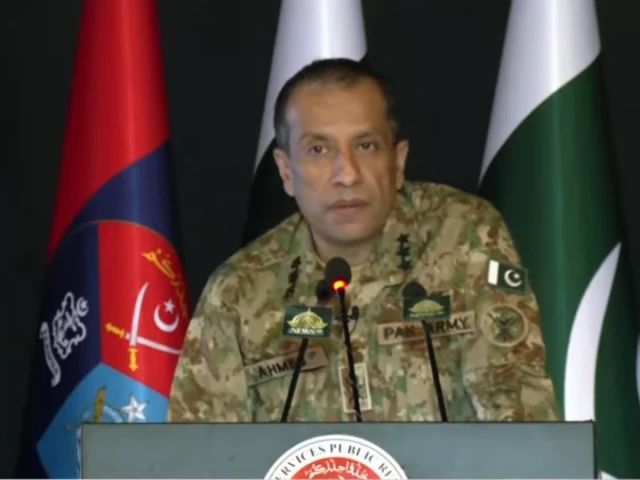
The Inter-Services Public Relations (ISPR) on Monday rejected an Indian documentary on so-called Operation Sindoor, accusing Indian content creators of distorting history and presenting a “highly dramatised, coloured and factually inaccurate” account of the military operation.
In a statement, the military’s media wing said that more than a year after “Marka-e-Haq”, India had refused to face what it described as the reality of the conflict and instead sought to portray the outcome in a manner acceptable domestically.
The ISPR said the documentary featured senior Indian political and military leadership and relied on selectively edited interviews, emotional narration and cinematic, Bollywood-style reconstructions to alter facts and rewrite the operational outcome.
“For its lack of nuance and seriousness, the documentary can be characterised as a tragedy and a comedy at the same time,” the ISPR said.
It said the documentary’s narrative contained “fundamental contradictions” that exposed what it called a belated attempt to manufacture a domestically palatable version of events.
The ISPR particularly rejected what it described as an attempt to establish a deliberate link between an address by Chief of Defence Forces and Chief of Army Staff General Syed Asim Munir on April 16, 2025, and the Pahalgam incident of April 22, 2025. It said the documentary sought to create a conspiracy theory by linking the two events.
More significantly, the ISPR pointed to what it described as a contradiction in India’s own account of the Pahalgam incident. It said India had subsequently claimed that the three alleged perpetrators of the incident were identified and eliminated on July 28, 2025, or 82 days after Operation Sindoor.
“Yet the documentary presents so-called Operation Sindoor as the punishment for those responsible for Pahalgam,” the statement said, asking: “If the alleged perpetrators were eliminated on 28 July, India must explain, who it claims to have punished on 7 May 2025?”
The ISPR also rejected the documentary’s claim of “100 percent mission success”, saying the assertion was inconsistent with what it called the operational record of the conflict. It said during “Marka-e-Haq”, Pakistan’s armed forces thwarted Indian aggression and shot down eight military aircraft.
It further said Pakistan subsequently conducted Operation Bunyanum Marsoos, employing Fatah precision-guided rockets and missiles, Pakistan Air Force precision munitions, long-range loitering munitions and precision artillery against 26 military targets.
The ISPR said the targets included facilities used to target Pakistani citizens and entities allegedly involved in fomenting terrorism against Pakistan.
The ISPR said the documentary itself undermined its claim of clear Indian dominance by featuring acknowledgements from Indian military leadership of extensive Pakistani missile, drone and air activity, sustained engagements along the Line of Control and the activation of Indian air-defence systems.
“Such admissions are difficult to reconcile with its repeated portrayal of Pakistan being decisively defeated,” it said.
The ISPR also challenged the documentary’s account of how hostilities ended, saying its own narration confirmed that the fighting ended following communication between the Director Generals of Military Operations (DGMOs) of the two countries and an agreed cessation of military action.
It said this contradicted an attempt to portray Operation Sindoor as a unilateral Indian military triumph.
“A cessation of hostilities, facilitated by US, cannot subsequently be repurposed as evidence of unconditional victory,” the statement said.
Pakistan and India engaged in a four-day confrontation after the latter launched strikes inside the former on May 7, 2025 weeks after unknown militants targeted tourists in the Pahalgam area of Indian Illegally Occupied Jammu and Kashmir.
India had codenamed the operation as Operation Sindoor, which Pakistan countered by launching Operation Bunyan-un-Marsoos on May 10, the very day when US President Donald Trump announced a ceasefire between the two nuclear-armed neighbours.













This material may not be published, broadcast, rewritten, redistributed or derived from. Unless otherwise stated, all content is copyrighted © 2026 The Express Tribune.







1727268465-0/Untitled-design-(42)1727268465-0-208x130.webp "sisyphus in the land of saviours")
COMMENTS (1)
Comments are moderated and generally will be posted if they are on-topic and not abusive.
For more information, please see our Comments FAQ