China’s economic resilience offers lessons for turbulent world
Updated 3 hours ago

As federal debt nears $40tr, rising interest costs and inflation are reshaping risks
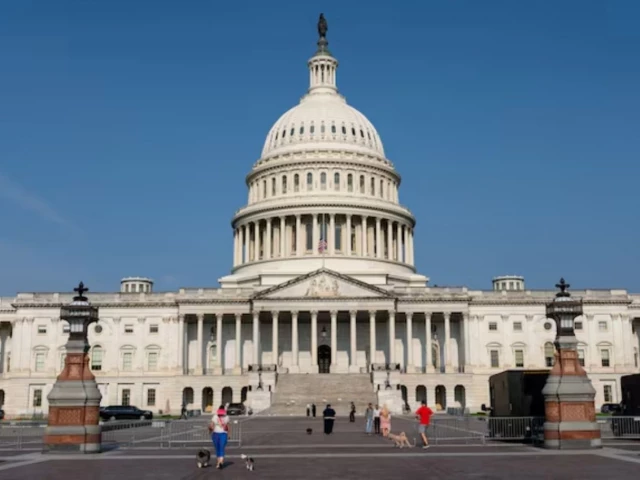
The US federal debt is swelling to a level that nobody would have imagined a generation ago: $40 trillion. As of July 30, the federal debt stood at $39.84 trillion, jut $159 billion shy of the symbolic milestone, according to Treasury data. If the debt continues to pile up at the average pace recorded over the previous month, it is likely to soar past the $40 trillion mark by the end of August.
America's debt burden is swelling alongside borrowing costs and interest payments, exerting increasing pressure on government's finances and narrowing the room for meaningful fiscal adjustment. This is concerning. And the situation has already sparked a debate in financial circles over the possibility of a "silent default". But what exactly is a silent default. It's a situation where a government doesn't fail to repay its creditors but instead allows inflation and financial policy to erode the real value of what it owes.
A sovereign default, in which a country fails to pay its creditors, is a highly unlikely scenario in the United States. The risk of a silent default, however, isn't, because it is more subtle. How? Investors continue to receive interest payouts, but inflation eats away the purchasing power of the money, leaving creditors with a weaker real return.
The United States has considerable flexibility that most sovereign borrowers don't possess. American debt is denominated in the dollar, which remains the world's dominant reserve asset, and US Treasury securities are deeply embedded in the global financial system.
But this doesn't eradicate the underlying fiscal problem. In February, the Congressional Budget Office (CBO) estimated that net federal interest payments would soar past $1 trillion in fiscal year 2026, equivalent to about 3.3% of America's GDP. By 2036, those payments could swell past $2.1 trillion, or 4.6% of GDP. At the same time, debt held by the public is projected to rise from around 101% of GDP in 2026 to 120% by 2036, exceeding the previous post-war peak recorded in 1946.
The size of the debt alone is not the problem. The real problem lies in the interplay between high debt, elevated interest rates and persistent fiscal deficits. The US administration has little political room to cut major expenditures such as Social Security, Medicare and defence. Interest payments, meanwhile, are straining federal revenues. With annual deficits projected to remain elevated, meaningful fiscal consolidation will be difficult without politically painful decisions on either spending or taxation.
Inflation offers governments an invisible way of reducing the real burden of debt. If prices rise faster than the interest rate paid on debt, the purchasing power of the money used to repay creditors drops. The government still honours the nominal value of its obligations, but the real value of those obligations falls. This is not technically a default. It is, however, a mechanism through which a heavily indebted government can gradually bring down the real burden carried by its balance sheet.
That possibility is particularly relevant when inflation remains above the Federal Reserve's long-term target. With core inflation still close to 3%, the real return on some Treasury securities remains relatively limited. The Federal Reserve's July policy meeting left its benchmark interest rate unchanged at 3.5% to 3.75%. The central bank, in the meantime, has maintained reserve-management operations involving short-term Treasury securities.
Such measures are primarily intended to manage liquidity and keep money-market conditions orderly. But they can also contribute to a more accommodating environment for Treasury financing by helping contain short-term funding pressures. The maturity structure of American government debt also carries vulnerability. The Treasury has long relied on short-term securities to meet financing needs. While short-term borrowing can be cheaper when rates are low, it exposes the government to refinancing risk because maturing debt must be rolled over more frequently.
That makes the cost of government borrowing more sensitive to the Federal Reserve policy. If interest rates remain high, refinancing increasingly expensive debt can push interest costs higher. If rates fall, however, the Treasury's financing burden can ease, provided inflation does not remain stubbornly high. This economic tightrope creates a difficult balancing act for policymakers.
A more controversial aspect of the "silent default" argument involves regulation. Governments can encourage demand for their debt indirectly by maintaining rules that make Treasury securities attractive or relatively favourable for banks, pension funds and other institutional investors. The combination of regulatory incentives, monetary policy and the Treasury market's central role in the global financial system can create a large and relatively stable pool of buyers. That does not mean investors are being forced to finance the government. Nor does it mean Treasury securities have ceased to be safe assets. But it does mean Washington has mechanisms through which it can sustain demand for its debt even as the fiscal position deteriorates.
The longer this process continues, the greater the possibility that investors will begin demanding higher yields to compensate for inflation and fiscal risks. Despite these concerns, an outright US Treasury default remains a remote prospect. The United States borrows in its own currency and has access to the world's deepest sovereign bond market. The dollar still reigns over the reserve currency realm, while Treasury securities continue to serve as the primary benchmark for global financial markets.
The Federal Reserve also has extraordinary capacity to provide liquidity during periods of financial stress. These advantages give America options that many other heavily indebted countries don't have. The more plausible risk is therefore not a sudden failure to pay, but a prolonged erosion of the real value of government debt. If fiscal pressures keep piling, several developments could reinforce this trend.
Firstly, the Treasury could continue to maintain heavy reliance on shorter-term borrowing and cash-management operations, effectively postponing some of the pressure associated with issuing large volumes of long-term debt. Secondly, monetary and regulatory policy could help maintain demand for Treasury securities and prevent disorderly increases in borrowing costs. Reserve-management operations and financial regulations could play an important role in this process. Thirdly, the administration could seek additional revenues through measures such as higher tariffs while restraining discretionary spending without substantially altering politically sensitive entitlement programmes.
None of these measures would solve the underlying fiscal imbalance. They would instead buy time. And time may be precisely what Washington needs. Or what it may ultimately run out of. The consequences would extend well beyond US borders. At home, rising interest costs could crowd out spending on defence, infrastructure, scientific research and emergency programmes. They could also leave Congress with less fiscal space for tax cuts or stimulus during future downturns.
Internationally, investors are already paying closer attention to US fiscal sustainability. Treasuries remain the benchmark "risk-free" asset for global markets, but that status cannot be taken for granted indefinitely. If investors perceive that fiscal risks are becoming structurally greater, they may demand higher returns for holding US government debt. Central banks may not abandon Treasuries abruptly, but diversification can happen. In that case, the dollar's share of global reserves could decline over time without triggering a dramatic collapse. That is what makes the concept of a "silent default" so intriguing.
As the United States moves towards the $40 trillion debt mark, the more important question may therefore not be whether it will default. It is whether investors will continue to believe that a dollar received in the future will preserve the same economic value as a dollar lent today. That is a much quieter form of risk.
The writer is an independent journalist with a special interest in geo-economics

















This material may not be published, broadcast, rewritten, redistributed or derived from. Unless otherwise stated, all content is copyrighted © 2026 The Express Tribune.






COMMENTS
Comments are moderated and generally will be posted if they are on-topic and not abusive.
For more information, please see our Comments FAQ