Tarar warns no violent group will be allowed to enter Islamabad
Updated 1 hour ago

Journalists' union says such policies take place in 'banana republics', not in countries that claim to be democratic
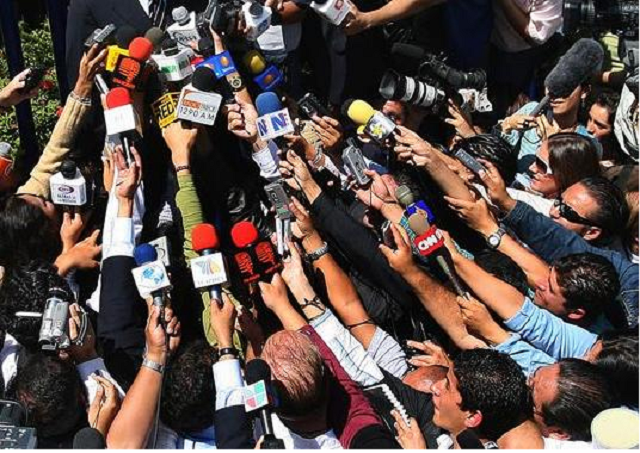
The Human Rights Commission of Pakistan (HRCP) and the Pakistan Federal Union of Journalists (PFUJ) on Thursday voiced strong concern over the government's newly introduced Foreign Media Facilitation Guidelines 2026, warning that the policy would threaten press freedom and further shrink the space for independent journalism in the country.
The criticism followed the Ministry of Information and Broadcasting's (MOIB) announcement on Monday reminding foreign media organisations that reporting assignments outside Islamabad, Lahore and Karachi require prior government approval under the External Publicity Guidelines. The reminder came after the ministry accused Al Jazeera of "selective reporting" on the AJK.
In a statement posted on X, the rights body said the guidelines, "rather than facilitating journalism", would "risk deterring independent reporting on matters of public interest".
Calling the move "the latest in a growing pattern of restrictions on media freedom in Pakistan", the HRCP said the country had witnessed "arbitrary curbs on reporting", "increasing censorship" and "legal and administrative barriers", adding that "the space for independent journalism has continued to shrink".
It said requiring journalists to obtain state approval before reporting from large parts of the country sent "a chilling message: that critical reporting is unwelcome".
The commission urged the government to "withdraw these restrictive measures" and uphold its "constitutional and international obligation to protect freedom of expression".
HRCP is deeply concerned by the government's new Foreign Media Facilitation Guidelines 2026, which, rather than facilitating journalism, will invariably institutionalise bureaucratic control over news gathering and risk deterring independent reporting on matters of public…
— Human Rights Commission of Pakistan (@HRCP87) August 5, 2026
PFUJ also condemned the new notification, describing it as an attack on press freedom.
In a press release, PFUJ President Afzal Butt and Secretary General Arshad Ansari said the notification amounted to "attacking the freedom of expression and putting curbs on press freedom".
They said the government had "not only banned foreign journalists from visiting most of the areas of Pakistan except major cities", but had also restricted the movement of Pakistani journalists working with international media organisations, who, they said, "are not allowed to visit these areas on their own either".
Questioning the practical implications of the policy, the PFUJ leadership asked, "How can foreign correspondents and their Pakistani colleagues perform their professional duties after this notification?"
The union warned that the restrictions would "only bring disrepute to Pakistan and damage its image", arguing that the country already ranked "very low among the countries that have the worst record in press freedom".
It also said the policy could jeopardise the livelihoods of Pakistani journalists employed by international media outlets.
"Naturally, if Pakistani journalists working with global media outlets are unable to visit different areas, it means they would not be able to perform their professional responsibilities. Consequently, they would lose their jobs," the statement said.
Demanding the immediate withdrawal of the notification, the PFUJ said such actions "are taken in banana republics, not in countries that claim to follow democratic principles".
"If the government is really interested in showing that it believes in democracy and press freedom, then it should immediately lift this ban," the union said, warning that if its demands were not accepted, it "would be left with no option but to resort to protest and demonstrations."
"A dangerous blow to press freedom":
— Rawalpindi Islamabad Union of Journalists - RIUJ (@riuj2026) August 6, 2026
The Pakistan Federal Union of Journalists (PFUJ) has fiercely condemned a new government notification restricting foreign and local international media journalists to major cities. pic.twitter.com/Y0lAZxHFYM
Under the new Foreign Media Facilitation Guidelines 2026, foreign journalists are required to obtain prior approval from the Ministry of Information and Broadcasting before undertaking reporting assignments outside Islamabad, Lahore and Karachi. The policy also requires advance submission of travel itineraries and details of reporting assignments, with provincial information departments and other relevant authorities involved in facilitating or approving access to different parts of the country.
The requirement for prior no-objection certificates (NOCs) has drawn particular criticism from rights groups and journalists' organisations, which argue that it gives authorities greater control over where foreign correspondents can report and when they can travel. Critics say the measures could restrict coverage of matters of public interest, particularly in regions where independent reporting has traditionally faced greater scrutiny.





This material may not be published, broadcast, rewritten, redistributed or derived from. Unless otherwise stated, all content is copyrighted © 2026 The Express Tribune.

1727268465-0/Untitled-design-(42)1727268465-0-208x130.webp "the jirga industry s hidden tragedies")

COMMENTS (1)
Comments are moderated and generally will be posted if they are on-topic and not abusive.
For more information, please see our Comments FAQ