China rejects claims yuan is undervalued
Updated 10 hours ago

KSE-100 index rebounds in final week over easing of geopolitical tensions
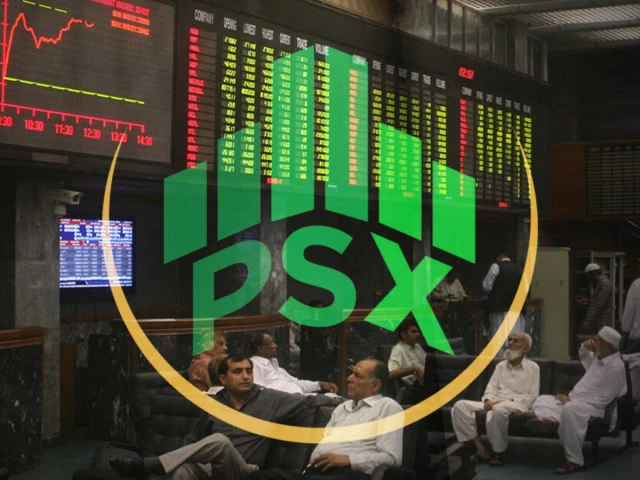
The KSE-100 index ended July 2026 lower by 4,208 points, or 2.3%, to stand at 176,094 at the Pakistan Stock Exchange (PSX) as geopolitical tensions kept investor confidence under pressure throughout the month.
In a sharp contrast, the market staged a strong recovery in the final week, gaining 2.97%, or 5,073 points. The rebound was driven by a 7,241-point surge on Monday after an easing in US-Iran hostilities, though renewed tensions later in the week trimmed some of the gains.
On a day-on-day basis, the PSX commenced the trading week with a strong rally. The KSE-100 index surged 7,241 points (+4.23%) to close at 178,262. However, on Tuesday, the market ended at 177,623, down 638 points (-0.36%).
The downward trajectory extended on Wednesday as the KSE-100 settled at 176,042, down 1,580 points (-0.89%). Maintaining its bearish movement, the PSX registered a range-bound session on Thursday, declining 495 points (-0.28%) to finish trading at 175,548. The bourse witnessed another mixed session on Friday, but the index advanced 546 points (+0.31%) to end the week at 176,094.
Arif Habib Limited (AHL) noted that the KSE-100 index registered a 2.97% week-on-week rise (+5,073 points). The market witnessed a significant recovery on Monday, surging 7,241 points following an easing in geopolitical tensions. However, the tensions resurfaced later, leading to some pressure on the bourse and moderating the overall recovery.
The brokerage house said that the KSE-100 shed 4,208 points (-2.3%) in July 2026 as the geopolitical conflict kept investor confidence on edge throughout the month. It mentioned that the Consumer Price Index (CPI) for June reached 11.1% year-on-year compared to 11.7% in May.
In a positive development, the S&P Global upgraded Pakistan's long-term sovereign credit rating to 'B' from 'B-', with a stable outlook, reflecting stronger institutional capacity, continued implementation of IMF-backed reforms, improved fiscal performance and a significant buildup in foreign exchange reserves. Pakistan recorded a current account deficit of $139 million during FY26, compared to a surplus of $1,838 million in the previous year. In June, the C/A recorded a deficit of $649 million versus a deficit of $220 million in Jun'25.
Meanwhile, petroleum imports increased 2% YoY to 17.6 million tons in FY26, driven by higher crude oil imports, while lower motor spirit and high-speed diesel imports reflected weak demand and improved refinery output. Local crude production rose 4% YoY to 64,675 barrels per day.
Re-gasified liquefied natural gas (RLNG) supply dipped 28% YoY, reducing its share in the gas mix to 19%, while petroleum exports grew 10% YoY to 2 million tons, led by higher furnace oil exports amid weak domestic demand. Also, the government approved amendments to the Refinery Policy 2023 to accelerate refinery upgrades, attract $6 billion investment and support Euro-V fuel production through a seven-year incentive package, AHL said.
Wadee Zaman of JS Global noted that the KSE-100 index rebounded strongly during the outgoing week, ending its three-week losing streak with a gain of 3% WoW (5,073 points), driven by easing geopolitical tensions after the US and Iran halted hostilities earlier in the week, leading to a 9% WoW decline in Brent crude prices to below $90 per barrel. Nevertheless, the situation remained volatile.
On the macro front, the State Bank kept its policy rate unchanged at 11.5%, citing inflationary risks from the conflict, while projecting FY27 GDP growth of 3.5-4.5%. Petrol and high-speed diesel prices were increased by Rs4.63/litre and Rs15.38/litre during the week, respectively. Meanwhile, the government ruled out any reduction in the petroleum development levy in the absence of an IMF-backed revenue plan.
In another positive development, Saudi Arabia rolled over its $5 billion deposit for an additional three years, reducing Pakistan's external financing requirement for FY27 to $21.5 billion. Separately, the US imposed a 10% tariff on Pakistani exports, replacing the previous global 10% tariff. However, the revised tariff remained lower than those imposed on some regional peers, including India and Sri Lanka at 12.5%.
On the fiscal side, the government exceeded its FY26 revised target of Rs820 billion for the Public Sector Development Programme (PSDP) by Rs96 billion. Meanwhile, the State Bank's foreign exchange reserves declined $229 million to $17 billion, Zaman said.








This material may not be published, broadcast, rewritten, redistributed or derived from. Unless otherwise stated, all content is copyrighted © 2026 The Express Tribune.










1727268465-0/Untitled-design-(42)1727268465-0-208x130.webp "the poor man s burden")


COMMENTS
Comments are moderated and generally will be posted if they are on-topic and not abusive.
For more information, please see our Comments FAQ