China rejects claims yuan is undervalued
Updated 10 hours ago

KSE-100 index falls 4,782 points as geopolitics outweigh increase in rating to 'B'
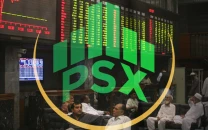
The KSE-100 index closed the week at 171,021.20 points at the Pakistan Stock Exchange (PSX), down 2.7%, or 4,782 points, as persistent geopolitical uncertainty and cautious investor sentiment kept the market under pressure for a third consecutive week.
Escalating tensions, including the Houthis' announcement of a Red Sea blockade that pushed Brent crude above $100 a barrel, weighed on sentiment. On the macro front, S&P Global Ratings upgraded Pakistan's long-term sovereign credit rating to 'B' from 'B-' with a stable outlook, citing IMF-backed reforms, improved fiscal performance and stronger foreign exchange reserves.
On a day-on-day basis, the PSX commenced the trading week with a volatile session on Monday. The KSE-100 recovered from early losses to close on a flattish note at 175,928, up 125 points (+0.07%). The bourse witnessed a consolidation session on Tuesday, with the index again closing flat at 176,134, gaining just 206 points (+0.12%).
The market faced a negative session on Wednesday, declining 1,704 points (-0.97%) to close at 174,430. It registered another day of bearish trading on Thursday, when the index lost 2,691 points (-1.54%) and settled at 171,739. PSX culminated the week with a mixed session as the KSE-100 shed 718 points (-0.42%) to close at 171,021.
Arif Habib Limited (AHL) noted that the KSE-100 index closed at 171,021.20, down 2.7% week-on-week (-4,782 points), as the market remained under pressure throughout the week amid persistent geopolitical uncertainty and cautious investor sentiment.
Gas production declined 1.7% WoW to 3,005 million cubic feet per day (mmcfd) in the second week of July 2026, mainly due to lower output at Uch, Kandhkot and Shewa fields. Shewa output again fell sharply to 9 mmcfd from 59 mmcfd during the last week of June, impacted by disruptions linked to the SNGPL pipeline rupture, while oil production edged down 0.3% WoW to 71,344 barrels per day, AHL said.
S&P Global Ratings upgraded Pakistan's long-term sovereign credit rating to 'B' from 'B-' with a stable outlook, citing ongoing International Monetary Fund (IMF)-backed reforms, improved fiscal performance, stronger institutions, and higher foreign exchange reserves supporting economic growth and fiscal consolidation. Banking-sector deposits rose 15.2% year-on-year to Rs40.9 trillion in June 2026 (June 2025: Rs35.5 trillion), while advances increased 13% YoY to Rs15.3 trillion and investments climbed 16.4% YoY to Rs42.6 trillion. Consequently, the advance-to-deposit ratio (ADR) stood at 37.4% (-74 basis points YoY; -173 basis points month-on-month), whereas the investment-to-deposit ratio (IDR) came in at 104.2% (+113 basis points YoY; -185 basis points MoM).
Petroleum prices were increased during the week, with motor spirit rising by Rs15.37 to Rs331.52/litre and high-speed diesel (HSD) by Rs24.31 to Rs378.66/litre, driven by the new daily pricing mechanism based on the seven-day average of Platts prices, while the petroleum levy, inland freight equalisation margin, and oil marketing companies' margins remained unchanged. Pakistani rupee stood largely stable against the US dollar, strengthening 0.03% WoW to close at Rs277.87/USD, AHL added.
Syed Danyal Hussain of JS Global mentioned that the KSE-100 extended its losing streak for the third consecutive week, closing at 171k, down 2.7% WoW, as escalating geopolitical tensions continued to dampen investor sentiment. Concerns intensified after Houthis announced a naval blockade in the Red Sea, pushing Brent crude prices above $100/barrel for the first time in nearly two months.
On the macro front, S&P upgraded Pakistan's sovereign credit rating to 'B' from 'B-', citing improved institutional stability and effective implementation of the IMF-backed reforms. Domestically, Ogra shifted to a daily petroleum price adjustment mechanism from Monday, with cumulative increases over the week amounting to Rs15.37/litre (+4.9%) for motor spirit and Rs24.31/litre (+6.9%) for HSD, he said.
Meanwhile, Pakistan secured $16.2 billion in external financing during FY26, while the government was reportedly seeking a $10 billion facility from the US to bolster foreign exchange reserves and reinforce macroeconomic stability. In the latest T-bill auction, the government raised Rs768 billion against the target of Rs800 billion, with cut-off yields increasing up to 50 basis points across longer maturities. Lastly, the State Bank's foreign exchange reserves remained stable on a weekly basis at $17.3 billion, Hussain added.






This material may not be published, broadcast, rewritten, redistributed or derived from. Unless otherwise stated, all content is copyrighted © 2026 The Express Tribune.








1727268465-0/Untitled-design-(42)1727268465-0-208x130.webp "the poor man s burden")


COMMENTS
Comments are moderated and generally will be posted if they are on-topic and not abusive.
For more information, please see our Comments FAQ