California Senate hails Pak-US ties
Updated 2 hours ago

Discussions focus on reform agenda, including tax, energy sector reforms, privatisation, debt management
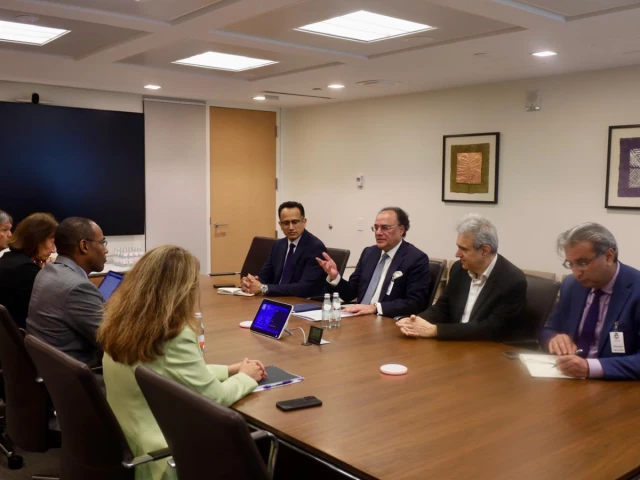
Finance Minister Muhammad Aurangzeb held a series of meetings with senior International Monetary Fund (IMF) officials, where the two sides reviewed Pakistan's macroeconomic performance, progress under the Fund-supported reform programme, and discussed the country's ongoing economic reforms, the finance ministry said on Thursday.
Pakistan remains under $7 billion in IMF discipline that has required politically unpopular tax increases, spending restraint and reforms. Pakistan narrowly avoided default in 2023 with a $3 billion IMF standby deal and later secured a $7 billion Extended Fund Facility, but its reserves still depend on official financing, rollovers and deposits from China and Saudi Arabia.
That leaves Islamabad exposed to shifts in bilateral support and IMF disbursement delays, and that vulnerability got exposed in April when Pakistan repaid about $3.5 billion, one-fifth of its reserves, to the United Arab Emirates, with Saudi Arabia providing $3 billion in fresh support. Pakistan's central bank said in January that reserves could return to near their 2021 record, reaching $20 billion by the end of 2026.
According to the ministry, Aurangzeb met First Deputy Managing Director Dan Katz, Deputy Managing Director Nigel Clarke, Middle East and Central Asia Department Director Jihad Azour, and IMF Mission Chief for Pakistan Iva Petrova.
Finance Minister Holds Meetings with IMF Senior Management, Reviews Reform Progress and Macroeconomic Performance
— Ministry of Finance, Government of Pakistan (@Financegovpk) July 23, 2026
Federal Minister for Finance and Revenue, Senator Muhammad Aurangzeb, held a series of meetings with the senior management of the International Monetary Fund (IMF),… pic.twitter.com/GvrM1Ot1L9
During the meetings, the finance minister reviewed Pakistan's progress under the Extended Fund Facility (EFF) and the Resilience and Sustainability Facility (RSF), alongside the broader IMF-backed reform agenda.
The minister highlighted Pakistan's "improved fiscal and external balances", the achievement of revenue targets, stronger foreign exchange reserves, record remittance inflows and an improved current account position.
According to the ministry, discussions also focused on the government's reform agenda, including tax and energy sector reforms, privatisation, tariff rationalisation, debt management, diversification of financing sources and Pakistan's return to international capital markets.
Read: Pakistan-US ties based on shared interests, commitment to advancing peace: President Zardari
The two sides also exchanged views on longer-term economic priorities, including human capital development, increasing women's participation in the economy, addressing demographic challenges, technology-led growth and promoting private sector-led, export-oriented development, the ministry said.
Exchange stabilisation facilities are rare US Treasury backstops, usually routed via the Exchange Stabilisation Fund, that provide dollars, swaps or guarantees to support reserves and steady currencies.
These facilities are different from the permanent standing dollar swap lines that the US Federal Reserve has with some major central banks and act as an international supply line of US dollars to underpin financial stability.
Concluding the meetings, Aurangzeb thanked the IMF for "recognising Pakistan's strong programme ownership and reform progress" and reaffirmed the government's commitment to "fiscal discipline, policy credibility, structural reforms and long-term economic transformation", according to the Finance Ministry.
The finance minister on Tuesday met US Treasury Secretary Scott Bessent. According to Reuters, Pakistan has asked the United States for a $10 billion exchange stabilization facility, according to a source briefed on the matter, which, if approved, could provide a lifeline for the cash-strapped South Asian economy.
The request, which is being reported for the first time, follows Pakistan's role in brokering talks over the Iran war, which raised its diplomatic profile and stirred hopes that it could seek economic gains from Washington and other partners.
In the request to US Treasury Secretary Scott Bessent, Islamabad is seeking a Bilateral Exchange Stabilization Support Facility between the US and the Pakistani government worth $10 billion with a maturity of up to five years.
The facility, if agreed to, would bolster Pakistan's reserves, ease pressure on the rupee and reduce its reliance on multilateral financing, even as Islamabad undertakes tighter fiscal and monetary policies in line with its International Monetary Fund programme.
Read More: Pakistan seeks US support for better access to global capital markets
Recasting ties with Washington
A US exchange stabilization facility would carry weight as both a liquidity backstop and political signal, easing pressure on reserves and the Pakistani rupee, while reducing the South Asian country's dependence on IMF tranches and ad hoc rescues.
IMF-backed reforms have stabilized the economy at a political cost, including higher taxes, spending restraint and limited room for development or welfare spending.
Global ratings agency Fitch said in April that Pakistan's adherence to its IMF programme has supported the country's funding capacity, while rebuilt foreign exchange buffers provide a cushion against economic shocks from the Middle East conflict.
But deeper constraints remain. Fitch cautioned that rising energy costs and potential supply disruptions could sharply erode the country's foreign exchange reserves.
Foreign investment in Pakistan has remained thin, deterred by recurring external crises, policy uncertainty, security risks, past profit-repatriation curbs and a narrow export base, while the country's credit rating remains deep in speculative-grade territory, keeping borrowing costs high and market access limited.
Pakistan has sought to use its ties to the Trump administration to address some of these issues, with economic cooperation that has so far spanned crypto, real estate and mining.
Pakistan has signed a stablecoin agreement for cross-border payments with an affiliate of World Liberty Financial, the main crypto business of President Donald Trump's family, pursued a memorandum of understanding to redevelop the closed PIA-owned Roosevelt Hotel in New York with the US government, and courted US mining investment, including in Reko Diq, where the US Export-Import Bank has announced $1.2 billion in financing.













This material may not be published, broadcast, rewritten, redistributed or derived from. Unless otherwise stated, all content is copyrighted © 2026 The Express Tribune.









COMMENTS
Comments are moderated and generally will be posted if they are on-topic and not abusive.
For more information, please see our Comments FAQ