Russia says Syria base deal will boost ties
Updated 27 minutes ago

Deal, which would last 30 years, estimated to be worth tens of billions of dollars, WSJ says, citing US officials
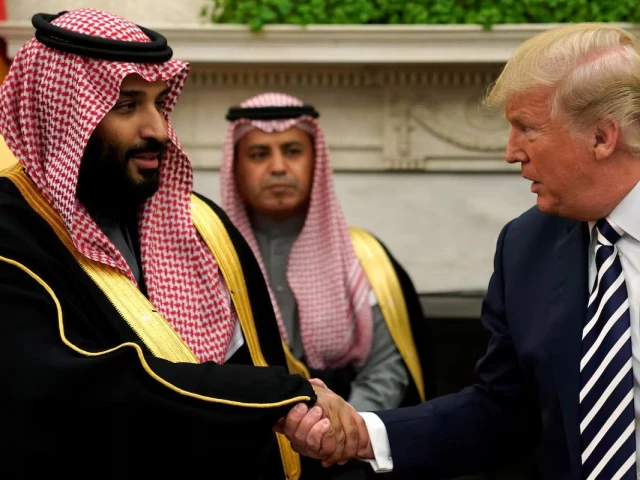
United States President Donald Trump has formally approved a landmark agreement with Saudi Arabia that will provide the country with a civilian nuclear program, The Wall Street Journal reported Tuesday.
Citing US officials, the Journal said the deal, which would last 30 years, is estimated to be worth tens of billions of dollars.
According to the report, it is designed to give American companies a central role in developing Saudi Arabia’s nuclear infrastructure while shutting out other foreign competitors. One of the key components of the new deal would involve American firms building a uranium enrichment plant in Saudi Arabia if a joint review by Washington and Riyadh concludes that the move is justified.
The report said the deal would provide the US with a role in monitoring Saudi Arabia’s nuclear ambitions, which Trump administration officials say could help prevent the program from being used for weapons development.
Two sources told Reuters that the Trump administration plans to submit the pact to Congress but that it does not include safeguards the US has long said would stop materials being used in nuclear weapons programs.
According to the sources, the administration would submit to Congress within days a document known as a 123 Agreement that will be signed by US Energy Secretary Chris Wright and Saudi Energy Minister Abdulaziz bin Salman. The two signed a preliminary agreement in Riyadh last year.
Read: Deterrence dynamics in South Asia
The agreement refers to Section 123 of the US Atomic Energy Act of 1954 and is required to permit the US government and American companies to work with entities in the kingdom to develop a multibillion-dollar civil nuclear industry.
The agreement does not include the "Gold Standard" that would block the kingdom from enriching uranium and reprocessing spent nuclear fuel, both of which are potential pathways to nuclear weapons, said the sources familiar with the agreement.
The agreement also does not include the "Additional Protocol" which grants the United Nations International Atomic Energy Agency broad and more intrusive oversight of a country's nuclear activities, such as the power to carry out snap inspections at undeclared locations, said the sources, who spoke on condition of anonymity to discuss sensitive issues.
One of the sources said the administration would submit the agreement as soon as Wednesday and another said it would be submitted in a week or so. A third who did not say whether the agreement lacks safeguards said it would be submitted soon.
Wright had said the preliminary agreement was not about enrichment and contained all the nonproliferation standards in the Atomic Energy Act, which are among the strongest in the world.
One of the sources said the agreement provides a legal pathway for cooperation on the nuclear fuel cycle, which includes uranium enrichment, but does not obligate the US to transfer any related capabilities or technology to Saudi Arabia.
Proliferation concerns
Saudi Arabia's Crown Prince Mohammed bin Salman has long said if Iran developed a nuclear weapon, Saudi Arabia would too, fueling concern among arms control advocates and some US lawmakers over a civil nuclear deal.
The crown prince told CBS in 2018 that "Saudi Arabia does not want to acquire any nuclear bomb, but without a doubt if Iran developed a nuclear bomb, we will follow suit as soon as possible." The kingdom has also said it wants to reserve the right to enrich uranium.
Read More: US president urges Congress to approve $350b defence package
The United Arab Emirates agreed to the "Gold Standard" in 2009 when it signed a 123 Agreement with Washington.
Once 123 agreements are submitted to Congress, they go into a review period of about 90 days of continuous congressional sessions for lawmakers to object, or they go into force. To block the agreement, Congress would need to pass a joint resolution and have a two-thirds majority to override any presidential veto.
Many Democrats and some Republicans, including Trump's Secretary of State Marco Rubio when he served in the Senate, have insisted any agreement include guardrails.









This material may not be published, broadcast, rewritten, redistributed or derived from. Unless otherwise stated, all content is copyrighted © 2026 The Express Tribune.






COMMENTS
Comments are moderated and generally will be posted if they are on-topic and not abusive.
For more information, please see our Comments FAQ