Oil eases as weaker demand outlook counters Mideast supply concerns
Updated 36 minutes ago

Momentum visible on the ground as BYD brings 2,000 New Energy Vehicles
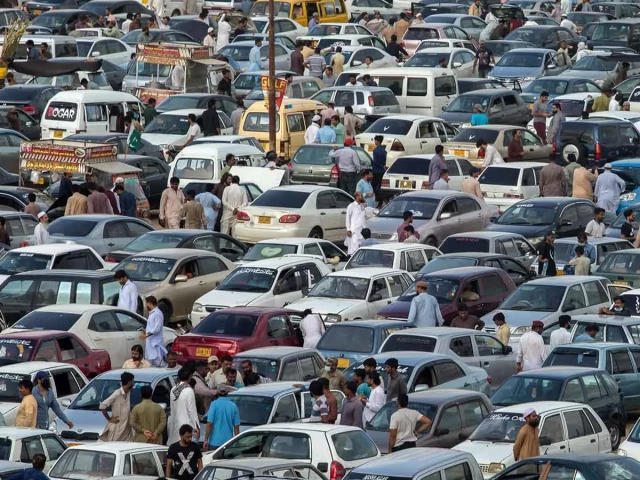
Recent tensions and disruptions in the Strait of Hormuz have triggered a fresh energy crisis, turning the global shift to electric vehicles from a gradual climate response into an urgent economic imperative.
For energy import-dependent nations like Pakistan, the stakes are particularly high. Decades of reliance on imported fuel have left the economy vulnerable, while the auto sector, long dominated by Japanese players, offered limited technological innovation and cars that remained out of the reach of people due to high prices and the lack of competition.
This convergence of energy insecurity and market shortcomings has turned Pakistan into a battleground for auto technologies. Japanese automakers, who built strong positions over three and a half decades, are now facing intense challenges from Chinese manufacturers bringing New Energy Vehicles (NEVs). The momentum is visible on the ground, with BYD recently unloading 2,000 NEVs in Pakistan.
The world is already in a massive transition as climate change forces economies to adapt. Many countries initially viewed sustainability efforts with scepticism due to the painful restructuring required. China has risen from a junior trade partner to a global leader, especially in the EVs market. Traditional powers like Germany and Japan are grappling with the shift, the latter reluctant to move away from its proven analogue engineering strengths.
In Pakistan, the Hormuz crisis has made EV adoption not just desirable but essential for reducing oil import dependence and easing pressure on the current account. A quick look at entry-level pricing reveals the longstanding affordability gap. In India, the Maruti Suzuki S-Presso Std (O) costs INR 349,900 (approximately Rs1.15 million). In Pakistan, the Suzuki Alto VXR is priced at almost Rs3 million. This disparity reflects a market that has remained smaller than 2007-08 levels amid stagnant GDP per capita.
Divergent expert assessments
Industry voices offer contrasting perspectives. Abdul Rehman Aizaz, former chairman of the Pakistan Association of Automotive Parts & Accessories Manufacturers (Paapam), attributes the challenges to broader economic conditions and policy. "Japan lags in EV transformation, so it is losing the market. There are so many OEMs now eating small chunks of the main market, while our economic condition lacks necessary growth. The government has totally failed to stimulate demand but has provided 20% tax relief to attract so many OEMs for the same market size, resulting in underutilisation of capacities and a waste of investments of over a billion dollars," he observed.
Shafiq Ahmed Shaikh, auto sector expert and consultant, outlines debates around past monopoly-like conditions, incomplete localisation after decades, and resulting foreign exchange outflows that made the sector vulnerable during balance-of-payments crises.
Sabir Shaikh, an auto trader, points to consumer shifts, saying over the last 30 years, three major Japanese companies have made significant profits, but they currently lack innovation despite their high-priced vehicles. Meanwhile, Chinese automakers are introducing a variety of new models with numerous options, including EVs and hybrids. As a result, consumers are growing weary of basic cars and are rapidly shifting towards Chinese brands.
Counter view: stagnation, not decline
Aamir Allawala, former president of Paapam, disputes the narrative of terminal decline for Japanese brands. "The market has stagnated overall due to economic conditions, rather than Japanese automakers specifically losing their footing," he argues. Strong sales continue in small and mid-range segments – Suzuki Alto, Cultus, Swift, Toyota Yaris – with production volumes higher than last year. Toyota Corolla, Fortuner, and Honda City remain stable, though some models like Hilux and Civic face pressure.
Allawala describes a bifurcated market: Japanese dominance in affordable gasoline and traditional hybrids versus Chinese-led premium NEV segment (SUVs and crossovers priced Rs7-10 million and above, eg, Haval, Jaecoo, Deepal). Chinese players are expanding the market through government incentives such as 1% sales tax on select models.
Localisation, FX and EV challenges
Allawala rejects claims that Japanese OEMs suppress local industry. Japanese brands maintain the highest localisation levels – Toyota Corolla at 65%, Suzuki Alto above 50%, and Swift above 40%. New entrants show significantly lower rates initially. Japanese vehicles also impose a lower foreign exchange burden per unit. The entire industry's CKD import bill is less than 2.5% of total imports; shifting fully to CBUs will increase the bill by at least 50%.
On the EV front, Allawala notes Japan's hybrid focus while cautioning that the long-term winner remains uncertain. Battery replacement costs can reach 50% of vehicle value, with poor resale compared to Japanese models. He cited a BYD owner facing a Rs4 million bill after warranty denial.
Broader structural issues
The Paapam Secretariat views the auto parts sector as a national asset, delivering 50-65% localisation and sustaining hundreds of thousands of jobs. Exports lag due to security concerns, lack of FTAs (25-30% tariff disadvantage), and high domestic costs, not quality. Comparisons to the JF-17 aerospace success are misleading due to differing policy continuity and funding models. Peer countries like India, Thailand, Indonesia, and Vietnam show what consistent policy support can achieve.
Outlook: Chinese revolution meets energy urgency
The Hormuz crisis has sharpened the focus on EVs globally as nations seek energy security. In Pakistan, Chinese companies are bringing a revolution to the auto sector, introducing advanced features, digital cockpits, Advanced Driver Assistance Systems (ADAS), better designs, and competitive pricing while aligning with the National Electric Vehicle Policy. This is addressing historical gaps in technology and competition.
Yet challenges remain, including charging infrastructure, battery costs, and the enduring strengths of Japanese brands in service networks, spare parts, and resale value.
Sustainable progress demands tackling root causes: boosting GDP growth and per capita incomes, building EV infrastructure, enforcing transparent localisation, negotiating trade agreements, and ensuring policy stability. As Allawala stresses, decisions must rest on "proper rationale, logic, justification, and a thorough consideration of all decision parameters" instead of scapegoating the industry.
Pakistan's auto sector stands at a pivotal moment. The energy crisis triggered by the Strait of Hormuz, combined with Chinese technological inflows, offers a historic opportunity to reduce import dependence, modernise mobility, and build long-term resilience.
The writer is a staff correspondent













This material may not be published, broadcast, rewritten, redistributed or derived from. Unless otherwise stated, all content is copyrighted © 2026 The Express Tribune.








COMMENTS (1)
Comments are moderated and generally will be posted if they are on-topic and not abusive.
For more information, please see our Comments FAQ