Gold prices fall after seven consecutive days of gains
Updated 44 minutes ago

Exports decline 6.8% to $30.1b as imports surge 17.6%, exposing structural weakness
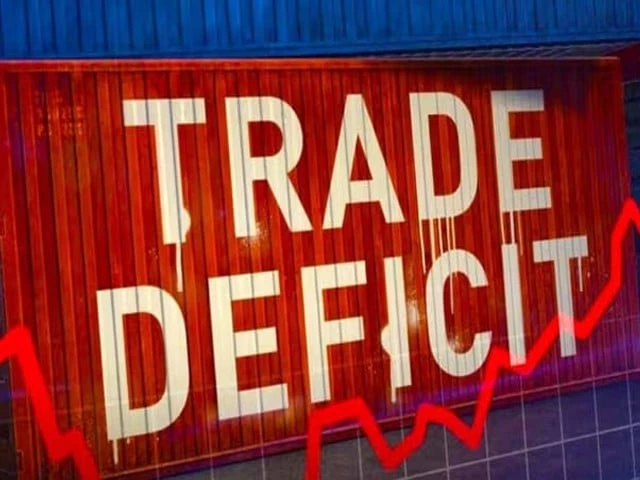
Over the past decade, exports grew by a mere 37.4%, up from $21.9 billion in FY2016 to $30.1 billion in FY2026. In the same period, imports surged 69.1% to reach $69.5 billion, causing the trade gap to balloon by 105.2% – the worst performance in ten years.
The trade deficit widened to a decade-high $39.4 billion in FY26, driven by anaemic export growth and rising imports, highlighting deep structural weaknesses that continue to undermine the country's economic stability, according to a research report by Economic Policy & Business Development.
This year's deficit was not the result of any external commodity shock. Exports actually declined 6.8% year-on-year, falling short of the official target of $35.3 billion by $5.2 billion, while imports rose 17.6% amid duty relaxations and higher oil prices.
The pattern points to chronic stagnation rather than cyclical factors. For a decade, Pakistan's exports have oscillated within a narrow band of $22-$33 billion, raising serious questions about the absence of a coherent breakout strategy. The FY27 export target has been set at $32.8 billion, still below the trajectory envisioned under the National Economic Transformation Plan, underscoring the need for sustained reforms.
Experts say Pakistan's export performance is hampered by over-reliance on a limited product mix. According to Dr Jazib Mumtaz, an applied economist associated with IBA, around 60% of exports consist of textiles and allied products, 30% are agri-based, and only 10% come from other sectors.
"Further disaggregating the data reveals that value-added textiles have a lower contribution than raw textile products. The lower value addition has caused exports to grow at a slow pace," Dr Mumtaz said. He stressed that without diversifying the export basket with more value-added products in textiles, agro-food, electrical, chemical, pharmaceutical, and other sectors, growth will remain sluggish.
On the import side, the country continues to bring in oil, cars, food items, and other value-added goods to meet the demands of a large and growing population. "Our imports will continue to grow at a higher pace," he added.
Dr Mumtaz recommended immediate focus on value addition in minerals and chemicals, alongside boosting services exports for quicker gains. He also highlighted Pakistan's comparative advantage in the agro-based sector as a key area for development.
Farazur Rehman, former President of the Korangi Association of Trade and Industry (KATI), described the decade's trade performance as "a wake-up call" for policymakers and industry leaders.
In his analysis, Pakistan has fallen behind competitors who successfully diversified into engineering goods, electronics, pharmaceuticals, automobiles, IT, processed foods, and other high-value industries. Exporters continue to grapple with high electricity and gas tariffs, expensive bank financing, frequent policy changes, complex taxation, limited technology investment, weak logistics, and insufficient diversification efforts.
"The current government has repeatedly expressed commitment to increasing exports However, good intentions alone cannot transform the economy," Rehman observed. He called for regionally competitive industrial energy tariffs, easier access to finance, predictable tax policies, faster customs clearance, modern infrastructure, and long-term policy stability spanning years rather than months.
Ismail Suttar, President of the Lasbela Chamber of Commerce and Industry, echoed these concerns. He noted that remittances, despite reaching record levels – around $41 billion – are insufficient for a country approaching a population of 300 million. Suttar urged breaking the "12x12 syndrome," which means producing few products and selling to few countries.
"To enhance exports, we first have to enhance production open up the tied hands of the exporters and give them a level playing field," he said. He warned that even starting today would require years to develop competitive exportable products, and current figures might look better only in the short term before worsening without action.
Adil Nakhoda, an international trade expert, warned that Pakistan's economy faces a deeper structural crisis beyond incentives. An economy where remittances out-earn exports reflects decades of failure to build productive capabilities. Despite numerous rebates, zero-rating, and concessionary schemes, the country suffers from an anti-export bias in its tariff regime that shelters the domestic market and undermines competitiveness. Remittances, he noted, finance consumption rather than production and mask underlying weaknesses.








This material may not be published, broadcast, rewritten, redistributed or derived from. Unless otherwise stated, all content is copyrighted © 2026 The Express Tribune.





COMMENTS
Comments are moderated and generally will be posted if they are on-topic and not abusive.
For more information, please see our Comments FAQ