10 terrorists killed in two engagements in K-P: ISPR
Updated 1 hour ago

Two countries mark 25th anniversary of Treaty of Good-Neighborliness and Friendly Cooperation
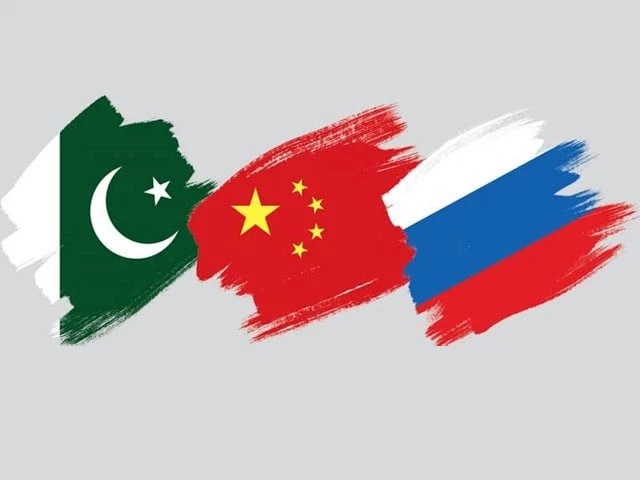
Russia and China have reaffirmed their commitment to deepening strategic coordination and expanding cooperation across political, economic and regional domains, as they marked the 25th anniversary of the Treaty of Good-Neighborliness and Friendly Cooperation.
In a joint article, Russia's Ambassador to Pakistan Albert P Khorev and China's Ambassador Jiang Zaidong described the 2001 treaty as a "landmark document" that laid the foundation for a comprehensive strategic partnership, calling it a "vital constant" amid sweeping global changes.
The envoys said the agreement formalised longstanding ties based on equality, mutual respect and win-win cooperation, and has since evolved into a model of major-country relations in a transforming global order.
They also highlighted the significance of the 1996 Joint Declaration, which set the course for "equal and trusting partnership aimed at strategic cooperation in the 21st century," noting that both documents continue to guide bilateral ties.
According to the ambassadors, political mutual trust remains the cornerstone of Russia-China relations, supported by frequent high-level exchanges and institutional coordination. They referred to President Vladimir Putin's visit to China in May this year, during which he held talks with President Xi Jinping and oversaw the signing of around 40 agreements spanning trade, energy, transport, innovation and education.
The envoys said the two sides had agreed to further align their development goals and strengthen coordination on major global issues, particularly in the areas of international security and economic cooperation.
Highlighting their shared global outlook, the ambassadors said Russia and China advocate for a more "equal and orderly multipolar world" and a reformed system of global governance based on fairness and sovereign equality. They noted that Pakistan shares similar positions and often works alongside both countries at the United Nations.
As permanent members of the UN Security Council, Russia and China, along with Pakistan, maintain close coordination on key international issues, they added.
The article also underlined cooperation within multilateral forums such as BRICS, the Shanghai Cooperation Organization (SCO), the G20 and APEC, describing the SCO as a key platform for promoting regional stability, combating terrorism and fostering economic and cultural ties.
On regional matters, the ambassadors stressed the importance of coordinated efforts on Afghanistan, expressing support for peace and stability in the country. They said Russia and China back diplomatic mechanisms such as the Moscow Format Consultations, the Foreign Ministers' Meeting of Afghanistan's neighbouring countries, and the China-Russia-Pakistan-Iran quadrilateral platform.
They also expressed readiness to support Pakistan and Afghanistan in resolving their differences through dialogue.
Economic cooperation remains a major pillar of Russia-China ties, the envoys said, noting that bilateral trade has surpassed $200 billion for three consecutive years. They highlighted growing collaboration in energy, innovation and advanced technologies, as well as the increasing use of national currencies in trade settlements.
The ambassadors pointed to ongoing efforts to align China's Belt and Road Initiative with the Eurasian Economic Union and the broader Greater Eurasian Partnership, aimed at enhancing regional connectivity.
They emphasised Pakistan's strategic location as a key link in emerging Eurasian trade and energy corridors, saying both countries attach "particular importance" to cooperation with Islamabad in this regard.
Cultural and educational exchanges were also cited as strengthening people-to-people ties. The envoys noted that over 400 events were held during the Russia-China Years of Culture (20242025), while the upcoming Years of Education (20262027) are expected to boost academic and research collaboration.
Currently, more than 72,000 Chinese students are studying in Russia, while over 28,000 Russian students are enrolled in Chinese institutions, they added.
The ambassadors expressed confidence in the future of Russia-China relations, pledging to deepen political trust, expand cooperation and strengthen coordination on international issues, while promoting shared development and regional stability with Pakistan playing a key role.





This material may not be published, broadcast, rewritten, redistributed or derived from. Unless otherwise stated, all content is copyrighted © 2026 The Express Tribune.










COMMENTS
Comments are moderated and generally will be posted if they are on-topic and not abusive.
For more information, please see our Comments FAQ