PSX closes nearly flat above 180,100 points
Updated 2 hours ago

NTP 2025-30 pits protection against productivity; new entrants fail to localise
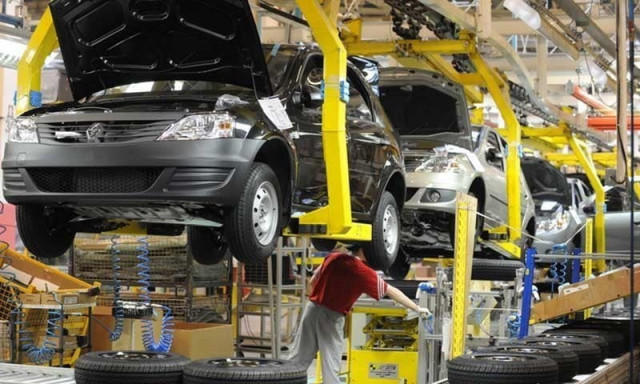
The proposed overhaul of tariffs under the National Tariff Policy (NTP) 2025-2030 has sparked intense debate within Pakistan's auto industry, with manufacturers warning that the changes could dismantle the vendor base and manufacturing capabilities built over four decades, potentially leading to irreversible losses in jobs, investment, and localisation.
Others argue that tariff liberalisation will open the market to greater competition, forcing efficiency gains and higher productivity in the long run.
Local manufacturers contend that high vehicle prices and low ownership levels stem more from the cumulative tax architecture than from tariff protection alone. "The country's cumulative tax architecture, rather than trade policy, has kept new car ownership among the lowest in the region," said Ishtiaq Hussain Siddiqi, Chief Executive of SM Engineering.
He noted that the sector remains one of the largest indirect tax generators, facing layers of customs duty, additional customs duty, regulatory duty, federal excise duty, sales tax, and some of the world's highest corporate tax rates.
Siddiqi highlighted India as a frequently cited model of liberalisation. However, he pointed out that India maintains tariffs of 60-100% on imported passenger cars depending on engine size, with concessions largely reserved for electric vehicles linked to substantial local manufacturing commitments. India's protections extend beyond tariffs through restricted import licences, stringent Bureau of Indian Standards certifications, and explicit domestic preferences under the 'Make-in-India' programme.
"Indian officials describe this not as protectionism, but as sequenced, conditional industrial policy designed to extract performance in exchange for market access," Siddiqi said. Pakistan, he added, is among a small group of developing countries capable of manufacturing across the full automotive value chain, from cars and light commercial vehicles to trucks, buses, tractors, and two- and three-wheelers, supported by nearly 2,000 indigenous parts' makers. He warned that abandoning protection without reforms risks trading away this capability for short-term price reductions. Key recommendations include reforming SRO 693 enforcement, rationalising the cascading tax burden, and correcting the CBU-CKD duty anomaly introduced by the Finance Act 2026, which makes imported completely built-up (CBU) units and certain parts cheaper than completely knocked down (CKD) kits used for local assembly.
Auto expert Mashood Ali Khan echoed these concerns, noting the dual influence of the government and the IMF in pushing tariff reductions under the National Tariff Policy. While the 2016-2021 and 2021-2026 policies successfully attracted new entrants, many failed to achieve meaningful localisation despite enjoying a 25% tariff advantage. "New entrants focused on launching models frequently rather than deepening localisation," Khan said. Existing players like the 'Big Three' maintained 60-70% localisation, sustaining a vendor base that new Korean and Chinese brands have not significantly expanded. He questioned whether reducing tariffs further to 15% would deliver localisation when higher protections had not.
Khan stressed the need for binding localisation commitments, benchmarks for new parts development over the next five years, and a focus on raw material manufacturing through B2B facilitation. He urged the inclusion of truck and bus segments, where new models are similarly eroding the local parts business. IBA Assistant Professor and international trade specialist Aadil Nakhoda acknowledged that the complex tariff structure has inflated showroom prices and the upcoming NTP aims to address this. However, he cautioned against equating tariffs with taxes. "A tariff is worse than a tax. Customs duties and ACD add onto the price, increasing the base at which other taxes are calculated," he observed.
Nakhoda contrasted Pakistan's situation with India's, which produces over 4.4 million passenger vehicles annually with dozens of original equipment manufacturers (OEMs) operating at efficient scales amid intense domestic competition. Indian auto parts' makers export products worth over $20 billion and engage in R&D, while Pakistan lacks Tier-1 producers and significant R&D. He argued that cascading tariffs and local content requirements have shielded an unproductive oligopoly rather than building global competitiveness.
"India is liberalising through FTAs (free trade agreements) with the EU and Asean, shaping its industry for future competitiveness," Nakhoda said. Pakistan's industry, he added, should lobby for productivity-enhancing certifications and standards-based non-tariff measures to integrate into global value chains instead of seeking perpetual protection.








This material may not be published, broadcast, rewritten, redistributed or derived from. Unless otherwise stated, all content is copyrighted © 2026 The Express Tribune.






COMMENTS (1)
Comments are moderated and generally will be posted if they are on-topic and not abusive.
For more information, please see our Comments FAQ