Swift revisits memories, creative risks
Updated 20 hours ago

From personal loss to public service, YBQ shares the experiences that reshaped his outlook on life
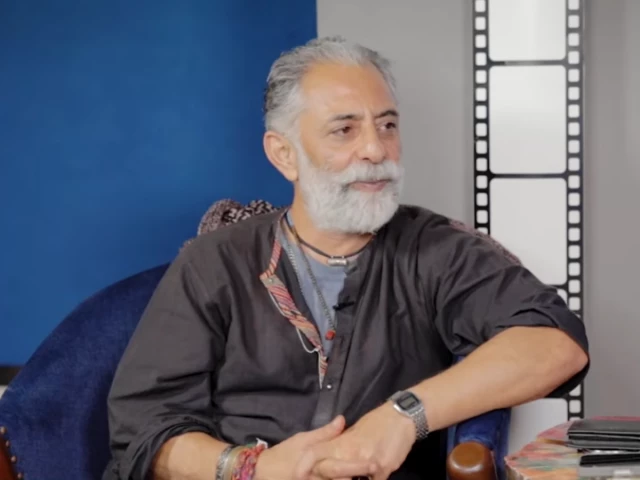
Artist, designer and actor Yousuf Bashir Qureshi - also known as YBQ - believes fear is the greatest obstacle to personal growth.
Speaking about the values that have shaped his life during a recent interview, Qureshi argued that people are conditioned to live with fear from an early age, preventing them from reaching their full potential.
"A fearful human cannot do anything," he said. "From childhood, we are told to stay away from this and stay away from that. These constant warnings build walls around us. We need to teach children with love and trust, not fear."
For Qureshi, life is meant to be fully lived rather than merely endured—a philosophy forged through profound personal loss, devastating setbacks and years of rebuilding.
A life changed by loss
Every life has a defining turning point. For Qureshi, it came with the death of his grandfather, whom he describes as his greatest source of strength.
"My life changed completely after his death. His love made me who I am. He gave his last breath to me, and I lived."
He said the experience transformed his outlook on life.
"That loss made me stronger. It taught me to value every single moment, to love people more and to focus entirely on making good memories."
After returning to Pakistan in 2004, Qureshi immersed himself in the country's creative scene.
He began teaching at the Indus Valley School of Art and Architecture (IVS) while undertaking a major textile collection for Master's Textile, handling every aspect of the project himself—from photography to the final fabric designs.
He later joined the Pakistan Design Council in Lahore before partnering with Raniya Durrani to establish the Commune Artists Colony, a collaborative creative space for artists.
But his return home was overshadowed by violence. Just four days after arriving from the United States, armed robbers broke into his home.
"Some people broke into my house, woke me up with a gun in my mouth and stole all my bags, which I hadn't even unpacked yet. Someone had tipped them off that a guy had just returned from the US."
He said reporting the crime proved equally difficult, as police delayed registering an FIR because he had spent years abroad and lacked local connections.
Another devastating blow followed in late 2007.
After returning from Hajj on December 29, in the aftermath of Benazir Bhutto's assassination, Qureshi discovered that his house had been burned down during the unrest.
"Everything was broken. I had to live at a friend's house. It took me two years before I could finally gather myself and start my fashion brand."
Turning 40 marked another important shift in his thinking. Qureshi said he consciously chose to stop speaking negatively about others and to let go of unrealistic expectations.
"After 40, I put a complete stop to bad-mouthing anyone. I also learned to stop hoping or holding expectations because expectations usually lead to disappointment."
Recalling a classroom exercise in primary school, he said a teacher wrote "Sky is the limit" on the board. Having recently travelled by plane, he disagreed and instead wrote, "Sky is the beginning."
Rather than being encouraged, he was ridiculed and his parents were called to school. "The teachers actually understood what I meant, but they wanted to protect a rigid system. That kind of system creates fear. When you let go of that fear, you finally start to grow."
Reflecting on today's youth, Qureshi warned against three forces that he believes limit human potential: fear, guilt and greed. "When you live in fear, you are always defending yourself. It's the same with guilt. If you are raised to feel guilty about everything you do, you can never be free."
He also rejected the idea that life should be driven by competition. "We aren't here to compete with each other. We are here to achieve something better together."
As part of that philosophy, he begins every morning by sending a short message to close friends and family simply to remind them they are loved.
The same outlook shapes his views on relationships. Qureshi believes marriage should be viewed as companionship rather than partnership.
"Marriage is a companionship, not a partnership. Business partnerships eventually end, but a companion stays with you even beyond death. It is about total acceptance and about giving, not taking."
Although widely recognised as a designer, artist and writer, Qureshi says acting has always held a special place in his heart. "I love living different lifetimes through characters."
He credits veteran actor Saba Hameed with helping refine his craft and says director Nadeem Baig ultimately persuaded him to pursue television professionally.
While his first film—directed by Hamza Ali Abbasi and co-starring Humayun Saeed and Saba Qamar—was shelved before release, Qureshi has since established himself as one of television's most versatile performers.
He is currently appearing in three dramas (Raja London Ka, Leader and Aik Mohabbat Aur), showcasing his range across distinctly different roles.







This material may not be published, broadcast, rewritten, redistributed or derived from. Unless otherwise stated, all content is copyrighted © 2026 The Express Tribune.









COMMENTS
Comments are moderated and generally will be posted if they are on-topic and not abusive.
For more information, please see our Comments FAQ