Israel strikes south Lebanon after soldiers killed, talks continue in Rome
Updated 59 minutes ago

.
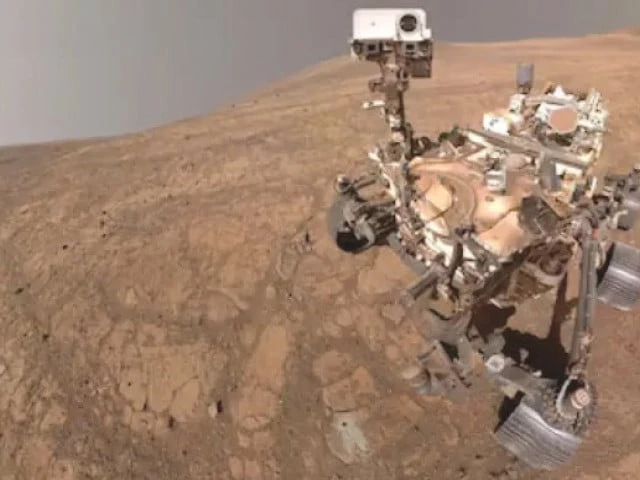
Using NASA's Perseverance rover, scientists are getting a greater understanding of the nature of some of the organic carbon - the molecular backbone for all known living organisms - detected on Mars as they explore the question of whether Earth's planetary neighbor ever harbored life.
New research describes the structure of the organic carbon found last year by the rover in sedimentary rock that contained a potential biosignature - a possible sign of past microbial life. This mudstone formed perhaps between 3.2 and 3.8 billion years ago beneath a now-vanished body of water in Jezero Crater in the Martian northern hemisphere.
Organic carbon can be a clue as to whether Mars ever harbored life because it serves as the chemical underpinning for the molecules that build DNA, cells and proteins. But its presence is not proof of life because it also can arise in nonbiological processes such as chemical interaction between rock and water.
The detection of organic carbon in two rocks in Jezero Crater - given the names Cheyava Falls and Walhalla Glades - was disclosed last year when the researchers announced the discovery of a potential biosignature in one of them.
The two rocks were sampled by the rover at locations about 330 feet (100 meters) apart, according to planetary scientist Ashley Murphy of the Planetary Science Institute in Arizona, co-leader of the new research published in the journal Science Advances.
Following last year's discovery, NASA released an image of the Cheyava Falls rock showing a very fine-grained and rusty-red-colored mudstone bearing ring-shaped features resembling leopard spots as well as dark marks resembling poppy seeds.















This material may not be published, broadcast, rewritten, redistributed or derived from. Unless otherwise stated, all content is copyrighted © 2026 The Express Tribune.






COMMENTS
Comments are moderated and generally will be posted if they are on-topic and not abusive.
For more information, please see our Comments FAQ