Shakira, Christina Aguilera concerts in Abu Dhabi cancelled amid US-Iran war
Updated 21 hours ago

Express Entertainment drama brings one of today's most alarming technological threats into mainstream storytelling
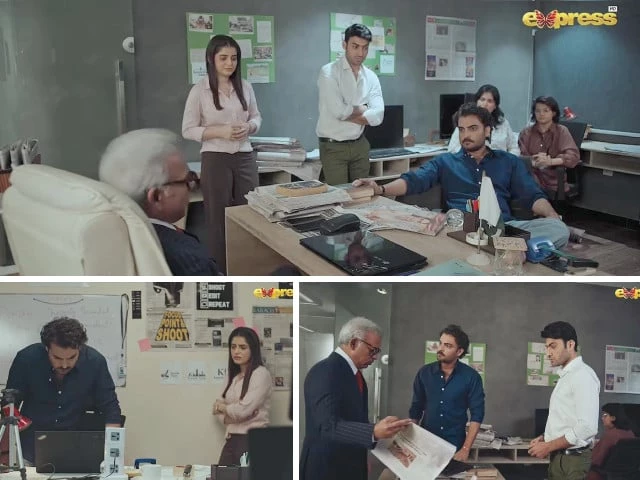
As artificial intelligence continues to transform digital communication, Pakistani drama Bhanwar has brought one of today's most alarming technological threats into mainstream storytelling: AI-generated deepfake videos.
The drama explores how artificial intelligence can be misused to manipulate reality, damage reputations, silence dissent, and spread misinformation an issue that is becoming increasingly relevant in Pakistan and around the world.
One of the show's most thought-provoking storylines follows an ethical journalist Adeel Azam, played by Asad Siddiqui, who works tirelessly on an investigative report exposing wrongdoing by a pharmaceutical company. After completing the story, however, his media organisation refuses to publish it due to internal pressure.
Determined to uphold journalistic integrity, the reporter refuses to back down and eventually succeeds in getting the investigation publish despite resistance from his editors and management.
The conflict escalates when his editor orders him to issue a public apology for the report. Confident that he has done nothing wrong, the journalist refuses.
The following day, he is stunned to discover a video in which he appears to apologise. The problem is that he never recorded such a statement.
When he confronts his editor, he is told that the organisation used artificial intelligence to generate the apology video. The AI-created clip perfectly replicates his face, voice, expressions and mannerisms, making it appear completely authentic despite being entirely fabricated.
His editor coldly tells him that he will never be able to prove to anyone that the video was AI-generated.
The scene reflects one of the greatest concerns surrounding generative AI today: the rise of highly convincing deepfakes. Such technology can be exploited to spread fake news, influence public opinion, destroy reputations, commit fraud, and undermine trust in digital media.
The storyline also raises another important concern: how employers and organisations could misuse AI against their own employees.
Speaking to The Express Tribune, Bhanwar director Abu Aleeha said Asad Siddiqui's character represents the kind of journalist who values ethics over shortcuts.
"Asad Siddiqui's character as a journalist is a very ethical and by-the-book kind of a person. I think he is an example of how everyone in digital media is running after shortcuts, views and money. We wanted to show that you can still achieve success through honesty."
Abu Aleeha explained that the journalist faces opposition from both his editors and the channel owners after exposing the medicine company. He eventually resigns, joins another media organisation, and then becomes the target of an AI-generated fake apology video that leads to his character assassination.
The director added that the story later follows the journalist as he investigates and exposes a criminal network involving three women. During the investigation, he is attacked and seriously injured while risking his life to uncover the truth.
"After taking all those risks, he succeeds. He not only saves the lives of those girls but also exposes the network".
The concerns highlighted in Bhanwar mirror ongoing real-world debates surrounding AI regulation in Pakistan.
Weeks ago, the Punjab government prepared the draft Punjab Performers' Digital Identity and Artificial Intelligence Protection Act 2026, legislation designed to safeguard artists' voices, faces and digital likenesses from unauthorised AI use.
The proposed law would require explicit written consent before AI-generated replicas or voice clones can be created. It also proposes prison sentences and multi-million-rupee fines for offences involving deepfakes, fake endorsements and unauthorised digital impersonation.
The issue has also sparked concern within Pakistan's entertainment industry.
Actor and filmmaker Shamoon Abbasi, who led a delegation of artists in discussions with Punjab government officials, described the proposed legislation as an important step towards protecting performers in the age of artificial intelligence.
Actor Hira Tareen also recently revealed that she had encountered contracts granting production companies extensive rights over her digital likeness.
Express Entertainment drama Bhanwar brings together a powerful ensemble cast including Mansha Pasha, Areeka Haq, Asad Siddiqui, Ali Safina and Saleem Meraaj.
Bhanwar airs every Wednesday and Thursday, blending social reality with suspense-driven storytelling, and reflecting the growing digital risks in modern Pakistani society.










This material may not be published, broadcast, rewritten, redistributed or derived from. Unless otherwise stated, all content is copyrighted © 2026 The Express Tribune.

COMMENTS
Comments are moderated and generally will be posted if they are on-topic and not abusive.
For more information, please see our Comments FAQ