Army major martyred in IED blast in Pasni
Updated 3 hours ago

The Senate session has begun under the chairmanship of Presiding Officer Manzoor Kakar
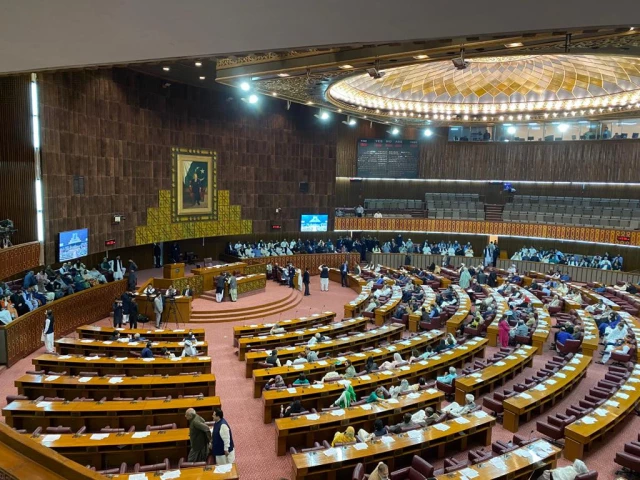
The National Assembly (NA) and Senate on Thursday passed the National Command Authority (Amendment) Bill 2026 and the Defence Forces Act 2026 by a majority vote, with the opposition boycotting the voting process and walking out of the assembly in protest.
Prime Minister Shehbaz Sharif was present in the House and, upon arrival, went to the opposition benches, where he shook hands with NA opposition leader Mahmood Khan Achakzai and Pakistan Tehreek-e-Insaf chairman Barrister Gohar, Asad Qaiser and Aamir Dogar.
The bills were presented to the House for approval after the government had earlier tabled them as part of a supplementary agenda.
The Defence Act, which came into force retrospectively on November 13, 2025, provided for the establishment of the Defence Forces Headquarters, which would serve as the headquarters of the armed forces.
Under the legislation, the Defence Headquarters would act as the prime minister’s senior military adviser on matters relating to national security, defence and the armed forces.
The Chief of Defence Forces (CDF) would have operational command and control of the armed forces and would be accountable to the federal government in matters relating to such command and control.
The legislation gave the CDF powers necessary for multi-domain integration, operational coordination, liaison and the joint conduct and oversight of matters relating to the armed forces.
The CDF would also have powers under relevant laws to retire, release or dismiss personnel, except those appointed under Article 243 of the Constitution. The CDF could also approve or reject resignations, retain personnel in service and reduce the retirement age or prescribed term of service of a person.
The Act further empowered the CDF to exercise other powers and perform duties specified by the federal government.
The federal government would formulate rules and regulations to implement the Act, while the CDF could issue directions and orders to give effect to its provisions.
The legislation also provided that the president could resolve difficulties arising from the implementation of the Act or inconsistencies between its provisions and other laws currently in force.
The National Assembly passed the National Command Authority (Amendment) Bill 2026, which came into force retrospectively from November 27, 2025. Under the amendment, references to the Chairman Joint Chiefs of Staff Committee in the Act were replaced with the Chief of Army Staff and Chief of Defence Forces.
The Senate on Thursday unanimously passed the Defence Forces of Pakistan Amendment Bill 2026 and the National Command Authority Amendment Bill 2026 amid strong opposition from Pakistan Tehreek-e-Insaf (PTI) lawmakers.
Later, Defence Minister Khawaja Asif presented the bills in the upper house, which passed both pieces of legislation unanimously.
Opposition Leader Allama Raja Nasir Abbas objected to the manner in which the bills were introduced and questioned the urgency behind the legislation.
“What is the emergency? Is this how legislation is carried out?” he asked.
Abbas said he had only just received a copy of the bill and urged the Senate Chairman to give lawmakers time to read it.
He announced that the opposition would protest and boycott the House.
PTI lawmakers subsequently stood up and walked out of the chamber.
Law Minister Azam Nazeer Tarar defended the government’s move, saying parliamentary rules allowed supplementary legislation to be introduced.
Tarar questioned what further discussion was required on the amendment.
“Tell me, what mathematical formula is there that we need to sit down and discuss?” the law minister said.
He said the three armed forces had operated with the same level of coordination during Marka-e-Haq, which he said had resulted in Pakistan’s victory.
He added that the legislation had already been passed by the NA after lawmakers had read it “word by word”.
Opposition stages boycott
The opposition had objected to the supplementary agenda, with Jamiat Ulema-e-Islam Fazl (JUI-F) lawmaker Aliya Kamran arguing that the opposition had not received copies of the legislation, prompting the law minister to tell lawmakers to “learn to make use of technology”, saying the bills were available on members’ tablets.
Achakzai said lawmakers needed time to examine the proposed legislation. “We are members of this parliament. We want legislation to be carried out,” Achakzai said. “Bring the bills to us. Our colleagues will read them and give their views. At least give us two or three days so that they can be debated.”
He also called for a briefing on Pakistan’s foreign policy and regional developments, referring to US President Donald Trump’s reported warning against countries maintaining economic ties with Iran. “Brief us on what is happening,” Achakzai said.
Turning to PTI founder Imran Khan, Achakzai said, “You have made the founder of the PTI an issue of the heavens. Even the worst criminal has the right to have his health taken care of.”
The opposition benches staged a boycott of the voting process and walked out of the National Assembly in protest.
Cabinet approves bills
The federal cabinet earlier approved the drafts of the Defence Forces Act 2026 and amendments to the National Command Authority Act 2010, paving the way for legislation to implement changes to the military command structure introduced through the 27th Constitutional Amendment, according to a statement issued by the Prime Minister's Office (PMO).
The draft was approved at a cabinet meeting chaired by PM Shehbaz in Islamabad and was expected to be presented to Parliament for approval during its ongoing session.
The Defence Forces Act was prepared to give effect to changes made to Article 243 of the Constitution through the 27th Amendment, which recast the country's military command structure. The constitutional changes provided for the army chief to simultaneously serve as the Chief of Defence Forces (CDF), while abolishing the office of Chairman Joint Chiefs of Staff Committee (CJCSC).
According to the PMO, the draft law would set out the administrative arrangements relating to the office of the CDF and the CDF Headquarters, providing the legal framework for the new command structure established through the constitutional amendment.
The cabinet also approved amendments to the National Command Authority Act 2010, which the PMO described as a necessary step following the 27th Constitutional Amendment. The amended bill would also be presented before Parliament.
وفاقی کابینہ کا اجلاس، ڈیفینس فورسز ایکٹ 2026ء اور نیشنل کمانڈ اتھارٹی ایکٹ 2010ء میں ترمیم کی منظوری#FederalCabinet #DefenceForcesAct #NationalCommandAuthority pic.twitter.com/fIA9JPDC6G
— APP (@appcsocialmedia) August 20, 2026
New military framework under 27th amendment
Under the new framework, the CDF's term would begin from the date of notification, while the federal government would determine the duties and responsibilities of the office. The amendment also provided that the incumbent army chief's tenure would recommence from the date of his notification as CDF.
The position of CJCSC was to be abolished on November 27. It was replaced under the new framework by the Commander of the National Strategic Command, with the prime minister empowered to appoint the commander on the recommendation of the army chief and CDF for a three-year term.
PM Shehbaz on July 24 promoted Lieutenant General Aamer Raza, chief of the general staff of the Pakistan Army, to the rank of four-star general and appointed him as Commander National Strategic Command.
Read: PM Shehbaz appoints General Aamer Raza as Commander National Strategic Command
The prime minister could reappoint the commander for one additional three-year term on the recommendation of the CDF. The appointment, reappointment or extension could not be challenged in any court.
The framework further stipulated that the retirement age, service tenure and removal provisions under the Army Act would not apply to the Commander of the National Strategic Command, who would continue to serve as a General in the Pakistan Army.
The cabinet also approved amendments to the National Command Authority Act 2010, which the PMO described as a necessary step following the 27th Constitutional Amendment. The amended bill would also be presented before Parliament.
The constitutional changes were followed by amendments to the service laws governing the Army, Navy and Air Force. The Pakistan Navy amendments removed provisions relating to the CJCSC and revised the command structure and terminology concerning the Chief of Naval Staff, while the Pakistan Air Force amendments removed corresponding provisions and references to the CJCSC.
On December 4, Field Marshal Asim Munir was appointed the country's first CDF, a position also created by the 27th amendment. He would serve as both the Chief of Army Staff (COAS) and CDF, a rare distinction in the country’s military hierarchy.















This material may not be published, broadcast, rewritten, redistributed or derived from. Unless otherwise stated, all content is copyrighted © 2026 The Express Tribune.








COMMENTS
Comments are moderated and generally will be posted if they are on-topic and not abusive.
For more information, please see our Comments FAQ