Gold rises Rs2,400 ahead of US inflation data
Updated 5 hours ago

Fiscal deficit narrows, primary surplus 3.5% of GDP; remittances hit record $4.25b
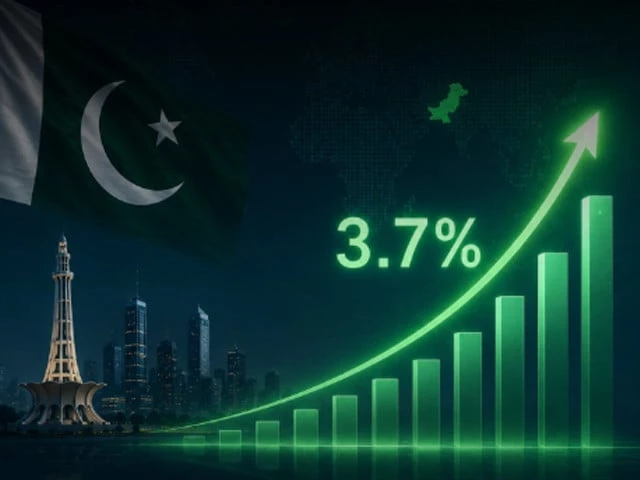
Pakistan's economy ended fiscal year 2025-26 on a stronger footing, with real GDP growth accelerating to 3.7% – the highest in four years – and the economy expanding to $452.1 billion amid improving macroeconomic stability and a sustained recovery in economic activity, according to the finance ministry's monthly Economic Update and Outlook for June 2026.
"Despite early year flood-related disruptions and subsequent volatility in global commodity markets, stabilisation gains were preserved, growth remained broad-based across agriculture, industry and services, and average inflation stayed in single digits within the target range," the report said. Fiscal performance also remained encouraging, underpinned by effective expenditure management, revenue mobilisation and provincial surpluses, which helped narrow the fiscal deficit and achieve a primary surplus of 3.5% of GDP during July-April FY2026.
The external sector remained stable, supported by sustained growth in remittances and IT exports, a broadly stable exchange rate, and improved foreign exchange reserves and import coverage. The current account recorded a surplus of $255 million during July-May FY2026, reflecting continued resilience in the external account. Investor confidence improved during the year, supported by the government's continued commitment to the International Monetary Fund's (IMF) Extended Fund Facility (EFF) and Resilience and Sustainability Facility (RSF) programmes, reinforced by rating upgrades from Fitch and Moody's. These developments were reflected in Pakistan's re-entry into international capital markets through Eurobond issuance after four years, the successful launch of Panda Bonds, and the strong performance of the KSE-100 index, which reached an all-time high and remained among the fastest-growing markets in Asia.
Building on these gains, the government announced Budget 2026-27 with a strategic focus on export-led growth, taxpayer relief, enhanced social protection and fiscal discipline. During FY2026, the agriculture sector registered growth of 2.9% despite flood damages. The sector is envisaged to improve in FY2027 and is targeted to grow by 3.6%, supported by growth of 3.9% in livestock, 3.5% in other crops, 2.9% in important crops, 1.7% in fisheries and 1.5% in cotton ginning.
Large-scale manufacturing witnessed strong growth of 6.4% during July-April FY2026 against a contraction of 1.5% in the same period last year. The Consumer Price Index (CPI) inflation was recorded at 11.7% year-on-year in May 2026 compared with 10.9% in the previous month and 3.5% in May 2025. On average during July-May FY2026, CPI inflation stood at 6.7% against 4.6% during the same period last year.
Meanwhile, net federal revenue increased by 5.8% to Rs8,601.1 billion during July-April FY2026, supported by growth in both tax and non-tax revenues, which increased by 10.3% and 6%, respectively. During July-May FY2026, FBR tax collection grew by 9.7% to Rs11,228.8 billion. Total expenditure during this period declined by 9.9% to Rs11,621.3 billion. The contraction was primarily driven by a 10.3% reduction in current expenditure, largely due to a significant decline in mark-up payments (21.9%).
With macroeconomic stabilisation largely achieved, Pakistan's economy is expected to maintain its growth momentum, supported by improving macroeconomic fundamentals, sustained expansion in manufacturing, especially LSM, a stable external account, improved fiscal discipline and continued resilience in the agriculture sector.
The recent easing of geopolitical tensions due to ongoing peace efforts in the Middle East has improved global market sentiment. Consequently, international crude oil prices have eased from recent highs, which is expected to reduce imported inflationary pressures and help lower domestic fuel and transportation costs. Inflation is anticipated to remain within the range of 11-12% for June 2026. On the domestic front, prudent macroeconomic policies, continued fiscal consolidation and targeted support for productive sectors are expected to sustain economic growth while preserving macroeconomic stability. The external sector outlook has strengthened further, supported by record workers' remittances in May 2026 and continued growth in IT exports, which are expected to reinforce the balance of payments, support foreign exchange reserves and enhance resilience against external shocks.












This material may not be published, broadcast, rewritten, redistributed or derived from. Unless otherwise stated, all content is copyrighted © 2026 The Express Tribune.









COMMENTS
Comments are moderated and generally will be posted if they are on-topic and not abusive.
For more information, please see our Comments FAQ