US targets Palestine Action in counterterrorism effort against 'far-left' groups
Updated 7 hours ago

Court overturns 1935 Humphrey's Executor precedent
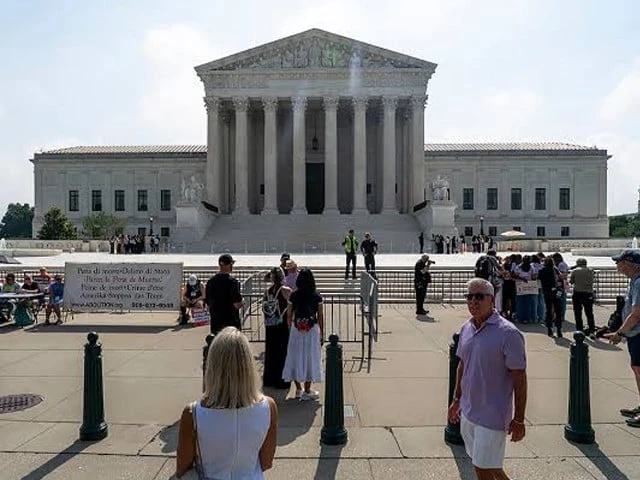
The US Supreme Court on Monday backed Donald Trump's firing of a Democratic Federal Trade Commission member, expanding his powers over the government and
overturning its 1935
precedent that had
recognized the authority of Congress to protect leaders of certain regulatory agencies from presidential removal at will.
The justices, in a 6-3 decision powered by the court's conservative
majority, invalidated tenure protections for FTC members enacted by Congress more than a century ago. In doing so, the justices overruled the court's pivotal decision in a case called Humphrey's Executor v. United States. Trump last year dismissed the FTC's Rebecca Slaughter over policy differences.
The court, however, signaled that Monday's decision should not be seen as undermining the Federal Reserve's independence, with the justices describing the US central bank as possessing a unique historical tradition.
In another landmark ruling on Monday, the court refused to let Trump fire Federal Reserve Governor Lisa Cook as it stood firm to preserve the central bank's independence.
In the FTC case, the court ruled that removal protections for FTC members unlawfully encroached on presidential power under the U.S. Constitution.
Chief Justice John Roberts, who authored a decision joined by his five fellow conservatives, said Trump's authority to dismiss Slaughter last year over policy differences "is not a close case." The court's three liberal justices dissented.
"The FTC's for-cause removal provision violates the separation of powers," Roberts wrote. "In its present form, the FTC enforces and administers some 80 statutes, which cover almost every facet of our Nation's economy. The tasks it undertakes are 'the very essence of execution of the law' - precisely
the president's constitutional role."










This material may not be published, broadcast, rewritten, redistributed or derived from. Unless otherwise stated, all content is copyrighted © 2026 The Express Tribune.












COMMENTS
Comments are moderated and generally will be posted if they are on-topic and not abusive.
For more information, please see our Comments FAQ