PAC seeks list of firms supplying meds worth billions
Updated 18 hours ago

Mayor Wahab vows equal service across party lines
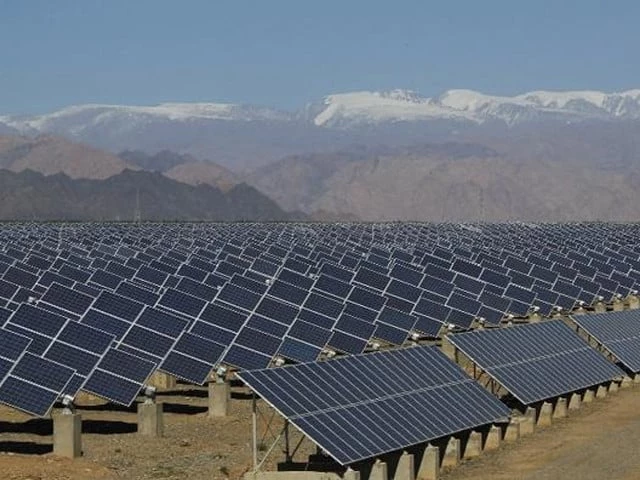
In a major push toward sustainable urban development, the Karachi Metropolitan Corporation (KMC) has unveiled a sweeping solarisation initiative for fiscal year 2026-27, allocating Rs750 million to transition streets, municipal buildings and key arteries across the city to solar power - a move Mayor Murtaza Wahab says is no longer optional but "a fundamental necessity" for responsible governance.
The project, announced under the mayor's directives, aims to slash reliance on conventional electricity, reduce municipal expenses, promote renewable energy, and ensure uninterrupted civic services, especially in areas crippled by frequent load-shedding.
Officials expect a significant drop in Karachi's carbon footprint alongside improved efficiency in civic operations.
Speaking to reporters, Mayor Wahab emphasised that KMC's development policy remains unequivocally inclusive.
"We make no distinction between government and opposition areas. My only affiliation is with Karachi and its people," he said. "Every KMC project is designed solely keeping citizens' needs and welfare in mind."
He added that KMC had already solarised parts of its head office, resulting in substantial savings and reduced environmental impact. Based on that success, the model is now being extended to more KMC offices, union council buildings and public infrastructure.
The mayor pointed out that KMC's renewable energy journey began two years ago with a citywide streetlighting programme, under which each union committee received roughly 50 streetlights - without political favour. Over the current fiscal year, more than Rs110 million were spent on installing and upgrading streetlight systems.
Major thoroughfares, including Sharae Faisal, Shahrah-e-Firdousi and Shahrah-e-Iran have already seen visible improvements in lighting and infrastructure, with encouraging results enhancing both city aesthetics and public convenience, he added.
In a pointed reference to past administrations, Mayor Wahab said: "Unlike previous eras, when many development projects remained confined to announcements and files, the current KMC administration has focused on practical implementation and tangible outcomes."
He invited Karachiites to judge the administration by its performance. "We have translated our promises into reality - whether infrastructure, road rehabilitation, parks, streetlighting, digital governance, revenue reforms or municipal services. Today's KMC is a far stronger and more effective institution than it was a few years ago."
He acknowledged that despite inheriting largely the same resources as previous regimes, the current administration has improved service quality, promoted transparency, accelerated development work, and restored public trust in municipal institutions.
The solarisation project is expected to particularly benefit remote and power-dependent neighbourhoods, where load-shedding routinely disrupts daily life. Solar-powered civic facilities, KMC says, will boost institutional autonomy, service delivery and public convenience across the board.









This material may not be published, broadcast, rewritten, redistributed or derived from. Unless otherwise stated, all content is copyrighted © 2026 The Express Tribune.






COMMENTS
Comments are moderated and generally will be posted if they are on-topic and not abusive.
For more information, please see our Comments FAQ