Wildfire descends on Croatian tourist town, injures 36
Updated 2 hours ago

Trump had told Netanyahu ‘All the Jews are sick of you’ during a phone conversation in 2025
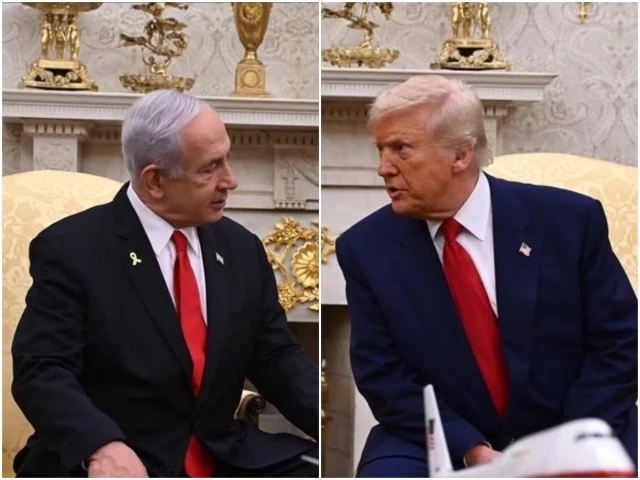
Growing tensions between United States President Donald Trump and Israeli Prime Minister Benjamin Netanyahu over the Iran ceasefire and Israel's military operations in Lebanon exposed one of the most serious strains in US-Israel relations in years.
The dispute fuelled questions about whether Trump was willing to place greater limits on Israeli actions than previous US presidents and whether the latest disagreements could reshape a relationship long considered one of Washington's closest strategic partnerships.
"There has been a genuine breakdown in the relationship between the Trump administration and Prime Minister Benjamin Netanyahu," Evan Cooper, research analyst at the Reimagining US Grand Strategy Programme at Stimson Centre, told Anadolu.
Read: Trump cuts ties with Netanyahu over manipulation concerns: Report
Cooper said that while the tensions may not be permanent, they were unlike any disagreement between the two governments in recent history.
"The Trump administration has signalled that it wants an end to the war with Iran and wants to reduce Netanyahu's ability to spoil a ceasefire. If the ceasefire holds, the lesson in the United States may be that standing up to Netanyahu is a viable and necessary tactic. This could fundamentally change the relationship between the two countries," he said.
Ian Lustick, political science professor at the University of Pennsylvania, agreed that relations between the two leaders have deteriorated sharply.
"Each is seething. But each has an interest in pretending it is not as serious a conflict as each feels it to be," he said.
Efforts to end hostilities with Iran, combined with Israel's continued military operations in Lebanon, fuelled the latest public disagreements between Washington and Tel Aviv.
During a heated phone call earlier this month, Trump called Netanyahu "crazy" and was disgruntled that Israel was sabotaging the peace deal with Iran.
Read more: Vance warns Israel against criticising deal
US Vice President JD Vance also criticised Israeli officials last week, saying Trump was the only head of state in the world who remained consistently sympathetic to Israel.
From the Israeli side, Defence Minister Israel Katz said that Israel would respond immediately and forcefully to any Iranian attack, adding that "no one can tell us what to do".
History of disagreements
Although the US and Israel are often described as inseparable allies, the relationship has experienced significant tensions before.
In 1956, president Dwight D Eisenhower strongly opposed Israel's joint military operation with Britain and France against Egypt.
Fearing a surge in Soviet influence, Washington exerted intense diplomatic and economic pressure, forcing then-Israeli prime minister David Ben-Gurion to withdraw from Egyptian territory in one of the few instances where a US president compelled Israel to reverse a major military operation.
In 1981, US president Ronald Reagan temporarily froze the delivery of advanced F-16 fighter jets to Israel following its surprise bombing of Iraq's Osirak nuclear reactor.
In the early 1990s, president George H W Bush threatened to withhold $10 billion in loan guarantees in an effort to pressure Israel over settlement expansion in the occupied Palestinian territories.
Relations again became strained during the Obama administration over the Joint Comprehensive Plan of Action (JCPOA), with Netanyahu openly opposing the agreement and bypassing the White House to address Congress in 2015.
Even so, the relationship has generally been strong.
The US was the first country to recognise Israel following its establishment in 1948 and has since provided more than $300 billion in economic and military assistance, making Israel the largest cumulative recipient of US foreign aid, according to the Council on Foreign Relations.
Military cooperation remains a cornerstone of the relationship, with Washington committed to providing $3.8 billion annually in security assistance through 2028.
Will the alliance survive?
Yet even as tensions grow between Trump and Netanyahu, Congress appeared poised to deepen military integration between the two countries.
A provision of the National Defence Authorisation Act (NDAA) currently under consideration in Congress would significantly expand technology and information sharing between the US and Israeli militaries.
"It would create an unprecedented system for technology and information sharing between the United States military and Israeli Defence Forces,” Cooper said.
"The provision is likely to pass, and if it does, that will demonstrate the fortitude of the relationship between the two countries. However, if President Trump pushes Republicans to pull support … it would be a sign that the alliance is being fundamentally reconsidered."
Lustick argued that the countries’ divergent positions on Lebanon are “accelerating the transformation of that relationship into a much more transactional set of ties".
"I would call it a special relationship that has become increasingly toxic,” he said.
He said a major shift in American politics was that the nature of the US-Israel relationship was increasingly being debated rather than accepted as an unquestioned consensus.
On Tuesday, Netanyahu said Israel must reduce its dependence on foreign support and build a more independent arms industry amid the growing disagreements with Washington.
Netanyahu had publicly backed efforts to eventually phase out the $3.8 billion in annual US military assistance provided under the current memorandum of understanding and replace it with expanded joint investment in defence and technology projects.
"The time has now arrived for us to move from aid recipient to partner," Netanyahu reportedly wrote in a letter backing the bill.
Lustick said it was unrealistic for Israel to maintain its current strategic position without US support.
On the other hand, he noted that congressional efforts to deepen military integration between the two countries demonstrated the enduring strength of the relationship regardless of political disputes.
“The NDAA in the US shows the influence of his effort to embed and institutionalise American military and security integration with Israel so as not to have to defend the wisdom or appropriateness of Israeli policies, which annual discussions of foreign aid can make necessary."
Is Trump signalling change?
Recent Israeli media reports suggested that members of the Trump administration have held informal contacts with opposition figures, including former prime minister Naftali Bennett and former military chief Gadi Eisenkot, amid growing frustration with Netanyahu.
Trump has also shared articles highlighting his influence over Netanyahu's political fortunes, fuelling speculation about Washington's willingness to increase pressure on the Israeli leader to back his rivals.
Lustick said such moves are intended to remind Netanyahu that maintaining a productive relationship with Trump remains politically essential.
"Netanyahu needs the image that he has a successful partnership with Trump in order to win the upcoming Israeli election in the fall," he said.
The debate also reflected divisions within Trump's political base.
A prominent faction of the Republican America First movement, including figures such as Tucker Carlson and Candace Owens, opposed continued US military and financial support for Israel, challenging the traditional pro-Israel consensus within the Republican Party.
"Trump is unwilling to choose sides too decisively in the intra-MAGA battle over Israel, and if he broke too publicly and too viciously with Israel, it would cause a crisis in MAGA and certainly affect Trump's relations with key mega-donors linked to the Israel lobby," Lustick said.
Cooper, however, argued that Trump's recent actions were primarily aimed at limiting Netanyahu's ability to undermine a ceasefire with Iran rather than removing him from power.
"Trump does not want Netanyahu to interfere in finding an end to the hugely unpopular war with Iran and if Netanyahu backs down, Trump is likely to be willing to continue to support Bibi,” he said.
“But if Netanyahu continues to try to spoil the agreement, especially through escalation against Lebanon, Trump has signalled that he will try to make Netanyahu's political life as difficult as possible.”
US will soon find itself 'on collision course' with Tel Aviv over Iran deal: Israeli minister
Separately, Israeli Culture and Sports Minister Miki Zohar said the US would soon find itself "on a collision course" with Israel over its agreement with Iran, arguing that the deal would not resolve concerns over Tehran's nuclear programme.
Speaking at the Local Government Conference in Tel Aviv, Zohar criticised the US handling of negotiations with Tehran, and warned, "The conduct of the US at this moment regarding the Iranian issue is not good."
"They do not internalise who they are dealing with," Zohar was quoted as saying by Israeli news site Ynet.
"The US will find itself on a collision course with Israel in the near future, and our response to the US will not be automatic," he added, warning that differences between Washington and Tel Aviv could deepen in the coming period.
"Our security interest will dictate the military move," he continued.
The minister also expressed scepticism about the effectiveness of the US-Iran memorandum of understanding aimed at ending the war.
"A US agreement, in my opinion, will not solve the nuclear weapons issue, and the war phase will return faster than people think," he said.
Zohar's remarks came amid growing criticism within Israel of Trump's administration following its signing of a memorandum of understanding with Iran.
Israeli officials have questioned whether the agreement can effectively prevent Tehran from advancing its nuclear programme, while the US argues that the deal is intended to contain tensions and avoid a broader military confrontation.
On June 18, the US and Iran signed the memorandum and launched negotiations in Switzerland on Sunday under Pakistani and Qatari mediation aimed at reaching a final agreement to end the war that began with the US-Israeli attack on Iran on February 28.
The understanding included provisions related to ending the war, including in Lebanon, reopening the strategic Strait of Hormuz, lifting the US naval blockade imposed on Iran, and addressing issues related to sanctions relief, the nuclear file and reconstruction.
The US and Israel had accused Iran of maintaining nuclear and missile programs that threaten Israel and US-allied countries in the region. Iran rejected the allegations, insisting that its nuclear programme was peaceful, that it did not seek nuclear weapons and that it poses no threat to other countries.
Israel, which occupies Palestine and territories in Lebanon and Syria, is widely believed to be the only country in the Middle East possessing a nuclear arsenal, and its nuclear facilities are not subject to International Atomic Energy Agency inspections.
Trump told Netanyahu ‘All the Jews are sick of you’
Meanwhile, according to a book published on Tuesday by journalists Maggie Haberman and Jonathan Swan, Trump told Netanyahu during a 2025 phone call that “all the Jews are sick of you" during efforts to secure a ceasefire in Gaza.
The book, Regime Change: Inside the Imperial Presidency of Donald Trump, examined the first year of Trump’s second term and described a tense exchange between Trump and Netanyahu.
Read further: ‘No one can tell us what to do,’ Israeli defence minister says amid US criticism
It claimed that Trump told Netanyahu, who was on the call with senior US aides Steve Witkoff and Jared Kushner: “Everybody’s sick of you, Bibi. All the Jews are sick of you. Even the two Jews on this call are sick of you.”
According to the book, the conversation took place during the UN General Assembly in September 2025 while Trump was promoting a 20-point plan aimed at ending the conflict in Gaza and rebuilding the territory.
The authors said Trump also told Netanyahu that he could not “back out of” Washington’s proposed ceasefire agreement for Gaza.
Earlier that month, Israel launched an airstrike targeting Hamas leaders in Qatar as they gathered to discuss a possible ceasefire agreement with Israel, according to the book’s excerpts.
The excerpts said the strike failed to kill the senior Hamas figures it targeted but killed several lower-ranking Hamas members and a Qatari guard.
Following the strike, Qatar refused to continue serving as a mediator between Israel and Hamas, according to the book.
The excerpts from the book did not make clear whether Trump’s outburst was linked to the Qatar strike.
Trump also told Netanyahu, “I’m the best friend Israel ever had. Everybody hates you, and I’ve stood by you,” it also claimed.
A separate excerpt released last week said Trump referred to Netanyahu as a “con man” during the early months of his second administration, according to the authors.
The claims made in the book were not yet officially confirmed by Trump, White House, Netanyahu or the Israeli prime minister’s office.













This material may not be published, broadcast, rewritten, redistributed or derived from. Unless otherwise stated, all content is copyrighted © 2026 The Express Tribune.






COMMENTS
Comments are moderated and generally will be posted if they are on-topic and not abusive.
For more information, please see our Comments FAQ