Zelensky rejects rival's call for vote, says would 'split' Ukraine
Updated 2 hours ago

'The war is going very well. As you know, we're winning by a lot,' says US president
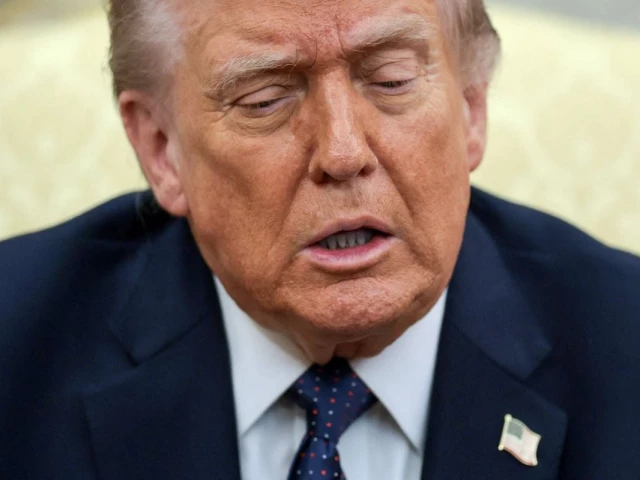
United States President Donald Trump claimed on Wednesday that Iran was offering significant concessions as negotiations between the two sides are set to continue next week.
"The war is going very well. As you know, we're winning by a lot. Iran is making very big concessions.
"We'll see what happens — but it has been very, very, very powerful," Trump told reporters at the Capitol.
He earlier said Iran had told the US that no tolls were being sought from ships travelling through the Strait of Hormuz.
The two countries, which ended a first round of negotiations in Switzerland on Monday, have offered conflicting accounts about financial incentives for Iran, control of the Strait of Hormuz and Israel's parallel war in Lebanon — all major aspects of their framework deal signed last week, aiming to end the war.
Trump has faced criticism over the deal domestically, including from hardliners in his Republican Party.
— Rapid Response 47 (@RapidResponse47) June 24, 2026
Iran’s Ghalibaf says deal to end war ‘declaration of US defeat’
Meanwhile, Iranian Parliament Speaker and chief negotiator Mohammad Bagher Ghalibaf said that the deal between Iran and the United States to end the war is “America’s declaration of defeat".
“The Islamabad understanding was not the result of pressure and coercion, but rather the result of the resistance and authority of the brave Iranian nation,” Ghalibaf said at a conference in Baku, Azerbaijan, on an Azerbaijani broadcast on Iranian television.
“That is why the Islamabad memorandum of understanding became a declaration of America’s defeat.”
BREAKING: Iran's top negotiator says deal to end US-Israel war is a 'declaration of US defeat'
— Al Jazeera Breaking News (@AJENews) June 24, 2026
🔴 LIVE updates: https://t.co/CSWeL6yXbK pic.twitter.com/GpOR2plbDK
He added: "The brave resistance of the armed forces and the heroic resistance of the people in the streets caused Iran to impose heavy costs on the United States and the fake Israeli regime."
قالیباف در اجلاس بینالمجالس کشورهای عضو سازمان همکاری اسلامی: مقاومت جانانه نیروهای مسلح و ایستادگی قهرمانانه مردم در خیابانها سبب شد، ایران هزینههای شدیدی به آمریکا و اسرائیل تحمیل کندhttps://t.co/ZpYKog9XhM pic.twitter.com/8tS8tCArW2
— خبرگزاری ایسنا (@isna_farsi) June 24, 2026
Ghalibaf added that regional countries alone should determine the Middle East’s security structure.
“We consider the withdrawal of foreign military forces from the region a strategic objective. We see the future of the region not in confrontation, but in interaction. [Military] bases of extra-regional forces in West Asia are a source of instability,” he said.
Ghalibaf said Iran is ready to cooperate with nations in the Middle East based on “non-interference in internal affairs and respect for sovereignty”.
He reiterated Iran’s stance that Israel must halt its attacks and occupation of southern Lebanon.
“We have not abandoned our friends and strategic partners in the most difficult and complex conditions … A ceasefire and an end to the war in Lebanon is just as important to us,” Ghalibaf said.
He also said that "the Iranian nation has shown that the era of imposing will on independent nations is over."
"Although this war imposed heavy costs on our nation, it revealed the fundamental truth that the people's resistance and resistance as the real power in the most difficult conditions disrupts the calculations of the aggressors."
No program to access attacked facilities, nuclear materials: Iranian Deputy FM
Deputy Foreign Minister Kazem Gharibabadi stated in a post on X that despite IAEA chief Rafael Grossi's request, no meeting was held with him in Switzerland, and that "here is also no program for access to the attacked facilities and nuclear materials."
"These issues will solely be examined and resolved within the framework of the final agreement," he said.
در سوییس هیچ نشستی با گروسی، علیرغم درخواست وی، برگزار نشد. هیچ برنامه ای نیز برای دسترسی به تاسیساتِ مورد حمله واقع شده و مواد هسته ای وجود ندارد. این مباحث صرفا در چارچوب توافق نهایی و در نتیجه اقدام عملی طرف مقابل در خاتمه تمامی تحریم ها و... بررسی و تعیین تکلیف خواهند شد. (۱)
— Gharibabadi (@Gharibabadi) June 24, 2026
"You cannot advance the 'stir up and take over' policy with media hype," he added.
Israel’s defence minister says military will not withdraw from Lebanon, even if US demands it
Israel’s Defence Minister Israel Katz said Israel will not pull its forces out of southern Lebanon “even if there is an American demand”, according to Al Jazeera.
“200,000 residents will not return,” said Katz, referring to the Lebanese forcibly displaced by Israel’s invasion and attacks, in comments carried by The Times of Israel.
“What happened in the past in security zones, where there was also a civilian population [present], was roadside bombs and attacks against the soldiers, and therefore we will not allow that,” added Katz. “We are not withdrawing.”
US-Iran Islamabad pact sends 'positive signal,' be jointly safeguarded, implemented: China
The US-Iran Islamabad Memorandum of Understanding has sent a "positive signal" and should be jointly safeguarded and implemented, China said on Wednesday.
China "advocates" dialogue and negotiation in addressing regional issues and differences among parties and "opposes the threat or use of force," Foreign Ministry spokesperson Guo Jiakun told reporters in Beijing.
Beijing "always upholds a just position, supports all efforts conducive to peace, supports the Iranian side in defending sovereignty, security, and territory, and national dignity, and supports Iran in improving its relations with Gulf states and regional countries," he added.
Rubio ‘reaffirms’ security commitment with UAE president
Secretary of State Marco Rubio discussed the US-Iran deal with the leader of the United Arab Emirates and renewed the US’s commitment to its security on his first leg of a tour of the Gulf, as per Al Jazeera.
Rubio met UAE President Mohamed bin Zayed on Wednesday, said his spokesperson Tommy Pigott.
“They discussed President Trump’s memorandum of understanding with Iran, efforts to secure full and safe transit through the Strait of Hormuz, and the importance of peace and stability in the region,” Pigott said.
Rubio “reaffirmed the US commitment to the security of the Emirates”, he added.
Iran’s Araghchi briefs senior Hamas official on US negotiations
Iranian Foreign Minister Abbas Araghchi has discussed recent US-Iran negotiations and the situation in Israeli-occupied Gaza during a call with senior Hamas official Basem Naim, according to Al Jazeera.
In a statement, Hamas said Naim congratulated Iran on its interim agreement with the US and expressed “deep appreciation for Iran’s steadfastness” during US-Israeli “aggression”.
Araghchi reiterated Iran’s support for the Palestinian people and said its negotiating team has been raising the issues of Israel’s continued “aggression against Gaza” and ceasefire “violations” with US officials and mediators.
Trump slams US Senate for 'poorly timed' Iran war powers vote, calling it 'meaningless'
US President Donald Trump slammed the US Senate for voting on legislation which directs Trump to halt military action against Iran.
In a post on Truth Social, Trump claimed that he has "Iran on the 'ropes', ready to go down for the fall, willing to give us practically anything,' in reference to the recent Islamabad Memorandum of Understanding that was signed.
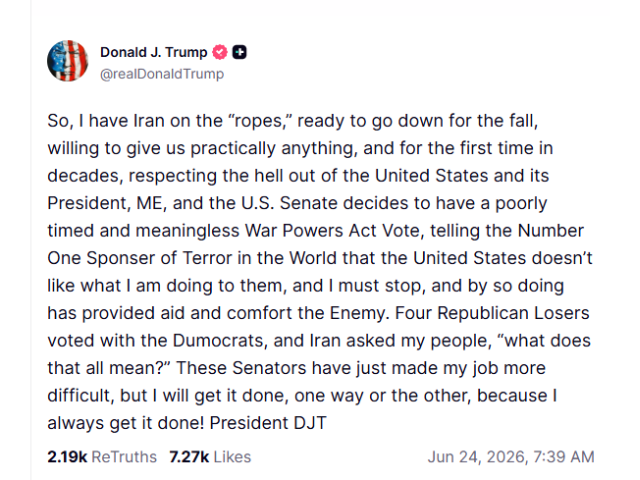
He went on to say the War Powers Act Vote was "poorly timed and meaningless" and told the "Number One Sponser of Terror in the World" that the US didn't "like what I was doing to them."
"...by doing so, [the vote] has provided aid and comfort the Enemy."
The Islamabad MoU, signed last week, was hailed by Trump's supporters as a historic "grand bargain', however, critics say the accord legitimises and strengthens Iran.
Oman opens temporary maritime corridor through Strait of Hormuz
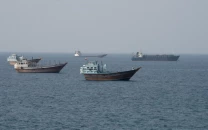
Oman announced on Tuesday the opening of a temporary maritime corridor for vessels transiting the Strait of Hormuz, citing its responsibility toward one of the world's most important shipping routes and its commitment to freedom of navigation.
The measure was introduced in coordination with the International Maritime Organization (IMO) and in line with outcomes of recent US-Iran efforts related to navigation and regional stability, according to a report by the Oman News Agency.
"Based on the Sultanate of Oman's responsibility toward the Strait of Hormuz and its importance to the global economy, and in accordance with its firm commitment to international law and the law of the sea, ensuring freedom of navigation in the strait without imposing transit fees, Oman has worked in coordination with the International Maritime Organization to provide the option of using a temporary maritime corridor for all vessels," the report said.
The corridor will be available according to coordinates announced by the IMO and the relevant Omani authorities, with vessels wishing to use the route required to coordinate with the international maritime body.
The report comes as Oman and Iran continue consultations on future navigation arrangements in the strategic waterway.
Earlier Tuesday, Muscat and Tehran announced the formation of "a joint working group" tasked with negotiating the future management of navigation in the Strait of Hormuz, maritime services to be provided there and related costs, in coordination with other Gulf littoral states and in accordance with international law and the sovereign rights of states bordering the waterway.
Under clause 5 of the Islamabad Understanding, Iran will hold dialogue with Oman on the future administration of the Strait of Hormuz and the maritime services to be provided there, in coordination with other Gulf littoral states and in accordance with international law and the sovereign rights of the states bordering the strategic waterway.
According to the memorandum, Iran also committed to making its utmost efforts to ensure the safe and toll-free passage of commercial vessels between the Gulf and the Gulf of Oman for a period of 60 days, with commercial shipping resuming immediately.
IAEA chief says nuclear inspections in Iran will proceed despite objections
International Atomic Energy Agency (IAEA) Director General Rafael Mariano Grossi on Wednesday said that nuclear inspections in Iran's enrichment sites will proceed despite Tehran's objections, according to Euronews.
Pointing to the memorandum of understanding signed between the US and Iran, Grossi rejected Iran’s denials that it had agreed to nuclear inspections during a news conference at Japan’s Fukushima Daiichi nuclear power plant.
The accord "says explicitly that the nuclear activities that are going to be carried out with regards to the nuclear material facilities will be supervised by the IAEA — in all letters," Grossi told reporters.
"Obviously, to do that, we will have to inspect. Whether this happens the day after tomorrow or in one week or in 10 days, it's important, but not essential. This is going to happen," he further said.
US Senate joins House in voting to halt Iran war, rebuking Trump
The US Senate backed legislation on Tuesday directing Trump to halt US military action against Iran, the latest rebuke of the Republican president from an increasingly restive Congress.
The Senate voted 50-48 in favour of the war powers resolution, which passed the House of Representatives early this month, reflecting growing concern even among some of Trump's Republicans about the unpopular conflict that began on February 28 when the US and Israel launched an attack on Iran.
It was the first time both chambers of Congress had passed a resolution directing a president to remove US armed forces from hostilities since the War Powers Resolution, more commonly known as the War Powers Act, was enacted in 1973.
While likely to remain largely symbolic, the vote was a setback for Trump, who until recently had enjoyed near-unanimous support from Republican members of Congress.
It also comes as the administration is expected to ask Congress to authorise tens of billions of dollars to pay for the war.
Trump's Republicans hold slim majorities in both the Senate and House, but a few have broken with the president on a handful of issues ahead of mid-term elections in November, which will determine whether the party will retain control of Congress.
Read: Iran rules out compromise on missile capability
Some Republicans recently baulked at Trump's $1.8 billion "anti-weaponisation" fund to compensate political allies he says have been targeted by federal authorities and stalled a $70 billion bill to fund his immigration crackdown.
Reuters/Ipsos poll results released on Tuesday showed that just one in four Americans believe the war against Iran was worth its costs, and a majority worry that a truce with Tehran is unlikely to last.
The Senate vote was largely along party lines, with four Republicans joining all but one Democrat in favour. Two Republican senators did not vote.
Constitutional uncertainty
Trump's administration is working to negotiate a peace agreement with Iran. Support for the resolution in Congress is likely to put pressure on the president not to resume hostilities, something he has suggested he might do if negotiations falter.
Under the 1973 War Powers Act, the concurrent resolution - passed by both the House and Senate - does not go to the White House for Trump's signature. In the 1973 law, Congress intended such resolutions as a mechanism for ending military operations.
But legal experts said the issue remains unsettled. No war powers resolution had previously passed both chambers of Congress and a 1983 Supreme Court ruling said such a measure must be submitted for a president's signature or veto to have legal effect.
The White House has insisted that the War Powers Act is unconstitutional and thus not binding.
On Tuesday, a White House official said the Senate vote is insignificant because the resolutions do not go to the president and have no force of law, and the measure passed only because two Republicans were absent.
The official also said the resolution directs Trump to remove US forces from hostilities, which the White House says were terminated with a ceasefire on April 7.
Experts say the constitutionality of the War Powers Act likely will be settled in the courts.
"The executive branch will likely ignore it on constitutional grounds, and it’s not clear who might have standing to sue to enforce it," said Scott Anderson, a senior fellow at the Brookings Institution and senior editor of the online legal publication Lawfare.
Representative Gregory Meeks of New York, who sponsored the resolution in the House, said he viewed the resolution as binding and would pursue all legal avenues to ensure that the administration complies.
Democrats also noted that the US Constitution gives Congress, not the president, the right to take the country to war. "Congress has to own this responsibility," Democratic Senator Tim Kaine of Virginia said in a speech urging support for the measure.
Slim but significant support
The resolution had also passed the House with slim Republican support. The tally there was 215-208 with four Republicans and every Democrat voting in favor.
In the Senate, the four Republicans who voted for the measure were Susan Collins of Maine, Rand Paul of Kentucky, Bill Cassidy of Louisiana and Lisa Murkowski of Alaska. Democratic Senator John Fetterman of Pennsylvania voted against it.
Republicans Mitch McConnell of Kentucky and David McCormick of Pennsylvania missed the vote.
Democratic lawmakers have promised additional votes on war powers measures, saying they want to force Republicans to go on the record about the war.
Additionally, Congress has the right to review and vote on any peace agreement with Tehran if it affects Iran's nuclear program, under a 2015 law passed as then-President Barack Obama negotiated a nuclear agreement with Iran and other world powers.
Senate Republican Majority Leader John Thune of South Dakota said on Tuesday he expected Congress would review and vote on an eventual Iran peace deal.






This material may not be published, broadcast, rewritten, redistributed or derived from. Unless otherwise stated, all content is copyrighted © 2026 The Express Tribune.





COMMENTS (1)
Comments are moderated and generally will be posted if they are on-topic and not abusive.
For more information, please see our Comments FAQ