CM Maryam claims improved rainwater drainage
Updated 5 hours ago

Seminar discusses evolving geopolitical dynamics, regional security challenges and need for economic resilience
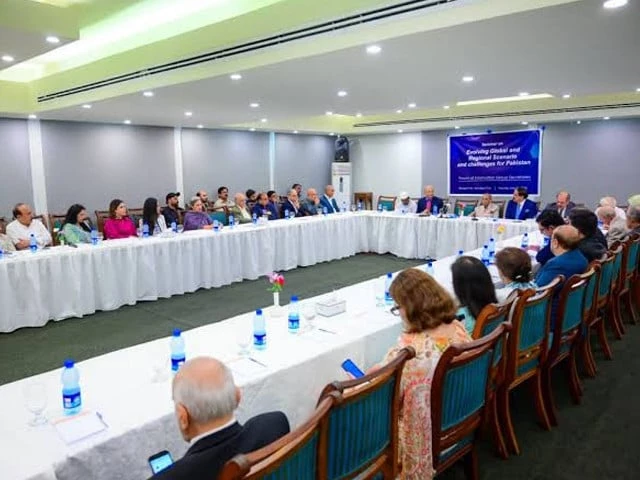
Speakers at a seminar on Saturday emphasised the need for Pakistan to pursue a prudent and balanced strategy in the face of rapidly changing global and regional dynamics marked by shifting power equations and the realignment of international alliances.
The interactive roundtable seminar, titled "Evolving Global & Regional Scenario and Challenges for Pakistan," was organised by the Forum for Information Group of Secretaries (FIGS).
The forum brought together policy experts, politicians, former civil servants, and diplomats to discuss emerging geopolitical trends, regional security concerns, and their implications for Pakistan.
Former National Security Adviser Lt Gen (retd) Nasir Khan Janjua said the recent US-Iran conflict reflected an ongoing shift in the international system, transitioning from unipolarity towards multipolarity.
The changing balance of power among major states, he said, was reshaping global politics while presenting both opportunities and challenges for Pakistan.
Referring to Pakistan's strategic location, he said the country was well placed to benefit from the emerging geopolitical environment. Pakistan and Iran, he added, could together play a pivotal role in promoting regional stability and economic cooperation.
He stressed that Pakistan should pursue its relations with emerging powers, particularly China and Russia, with balance and foresight while avoiding becoming entangled in major power rivalries.
He also highlighted the importance of peace and stability in Afghanistan, describing them as essential to Pakistan's security interests.
Calling for greater economic self-reliance, Gen Janjua said Pakistan needed to undertake sustainable economic reforms to emerge from the debt trap and strengthen its strategic autonomy.
Former Senator Farhatullah Babar said recent regional developments carried important lessons for all countries in the region and underscored the need for policies grounded in long-term national interests rather than short-term considerations.
He identified three major challenges facing Pakistan: the rivalry between the United States and Iran, the situation in Afghanistan, and attempts by the Indian government under Prime Minister Narendra Modi to use water as a strategic weapon.
Such developments, he warned, could set a troubling precedent in regional politics.
Babar stressed that dealing with these challenges required coherence in policymaking, close civil-military coordination, and a unified national approach to protecting Pakistan's strategic and economic interests.
Dr Ashfaque Hasan Khan, Director General of the Institute of Policy Studies at the National University of Sciences and Technology, said economics and politics had become increasingly intertwined, with geopolitical considerations exerting significant influence on economic decision-making worldwide.
Describing energy as the lifeblood of modern economies, he said disruptions in energy supplies had direct consequences for inflation and overall stability.
Recent US-Iran tensions generated uncertainty in international markets and heightened inflationary pressures across the globe. Countries dependent on imported energy, including Pakistan, were particularly vulnerable to such shocks, he added.
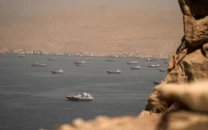
Dr Khan also drew attention to the strategic importance of the Strait of Hormuz, saying it had effectively become a geopolitical pressure point because of its central role in global energy transportation. He expressed optimism that Iran was gradually returning to normalcy and could emerge economically stronger if regional stability was maintained.
He said the recent Memorandum of Understanding between the United States and Iran had helped ease tensions, provided Iran with much-needed breathing space, and enhanced Pakistan's standing by highlighting its constructive role in promoting regional stability.






This material may not be published, broadcast, rewritten, redistributed or derived from. Unless otherwise stated, all content is copyrighted © 2026 The Express Tribune.






COMMENTS
Comments are moderated and generally will be posted if they are on-topic and not abusive.
For more information, please see our Comments FAQ