China vows to protect trade rights
Updated 1 hour ago

Swiss vote, likened to Brexit, raised fears over ending free labour movement with the EU partner
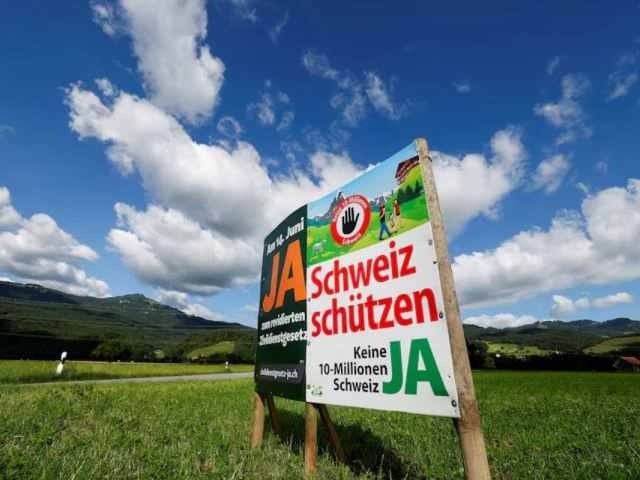
Switzerland on Sunday rejected a proposal to cap its population at 10 million, a projection showed, as voters prioritised economic stability and ties with the European Union over worries immigration was straining public services and pushing up rents.
The projection by national broadcaster SRF, which traditionally calls referendum votes, showed about 45% of voters came out in favour of the proposal and 55% against.
The vote, which was likened to Britain's 2016 Brexit referendum, had put businesses on edge due to concerns it could end the free movement of labour between Switzerland and the EU, the country's main trading partner.
The proposal, championed by the right-wing Swiss People's Party, stipulated that the population must not exceed 10 million before 2050, and that if it did so for two years, Switzerland should end freedom of movement with the EU.
Urs Bieri from polling firm GFS Bern said the initiative failed to pass because although concern about population growth is widespread, people were not convinced by the plan and were worried about possible side effects.
Read More: EU overhaul to toughen migration rules takes effect, though doubts remain about impact
"Voters were worried about negative consequences for Switzerland's relationship with the EU and for the labour market," he said.
"People are also worried about things like having enough care and health workers. Also, there's a feeling that in the current international environment it's not sensible for a small country to do this," Bieri added.
More than a quarter of Swiss foreign-born
The Swiss population already stands at 9.1 million and has grown far more quickly than in the surrounding EU. Foreigners make up nearly 28% of the Swiss population, which official projections forecast will reach 10 million by the early 2040s.
Polls had forecast a close outcome, and the result tallied with a final survey by GFS Bern, which had predicted the proposal would be narrowly rejected.
Still, the backing for the measure sits alongside growing support for policies aimed at curbing immigration across Europe. Campaign posters proclaimed that only 10% of incomers were skilled workers and that asylum seekers were more likely to be rapists.
Marcel Dettling, president of the Swiss People's Party, told SRF the initiative had been very popular in rural areas, but had ultimately been defeated by urban voters.
"Not a single problem has been solved," he said. "We will continue to push for sensible immigration."
A preliminary estimate put turnout at about 58%, well above the recent average of 48% for Swiss referendums.
Business groups hail ‘important signal’
Business groups welcomed the referendum result after warning that a population cap would limit access to foreign workers, damage the economy and sour relations with Brussels.
"The initiative's rejection sends out an important signal for an open and internationally connected Switzerland," said Martin von Moos, president of HotellerieSuisse.
Opponents had dubbed the plan a recipe for chaos because of the upheaval it could cause.
They also questioned whether it was wise to clash with Brussels after a bruising 2025, when President Donald Trump slapped the highest U.S. tariffs in Europe on Swiss goods.
The no campaign had run posters with an image of a smiling Trump and the caption: "Breaking with Europe, now of all times?"
Patrick Leisibach, a migration expert at think tank Avenir Suisse, said economic arguments had played a key role, with people wary of how a "yes" vote would affect their daily lives.
"They wonder 'who is going to serve me at the restaurant?' and 'who is going to care for me when I get old?' It's more about personal welfare, which made people reject this initiative," Leisibach said.













This material may not be published, broadcast, rewritten, redistributed or derived from. Unless otherwise stated, all content is copyrighted © 2026 The Express Tribune.






COMMENTS (1)
Comments are moderated and generally will be posted if they are on-topic and not abusive.
For more information, please see our Comments FAQ