Ceremony in Karachi honours outgoing French diplomats
Updated 1 hour ago

PPP's Hussain Tariq questions Rs6.9 trillion direct tax target, flags 54% rise in electricity inflation in a year
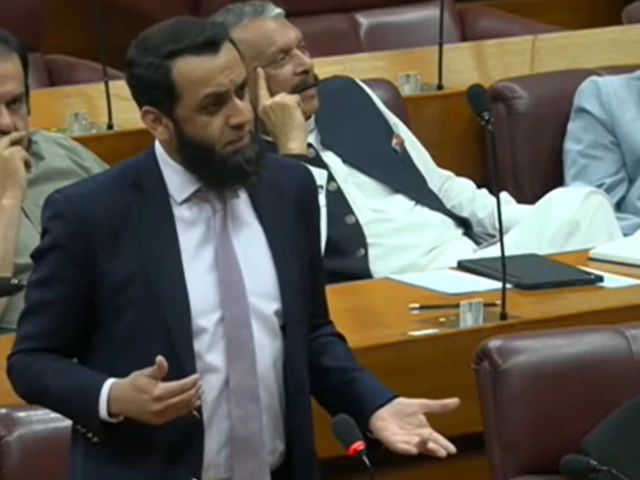
Information Minister Attaullah Tarar on Sunday defended the federal budget in the National Assembly, claiming enforcement measures had generated Rs800 billion in total revenue recovery and describing it as a "relief budget" marking the beginning of economic growth and stability.
Tarar, responding to remarks made by opposition members during the budget debate, said "very good suggestions were received." Regarding the budget, he stated it had received global recognition. "The whole world, the media, opinion makers and economists are appreciating it," he said, urging the opposition to "at least not undermine Pakistan itself."
Salaried relief
On salaried relief, he stated, "Significant relief has been given to the salaried class. No tax has been imposed on those earning up to Rs50,000." He clarified that those earning between Rs50,000 and Rs100,000 will pay only 1% tax, adding that relief had been extended across income slabs, particularly for professionals and the middle class.
FBR reforms and recovery
On the Federal Board of Revenue (FBR) reforms, Tarar said structural changes had been introduced. "If you recommend any customs or income tax officer today, that officer will be suspended by evening," he claimed. He also spoke about tax litigation worth billions, alleging collusion between certain legal actors and tax evaders in the past, and said new tribunals had been established on merit with recovery mechanisms strengthened.
He noted the recovery of around Rs60 billion from the sugar sector, with enforcement measures generating around Rs800 billion in total. A transparent transfer and posting system had also been implemented, he said, to eliminate influence and recommendations. He added that this was achieved through determination, political will, and institutional coordination.
Read: Aurangzeb says Budget 2026-27 delivers on promise to move economy from stability to growth
The information minister also said modern systems such as faceless customs appraisal had been introduced to reduce corruption and delays at ports, adding that these changes ensure "the burden of those who do not pay taxes will no longer fall on those who do."
On retail taxation, Tarar mentioned that around 3.6 million retailers were previously outside the tax net and had now been brought into it through a fixed-tax scheme, creating fairness and transparency in the system.
Housing and exports
Regarding housing, the minister said relief had been given to the middle class, particularly in property transactions involving small plots. The "Apna Ghar Scheme" was also highlighted, under which loans of up to Rs10 million are being provided, targeted at low-income groups, with the initiative expected to stimulate construction activity, create employment, and strengthen economic growth.
On exports, Tarar stated that policies had been adjusted to support export-led growth, including the removal of advance tax and reductions in minimum tax and super-tax for exporters. The information minister also mentioned reductions in taxes within the services sector, including shipping services, where sales tax had been brought down from 18% to 0%.
Economic turnaround
Tarar recalled warnings that "Pakistan was going to default within a month" and that investment had completely stopped. He said "conditions were being set for Pakistan's default" and that some were even hoping for it. "But by the grace of Almighty Allah, things turned out differently," he noted, crediting PM Shehbaz Sharif's leadership and saying that in difficult times "politics was sacrificed for the survival of the state."
Describing the past economic situation, he said the exchange rate used to fluctuate like a "fan running continuously," business activity had stalled, letters of credit were not being opened, and exporters' goods were stuck at ports.
Further, inflation stood at 38% and interest rates above 22%.
Now, he said, GDP growth had improved from negative territory to around 3.7%, per capita income had risen from about $1,751 to $1,901, foreign exchange reserves had increased, and remittances had reached record levels.
Tarar also mentioned that the current account deficit had improved from around 8% of GDP to about 0.7%, and IT exports had reached around $3.8 billion with freelancers contributing significantly. This macroeconomic stability "did not come overnight," Tarar stressed.
Consultations were held across multiple sectors including industry, chambers of commerce, IT, and agriculture before finalising the budget, Tarar shared.
Describing the budget as one that supports "farmers, labourers, shopkeepers, retailers, and salaried individuals," he noted that agricultural relief measures include reductions in duties on imported machinery, along with enhanced support for youth and farmers. National leadership and institutions were credited for contributing to peace and stability, with emphasis on teamwork involving the SIFC and government economic teams.
Restraint in the House
Referring to the opposition leader's speech the day before, Tarar pointed out that they too had once been in opposition and had witnessed incidents where "books were set on fire from these very desks and papers were thrown."
Although he emphasised that protest is the right of the opposition and "this has always been an established tradition," he noted that "for the first time, books were also thrown from the government benches towards the opposition benches," highlighting the need for restraint.
He further stated that "time changes, people change positions," but what is often forgotten is that dialogue has always been offered. "When we were there, we offered dialogue, and today from here also, we offer dialogue," he said, adding that the difference lies in "attitude and intention."
He also recalled that when they were in opposition, they too spoke about a "Charter of Economy" and a "Charter of Democracy," and today, from the treasury benches, the same call continues. "This House is the custodian of democratic traditions," he said.
PPP MNA calls on FinMin
Earlier, Pakistan People's Party (PPP) MNA Hussain Tariq termed direct tax targets set in the new budget at Rs6.9 trillion as "very ambitious and unlikely to be achieved," calling on Finance Minister Muhammad Aurangzeb to respond to his concerns.
Tariq stated that the budget is not just about figures, but also about balancing "debit and credit" and providing financial direction for the country's population. He said the PPP understands budgetary discussions "on facts and figures," but the party has always emphasised how the budget impacts ordinary citizens.
"If people are benefited, it is fine, but if a budget makes things more expensive, then we feel it should be changed," he said, adding that there have been ongoing discussions within the government regarding the issue.
FBR targets
Referring to targets set by FBR, the MNA noted that a target of Rs14.131 trillion was set, which, like every year, was not achieved and had to be revised. He stated the new target of Rs15.264 trillion represents a 17% increase compared to last year, while inflation has been adjusted at 8%.
"Above that, how will it adjust?" he questioned, adding that PPP Chairman Bilawal Bhutto Zardari had also pointed out that the FBR sets targets but fails to achieve them, after which a "tug of war" begins between the state and provinces over revenue responsibilities.
On indirect taxes, Tariq said all members recognise them as regressive, noting a revised target of Rs6.5 trillion with a 17% revision added overall.
Inflation and cost of living
Tariq highlighted inflation pressures, saying the Sensitive Price Indicator had increased by 14.75%, reflecting a significant impact on the poor, and that the prices of 51 essential items used by low-income groups had increased in year-on-year data up to June 4. "I agree inflation is around 8% overall," he said, "but there are other pressures as well."
He added that electricity inflation had increased by 54% in a year. "If a person is earning a minimum wage, how will he pay electricity bills?" he asked. "If he pays bills, he will not be able to fulfil his children's needs," he said, stressing that citizens should not be left helpless due to external conditions such as war.
He further noted that in Sindh, where temperatures reach 47 to 50 degrees Celsius, load-shedding leaves people in extremely difficult conditions.
Agriculture and regional equity
On agriculture, Tariq said he appreciated Minister Rana Tanveer Hussain for his efforts in the National Food Security sector. He noted that opportunities in areas such as GMO and gene editing were not fully utilised in the past, and said policy improvements had been made, but farmers still do not benefit enough to invest in modern machinery.
He said agriculture often yields only a 50% profit margin while input costs remain high. Referring to government remarks, Tariq said the finance minister had claimed that agriculture received significant attention last year, however, this year only limited discussion took place. He also mentioned that Rs117.4 billion was allocated to agriculture, which he described as the backbone of the economy.
The MNA concluded by emphasising regional equity, saying it should not only be considered at the provincial level but must also extend to district-level investment, where economic stress is most visible.
He also added that the budget does not appear to provide a clear financial direction for the coming years, particularly in terms of employment generation and short and long-term economic policy.
PTI's Asad Qaiser calls government "fascist"
Pakistan Tehreek-e-Insaf MNA Asad Qaiser, also speaking in the National Assembly, stated that both ruling parties had been defeated in Gilgit-Baltistan and that his party was not allowed to fully participate in the political process there.
Criticising the government, he remarked that those who "wear suits and ties here talk about democracy, but it is not democracy, it is fascism," adding, "You are a fascist government."
Discussing local energy concerns, Qaiser said his own district requires 180 megawatts of electricity yet faces 12-hour load-shedding. He stated that electricity is not being provided from Tarbela, emphasising that it is the right of the people to receive affordable electricity.
PPP's Faruqui questions relief
PPP's Sharmila Faruqui said that if economic "excellence produces a mediocracy rather than relief for the people," then the direction of policy must be questioned. She noted that while the government is claiming relief for the salaried class, this is the same class that "pays more tax than anyone else," adding that last year the salaried segment contributed around Rs550 billion, while the relief being offered is only about Rs50 billion.
Read More: Saved by the Budget?
She criticised the expansion of indirect taxation, including the climate levy and other revenue measures, as well as the expansion of the Sales Tax Third Schedule to around 30 items, including basic household goods, milk products, and other everyday essentials.
Faruqui argued that this approach increases the burden on already documented taxpayers while expanding indirect taxation on consumers. She also pointed out that relief appeared directed more towards credit card users, foreign travellers, and business class passengers rather than the poor. "If you are poor, you keep paying tax," she said.
Referring to official estimates, Faruqui noted that poverty stands at around 29%, "meaning one in every four Pakistanis is poor." She questioned the Economic Survey's poverty benchmark of Rs8,400, asking, "can anyone here run a household on Rs8,400 a month?" and stressed that "the definition of the poverty line must be revised honestly."
Demographic pressures
Faruqui warned that Pakistan's population could reach 390 million by 2050 if current trends continue. With around 68% of the population under the age of 30 and unemployment at 7.1%, she criticised the budget for offering little for youth development, saying spending on a youth population of nearly 160 million amounted to "0.07%," questioning national priorities.
Faruqui terms FBR "white elephant"
On the fiscal structure, Faruqui noted that around Rs8 trillion in current expenditure and federal revenue is consumed by interest payments, while pensions stand at Rs1.1 trillion, calling the situation unsustainable.
She also described the FBR as a "white elephant," expressing frustration over repeated references to it without meaningful reform. Faruqui argued that had institutional inefficiencies been addressed earlier, provinces would not need to be asked to cover fiscal gaps under constitutional provisions.
Further, she cited circular debt at around Rs5.1 trillion and questioned why awards were being given to those responsible for the sector despite inefficiencies being passed on to the public.
She also described electricity and petrol prices as among the highest in the region, while "ministers are being rewarded for inefficiency."
Karachi and regional disparities
On Karachi, Faruqui noted that the city pays the highest taxes in the country yet receives disproportionately low development allocations. She cited the Hyderabad and Sukkur motorway as examples, noting that against a total project cost of around Rs363 billion, only about Rs30 billion has been allocated, making completion unlikely.
NHA allocations were also described as inadequate, with Sindh receiving insufficient funding across multiple schemes.
Growth and IMF
In closing, while acknowledging the budget as moving from "stabilisation towards growth," Faruqui termed the projected growth rate of around 4% insufficient and "mediocre."
She stressed that the country cannot continue relying on increased taxation to finance debt servicing while development budgets are cut and pensions rise, and concluded that the salaried class should not continue bearing the burden of fiscal adjustment "to satisfy the IMF framework."




This material may not be published, broadcast, rewritten, redistributed or derived from. Unless otherwise stated, all content is copyrighted © 2026 The Express Tribune.




COMMENTS (2)
Comments are moderated and generally will be posted if they are on-topic and not abusive.
For more information, please see our Comments FAQ