Gold prices surge by Rs10,000 per tola in Pakistan
Updated 3 hours ago

Agriculture storage gets Rs7.1b while losses run into hundreds of billions
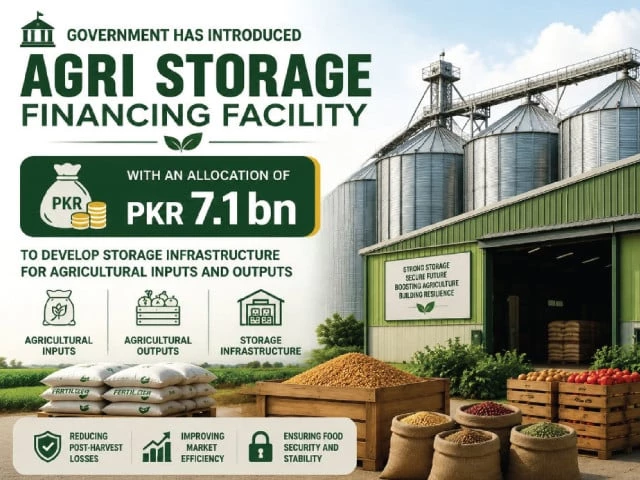
In an economy where billions have become the new millions and trillions the new billions due to years of inflation and rupee depreciation, the federal government's decision to allocate just Rs7.1 billion for agricultural storage infrastructure in Budget 2026-27 has raised questions about the understanding of those in the power corridors of Islamabad regarding a crisis that costs more than Rs140 billion annually in wheat losses alone.
Agriculture Republic Co-Founder Aamer Hayat Bhandara described Pakistan's storage infrastructure as "one of the weakest links in the agricultural value chain". The country suffers from inadequate warehousing capacity, outdated storage facilities, insufficient cold-chain infrastructure, poor handling practices and significant pest and moisture-related losses.
While wheat benefits from relatively better storage arrangements through public procurement systems, other crops such as maize, fruits, vegetables and pulses remain highly vulnerable to post-harvest losses.
Mahmood Nawaz Shah, Vice President of the Sindh Abadgar Board, said overall agricultural losses are alarming when pre-harvest, post-harvest and storage-related wastage are combined.
"If we combine all these losses across agriculture, including grains as well as fruits and vegetables, overall losses come to around 35% at different levels and for different crops," he said.
The challenge is particularly severe in horticulture. Pakistan produces nearly 30 million tonnes of fruits and vegetables annually but has less than one million tonnes of cold-storage capacity available.
For grain crops, storage capacity also remains inadequate. Pakistan's wheat production stands at nearly 29.6 million tonnes, yet modern storage facilities remain 300,000 to 500,000 tonnes short of what is needed to safely preserve large quantities of produce.
Beyond physical infrastructure, experts argue that the problem is rooted in the broader agricultural marketing system. Bhandara pointed out that many farmers lack the financial capacity to hold produce after harvest. Banks and financial institutions have shown limited interest in providing post-harvest financing, forcing farmers to make distress sales immediately after harvest when market prices are at their lowest.
The situation is further complicated by inefficiencies in wholesale markets, where farmers often face issues related to commissions, weighing practices and market charges. For perishable commodities, post-harvest losses are estimated at between 20% and 40%, depending on the crop and region. Such losses reduce farmer incomes, weaken food security and undermine Pakistan's export competitiveness.
The newly announced financing facility has therefore been welcomed as recognition that food security depends not only on increasing production but also on preserving agricultural output through stronger supply chains.
"If complemented by robust EWR regulations, commodity market reforms and broader private-sector participation, the facility can become a catalyst for modernising Pakistan's agricultural value chain while creating sustainable lending opportunities for the banking sector," said Ahmad Jawad, Chief Organiser at the Pakistan Business Forum. "A positive step towards strengthening agricultural value chains."
Yet experts maintain that infrastructure alone will not solve the problem.
Pakistan's storage ecosystem remains fragmented among federal agencies, provincial food departments, private traders, commission agents, millers and farmers. According to Bhandara, this fragmentation creates inefficiencies in inventory management, market information systems, quality standards and supply-chain coordination. He advocated reforms including a national warehouse receipt system, digital inventory management, commodity tracking mechanisms, public-private partnerships and stronger links between storage facilities, commodity financing and crop insurance.
"The objective should be to transform storage facilities into financial and marketing assets rather than treating them merely as physical warehouses," he said.
Storage also plays a critical role in stabilising agricultural markets. When farmers are unable to store produce or access financing, they are compelled to sell during harvest season when supply is abundant and prices are depressed. Consumers, meanwhile, often face shortages and higher prices months later due to inefficient stock releases and speculative behaviour.
This cycle has repeatedly affected commodities including wheat, maize, onions and potatoes.
Shah noted that the government has introduced incentives over the past two years to encourage private-sector participation through electronic warehouse receipt systems and other financing mechanisms. However, he cautioned that the business case remains challenging.
"The private sector will invest only if there is a clear upside after accounting for purchase costs, storage expenses, financing costs and profit margins," Shah said.
He also criticised the absence of a broader agricultural strategy in the federal budget. "The prime minister's speech mentioned agriculture, but beyond that there was no clear direction or concrete programme. This shows a lack of strategic understanding and planning for the sector," Shah remarked. Another major obstacle is energy availability. Modern cold-storage systems require uninterrupted electricity, yet rural areas continue to experience prolonged power outages.
"If there is no electricity for 14 to 16 hours a day, highly perishable commodities cannot be stored effectively," he said. "Storage solutions are highly energy-intensive. Until these basic issues are resolved, storage, exports and handling of perishables will remain a major challenge."

















This material may not be published, broadcast, rewritten, redistributed or derived from. Unless otherwise stated, all content is copyrighted © 2026 The Express Tribune.






COMMENTS
Comments are moderated and generally will be posted if they are on-topic and not abusive.
For more information, please see our Comments FAQ