Lady health workers protest for job security
Updated 17 hours ago

Farmers warn of severe irrigation crisis as body alleges unfair distribution under Water Apportionment Accord
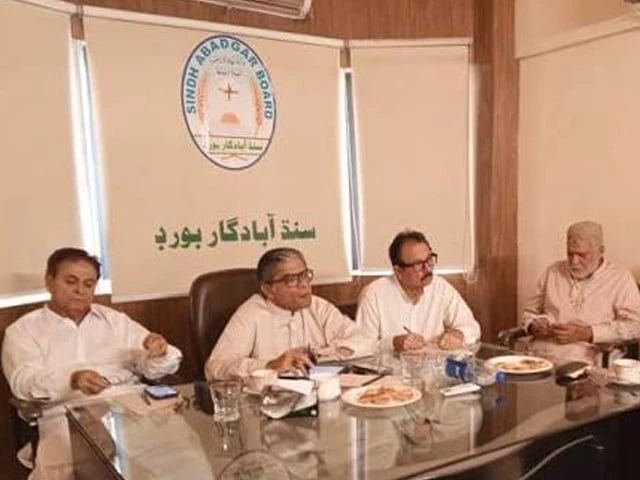
Representing rural communities facing acute shortages of irrigation and drinking water, the Sindh Abadgar Board (SAB) has strongly criticised the Indus River System Authority (IRSA) for reducing Sindh's share of Indus River water by 25 per cent, while Punjab is reportedly facing only a four per cent shortfall.
In a statement issued on Monday, SAB office bearers and members said that despite the availability of surplus water in the system, Sindh's allocation had been reduced while water was being supplied to canals in Punjab in violation of the agreed framework.
SAB senior vice president Mahmood Nawaz Shah said IRSA had reduced Sindh's allocation by 33,000 cusecs - from 133,000 cusecs to 100,000 cusecs at Chashma Barrage in Punjab. "This will take another 10 days to reach Sindh's irrigation system, where paddy sowing has already begun and requires water," he said.
He warned that farmers would be forced to re-transplant rice seedlings over an estimated 1.8 million acres of agricultural land due to the shortage.
Shah further said the decision had been taken at a time when combined storage levels at Tarbela, Mangla and Chashma barrages stood at over 3.9 million acre-feet, while inflows were exceeding outflows.
He alleged that IRSA had justified the cut on the grounds that Sindh had used additional water in previous months, adding that the surplus water had not been demanded by the province and could not be adjusted against its seasonal share under the Water Apportionment Accord of 1991.
Warning of severe consequences, Shah said the reduction would force water rotation and possible closure of distributaries, worsening an already fragile situation.
He noted that high temperatures had further increased crop water requirements due to higher evapotranspiration, adding that water storage in dams at this stage would deprive the agricultural economy of essential irrigation supplies.
"The agricultural economy of lower riparian areas is likely to suffer massive financial losses due to this shortfall," he said.
Shah also pointed out that unlike Punjab, Sindh's aquifers could not compensate for canal water shortages.
The SAB urged IRSA to immediately release the available water share to Sindh to prevent crop losses and avoid a deepening irrigation crisis.
The meeting was attended by Dr Zulfiqar Yousfani, Dr Bashir Nizamani, Syed Nadeem Shah, Aslam Mari, Imran Bozdar, Mohamed Taha Memon and other office bearers, who also expressed concern over the situation.


















This material may not be published, broadcast, rewritten, redistributed or derived from. Unless otherwise stated, all content is copyrighted © 2026 The Express Tribune.






COMMENTS (1)
Comments are moderated and generally will be posted if they are on-topic and not abusive.
For more information, please see our Comments FAQ