Powerful Colombia earthquake kills at least 111
Updated 4 hours ago

Trump says he will call Netanyahu to urge no retaliation as US 'very close to final deal'; 'don’t want it to blow up'
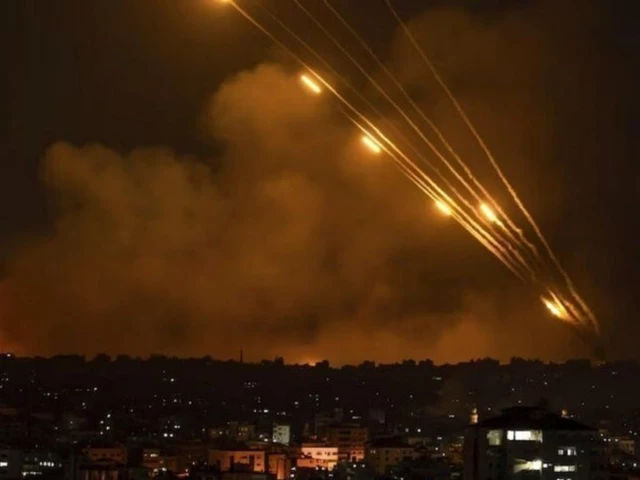
Iran's Revolutionary Guards said their attacks on Israel on Sunday evening were a "warning" of a broader response that would encompass all US and Israeli targets in the region if "aggressions" are repeated.
Iran's Revolutionary Guards said that it targeted Israel's Ramat David air base with the IRGC Aerospace Force’s ballistic missiles, saying the attack was a warning and in case aggressions were repeated, the responses would be broader and would encompass all American-Israeli targets in the region.
IRGC further said that the acceptance of the ceasefire was conditional on cessation of fire on all fronts, but the US and Israel did not adhere to their commitments.
Turkish media "Anadolu Agency": Air raid sirens went off in Haifa and several other locations across northern Israel after Iran launched missiles. As interception attempts were underway, blasts were heard in both Nazareth and Haifa. pic.twitter.com/QUVV9WlRln
— IRNA News Agency ☫ (@IrnaEnglish) June 7, 2026
US President Donald Trump said he would call Israeli Prime Minister Benjamin Netanyahu to urge him not to retaliate following recent developments in the region, adding that further escalation was unnecessary.
He said Iranian strikes “didn’t hurt anybody” and expressed hope that Israel would avoid a response, warning that retaliation could prolong decades of conflict.
Trump also said the US was “very close to a final deal” with Iran, calling it a “good deal” and warning that the situation should not be allowed to derail ongoing diplomatic efforts.
He further stressed that both sides had already exchanged strikes, saying, “Each of them had their fun. Israel had its strike and Iran had its strike. We don’t need another one,” and reiterated that he intended to call Netanyahu immediately to convey his position.
🚨🚨More quotes from my phone call with president Trump: “The Iranian strikes didn’t hurt anybody. Hopefully Israel is not going to retaliate. If Bibi strikes them back it’s just gonna keep going like the last 47 years, or the last 3000 years"
— Barak Ravid (@BarakRavid) June 7, 2026
🚨🚨Trump added: "We are very close… https://t.co/zesy2EF0Qi
Iran's Ghalibaf threatens US, Israeli assets in ME as 'legitimate targets' after strikes in Beirut
Iran's top negotiator said in a post on X that the US naval blockade of Iran and its green light for Israel to escalate attacks in Lebanon make US bases and Israeli assets in the Middle East legitimate targets.
The comments from Iran's Parliament speaker, Mohammad Bagher Ghalibaf, followed Israeli attacks on the southern suburbs of Lebanon's capital, a stronghold of Hezbollah.
"They are neither committed to a ceasefire nor believe in dialogue, and through the naval blockade and violation of agreements regarding Lebanon, they showed that they only understand the language of power," Ghalibaf said in an apparent reference to the US and Israel.
۱/ نه به آتشبس پایبندند نه به گفتگو باور دارند، و با محاصرهٔ دریایی و نقض توافقات دربارهٔ لبنان نشان دادند که فقط زبان قدرت میفهمند.
— محمدباقر قالیباف | MB Ghalibaf (@mb_ghalibaf) June 7, 2026
Israel struck the outskirts of Beirut on Sunday for the first time since the US announced a truce plan for Lebanon last week, and an Iranian lawmaker threatened to retaliate, putting talks to end the wider war into new jeopardy.
Iran has long said any peace deal with the United States would depend on a ceasefire also holding in Lebanon, which Israel invaded in March in pursuit of Iran-backed Hezbollah fighters who fired across the border in solidarity with Tehran.
There was no immediate formal response from Tehran to Sunday's Israeli strikes on the southern outskirts of Beirut, but influential Iranian lawmaker Ebrahim Rezaei posted on X that Iran would deliver a "decisive and painful response".
"Look at the sky of the occupied territories tonight," wrote Rezaei, who serves as the spokesperson for parliament's national security committee.
به حمله رژیم صهیونسیتی به ضاحیه پاسخ قاطع و دردآور خواهیم داد. این سگ هار را باید تأدیب کرد و سر جایش نشاند.
— ابراهیم رضایی (@EbrahimRezaei14) June 7, 2026
امشب آسمان سرزمینهای اشغالی را ببینید.
Washington and Tehran have shown little progress in reaching a deal to end the war that President Donald Trump launched in February with a campaign of air strikes alongside Israel against Iran. Trump has repeatedly threatened to restart the strikes unless there is an agreement soon.
Read More: Trump says he would not unfreeze Iran's assets before deal is done
"We're very close to a deal, or I'm going to blow the hell out of them," Trump told NBC News in an interview, broadcast to mark 100 days of the conflict. The comments were recorded on Friday and broadcast on Sunday as Trump visited his New Jersey golf course.
Trump leans on Netanyahu
Trump has leaned on Israel to scale back its campaign in Lebanon to allow room for a peace deal with Iran, including rebuking Prime Minister Benjamin Netanyahu with obscenities in a phone call last week. After the call, Netanyahu called off air strikes on Beirut and agreed to the latest truce plan with the Lebanese government.
But Israel has never fully halted its campaign in Lebanon, which has killed thousands of people and driven hundreds of thousands from their homes. Hezbollah, which was not party to the truce and would be dismantled under its terms, has also continued attacks and said it would not give up its weapons unless Israel halts fighting and withdraws.
Netanyahu said Sunday's strike on Beirut's southern outskirts, a district known as Dahiyeh that has long been a Hezbollah stronghold, was ordered in response to Hezbollah firing toward Israel.
The Israeli military had earlier said it had intercepted two projectiles fired over the border. It issued an evacuation order for the southern Lebanese city of Tyre and the surrounding areas ahead of possible strikes there.
Elsewhere in Beirut on Sunday, mourners held a military funeral for Brigadier General Wissam Sabra, a senior military officer killed in a strike on his vehicle in the south the previous day.
The wider war has been stalemated since the United States and Israel paused their attacks on Iran in early April, with Tehran blocking most shipping through the Strait of Hormuz, the main transit route for Middle East oil. Washington has imposed its own blockade of Iranian ports.
Though the sides have both said they are close to a preliminary agreement that would reopen the strait, they have repeatedly traded strikes, with escalations in recent days that have included attacks on nearby Arab states hosting US bases.
US forces struck Iranian coastal radar sites in Goruk and Qeshm Island, both in the Strait of Hormuz, early on Saturday after shooting down drones launched by Iran that US Central Command said posed a threat to maritime traffic. Two more Iranian attack drones that were threatening shipping in the strait were shot down, the US military said late on Saturday.
Also Read: Israel’s permanent state of war comes with economic, social costs
Iran's Revolutionary Guards said they retaliated against US bases in Kuwait and Bahrain. Kuwait's army said it engaged seven ballistic missiles that passed over residential areas, resulting in material damage but no casualties.











This material may not be published, broadcast, rewritten, redistributed or derived from. Unless otherwise stated, all content is copyrighted © 2026 The Express Tribune.






COMMENTS (1)
Comments are moderated and generally will be posted if they are on-topic and not abusive.
For more information, please see our Comments FAQ