Iran demands Qatar to release downed pilots
Updated 25 minutes ago

The Supreme court to also role on tariffs, migration and users of illegal drugs barring guns
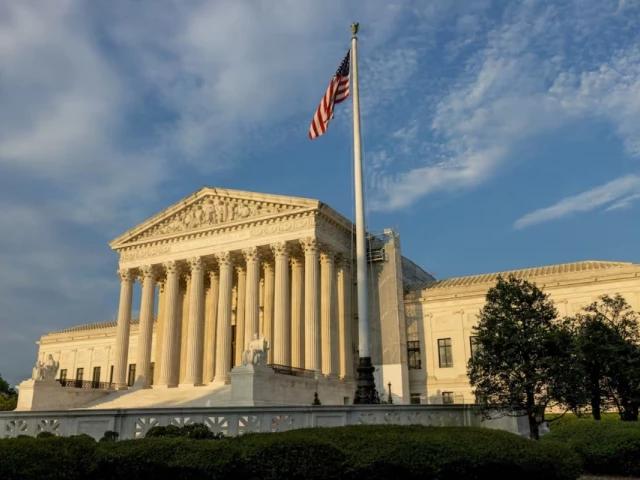
Disputes involving President Donald Trump's policies on tariffs, immigration and firing regulatory officials have drawn a lot of attention during the Supreme Court's current term, but the justices also are poised to decide major cases concerning US "culture wars" issues such as guns and transgender athletes.
The court is expected to wrap up its nine-month term by around the end of this month. In two major cases, it is due to a rule in challenges to a US law barring users of illegal drugs from owning guns and a Hawaii law that restricts the carrying of handguns on private property open to the public, like most businesses, without the owner's permission.
It is also set to decide the legality of laws in Idaho and West Virginia banning transgender athletes from female sports teams amid intensifying efforts by the Republican president and various states to restrict the rights of transgender people.
The court, which has a 6-3 conservative majority, has moved American law steadily rightward in recent years.
Gun rights
In a nation divided over how to address persistent firearms violence, including frequent mass shootings, the court has taken an expansive view of the US Constitution's Second Amendment, which enshrines the right to keep and bear arms.
Read More: Trump says he would not unfreeze Iran's assets before deal is done
During January arguments in the Hawaii case, the conservative justices appeared ready to expand gun rights again, indicating scepticism on Second Amendment grounds toward the state's law. Hawaii's law requires a property owner's "express authorisation" to bring a handgun onto private property open to the public. Four other US states have similar laws.
The court is expected to reject Hawaii's defence of the law, according to Hayley Lawrence, a gun control advocate who serves as executive director of the Duke Centre for Firearms Law.
"It seems to me Hawaii is going to lose 6-3," Lawrence said.
The court, Lawrence said, also might shed further light on the legal framework it adopted in a 2022 decision in a case called New York State Rifle & Pistol Association v. Bruen for analysing whether firearms control laws pass Second Amendment muster. The Bruen decision stated that any government regulation restricting firearms must be consistent with the US historical tradition of gun regulation.
Drug users
The court heard arguments in March over the legality of a federal criminal statute banning anyone who is an "unlawful user" of any controlled substance from possessing firearms or ammunition. That provision is part of the Gun Control Act of 1968, which outlines specific categories of people, such as felons and fugitives, who are barred from possessing firearms.
The case was brought by a Texas man who said he uses marijuana several times a week and was charged under the law. The same law was invoked in charges brought against then-President Joe Biden's son, Hunter, in 2023. The elder Biden later pardoned his son. The Trump administration is defending the law.
University of Chicago law professor Darrell Miller said the court appears sceptical of the provision that prohibits unlawful drug users from possessing a firearm, but also is concerned about sweeping too broadly and undermining other parts of the broader law, such as the part dealing with keeping guns from felons.
"The court is deciding a drug case, but they have one eye on the felony possession statute," Miller said.
Transgender athletes
Trump has pursued several policies cracking down on the rights of transgender people, and the SC last year let his administration implement a ban on transgender people serving in the US military while a legal challenge played out. The administration is backing the Idaho and West Virginia laws, which ban transgender athletes from sports teams for women and girls at public schools, including universities.
During the January arguments, the conservative justices indicated they are likely to uphold these laws.
Opinion polls indicate that a majority of Americans oppose transgender athletes competing in sports teams that align with their gender identity, particularly at the collegiate level.
"There is vast consensus on this issue," said William Bock, a sports law attorney at the firm Kroger Gardis Regas who supports the Idaho and West Virginia measures. "Seventy to 80 per cent of the public doesn't understand why people are fighting about this."
Sasha Buchert, an attorney at the LGBT legal rights group Lambda Legal who represents one of the plaintiffs, expressed hope for a ruling striking down the state laws, saying the arguments in the case "went much better" than those in 2024 in a different dispute involving gender-affirming medical care for transgender minors. In that case, the court's conservatives powered a 6-3 ruling upholding Tennessee's ban on such care.
In a 2020 decision, the SC ruled that a federal law barring workplace discrimination protects gay and transgender employees. But since then, the justices have allowed restrictions on transgender rights to take effect.
Also Read: US lawmakers warn of potential gap ahead of June 12 deadline for intelligence law extension
For instance, the court in March blocked a series of California laws that could limit the sharing of information with parents about the gender identity of transgender public school students without the child's permission, handing a victory to Christian parents who challenged these protections.
In addition to the military ban, the Trump administration has pursued policies barring transgender people from using their gender identities on passports and prohibiting transgender federal workers from using bathrooms reflecting their gender identity.
The SC already has ruled on one major LGBT rights case argued during its current term.
In an 8-1 ruling in March, it rejected a Colorado law that banned psychotherapists from using "conversion" talk therapy intended to change an LGBT minor's sexual orientation or gender identity. The justices sided with a Christian licensed counsellor in casting the prohibition as an intrusion on the Constitution's First Amendment protections against government abridgement of freedom of speech.
Immigration status
Immigration policy is also enmeshed in the American culture wars. The court is due in the coming weeks to rule in two major cases involving Trump policies - his efforts to restrict birthright citizenship and to strip humanitarian protections, called Temporary Protected Status, from hundreds of thousands of Haitian and Syrian immigrants.
The arguments in those cases indicated Trump could lose on birthright citizenship, as he did in February on tariffs, but win on Temporary Protected Status.
Also pending is a decision in a religious rights case involving a Rastafarian man who sued Louisiana prison officials after guards shaved him bald in violation of his religious beliefs in a case brought under a US law protecting incarcerated people from religious discrimination.
In a death penalty case, a man convicted of a 1997 murder in Alabama was spared execution after the SC in May kept in place a judicial finding that he was intellectually disabled and thus ineligible for the death penalty under one of its precedents.














This material may not be published, broadcast, rewritten, redistributed or derived from. Unless otherwise stated, all content is copyrighted © 2026 The Express Tribune.


1727268465-0/Untitled-design-(42)1727268465-0-208x130.webp "independence 2 0")



COMMENTS
Comments are moderated and generally will be posted if they are on-topic and not abusive.
For more information, please see our Comments FAQ