India's Modi turns to Instagram to woo young voters after Gen Z protest
Updated 1 hour ago

After a quarter of a century of continuous habitation, the ISS is scheduled to be deorbited in 2030
The race to replace the ageing International Space Station (ISS) is heating up after US company Vast announced a mission to fly an astronaut to its planned Haven-1 station next year.
If the repeatedly delayed Haven-1 is launched into orbit as scheduled in early 2027, it will become history’s first commercial space station, beating out several competitors. It would also mark a post-ISS era for humanity’s presence in space, as the West seeks independence from Russian space operations due to the war in Ukraine.
After a quarter of a century of continuous habitation, the ISS is scheduled to be deorbited in 2030. On Tuesday, Vast became the first aerospace company to announce a crewed mission to its future station.
“This is an important milestone in a new era in crewed spaceflight that is less expensive — and less reliant on Russia,” Vast CEO Max Haot told AFP in an interview.
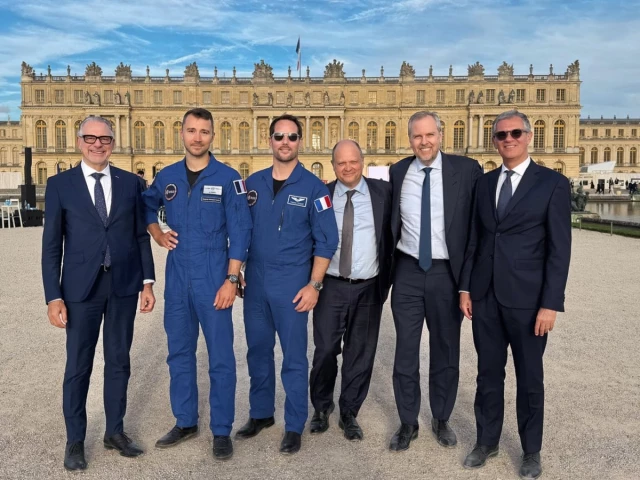
A historic partnership dedicated to advancing commercial human spaceflight. Thank you to France, @EmmanuelMacron, @CNES for your leadership, and to @ESA for its support as we work together toward two crewed missions in 2027.
— Vast (@vast) June 3, 2026
Photo taken at Choose France 2026 event on June 1,… pic.twitter.com/6OrAgT1FHG
Attractive prices
French astronaut Arnaud Prost is joining us on the crew of the inaugural mission of what will be the world’s first operational commercial space station when it launches next year”, Haot said.
On board Haven-1, Prost will be tasked with carrying out tests ahead of scientific experiments, which will be similar to those conducted on the ISS, he explained. The privately funded station will have a single module, compared to 16 currently on the ISS.
During its three years in orbit, it will “host four two-week missions”, Haot said. Vast has bigger plans for its replacement. Haven-2 will eventually have nine modules, but the company plans to deploy them gradually over time.
Read More: Pak astronauts undergoing training in China
This will mean the modules cost “five to 10 times lower” than those for the ISS, which often exceeded a billion dollars, Haot said.
“This will allow us to increase the number of crewed flights and offer more attractive prices to our customers,” he added. “We hope to launch three modules per year for our future station — and that at least one module will be launched by a European rocket.”
The company aims to have four modules in space by 2030, which would support six-month missions on board. Other US aerospace companies also have plans to launch commercial space stations, including Axiom Space and Amazon billionaire Jeff Bezos’s Blue Origin.
The California-based Vast, which was founded in 2021 by cryptocurrency billionaire Jed McCaleb, acknowledges it entered the race late. But the company now claims to be two years ahead of its rivals, citing contracts with NASA.
European HQ
Also on Tuesday, Vast announced a mission to send French astronaut Thomas Pesquet to the ISS next year. The company also plans to open its European headquarters in Paris.
For both new missions, Vast will use SpaceX’s Falcon 9 rockets and Dragon 2 capsule to get the astronauts into space. When asked about relying on billionaire Elon Musk’s company, Haot said SpaceX’s “unique” approach emphasised “speed and rocket reusability”.
Also Read: NASA Artemis II astronauts prepare to end moon mission in 'fireball' re-entry
“It’s a model for everyone, and it’s the future of space,” he said. “If SpaceX had not succeeded in creating Dragon, Vast would not exist. And the US and Europe would still be dependent on Russia to send humans into space.”
Despite many international cooperation agreements falling apart after Moscow invaded Ukraine in 2022, the US and other ISS partners have continued working with Russia on the space station.















This material may not be published, broadcast, rewritten, redistributed or derived from. Unless otherwise stated, all content is copyrighted © 2026 The Express Tribune.






COMMENTS
Comments are moderated and generally will be posted if they are on-topic and not abusive.
For more information, please see our Comments FAQ