Gold rises Rs2,400 ahead of US inflation data
Updated 3 hours ago

Petrol, diesel volumes fall 11.9%, 32.3% as Iran-US war drives prices up 59%

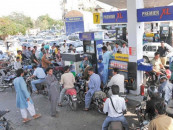
Pakistan's oil marketing companies (OMCs) recorded their sharpest monthly sales decline since November 2023 as elevated petroleum prices, driven by the Iran-US war, forced consumers to curb fuel consumption and restrict travel to essential needs.
"Elevated POL prices drove the sharpest volume decline since November 2023," noted Bazif Memon, Energy Sector Analyst at Optimus Capital Management. "Consistent weekly increase in petroleum prices likely left consumers with no option but to resort to only necessary use of petroleum products," he added.
According to a research report released by Optimus Capital Management, total petroleum product sales stood at 1.17 million tonnes in May 2026, reflecting a decline of 23.5% compared with the same month last year and 13.8% lower than April 2026. Excluding furnace oil, sales fell 21.3% year-on-year to 1.14 million tonnes.
The brokerage house attributed the sharp decline primarily to sustained increases in domestic fuel prices, which were linked to rising international oil prices amid the ongoing US conflict with Iran and ensuing broader uncertainty in global energy markets.
The decline marks one of the steepest contractions in petroleum demand witnessed over the past two and a half years and signals growing pressure on household and transport budgets.
In May 2026, motor spirit prices increased 59% year-on-year to an average of Rs402 per litre from an average of Rs253 per litre in the same period last year. Diesel prices increased to an average of Rs401 per litre, up 57% year-on-year, according to Myesha Sohail, who covers the energy sector at Topline Securities.
Motor spirit, commonly known as petrol, remained the largest contributor to industry sales, reaching 617,000 tonnes during May. However, volumes were still down 11.9% year-on-year. High-speed diesel, widely used in transport, agriculture and industry, recorded a much steeper fall of 32.3% to 455,000 tonnes. Furnace oil sales witnessed the steepest decline of 63.8% year-on-year and nearly 79% down on a monthly basis to just 29,000 tonnes.
Despite the weak monthly performance, cumulative industry sales during the first 11 months of FY26 reached 14.93 million tonnes, up 1.2% from the corresponding period of the previous fiscal year.
The report also highlighted a significant shift in consumer behaviour. As petroleum product prices climbed, motorists increasingly moved away from premium fuels and opted for cheaper alternatives. High Octane Blending Component (HOBC), commonly known as high-octane petrol, saw volumes collapse by 67% year-on-year during May.
"After the sharp surge in the prices of POL products, consumers naturally shifted to the cheaper alternative, MS," Memon noted.
Analysts say the trend reflects rising cost-consciousness among consumers, many of whom are attempting to manage transportation expenses amid persistent inflationary pressures.
Among major OMCs, Pakistan State Oil (PSO) maintained its dominant market position with sales of 518,000 tonnes during May. Although PSO's volumes declined 19.4% year-on-year, the company increased its overall market share to 44.2%, supported by gains in the diesel segment.
Attock Petroleum Limited (APL) reported sales of 97,000 tonnes, down 29.5% from a year earlier, while Wafi Energy recorded sales of 103,000 tonnes, a decline of 16.3%. Hascol Petroleum posted the steepest drop among major listed players, with sales falling 37% year-on-year to 34,000 tonnes.
Market share dynamics also shifted during the month. According to Optimus, only PSO and Wafi Energy managed to improve their diesel market shares, while GO Petroleum and Wafi Energy registered gains in the petrol segment.
The collapse in furnace oil demand was linked to increased availability of liquefied natural gas (LNG). Pakistan received four LNG cargoes during May, reducing the need for more expensive furnace oil-based power generation.Consequently, furnace oil volumes declined sharply on both a monthly and annual basis.
Looking ahead, Optimus Capital expects petroleum demand to remain under pressure as long as geopolitical tensions keep international oil prices elevated.
"Considering the volatile situation on the international front, petroleum prices are expected to remain elevated, compelling consumers to adopt conservative fuel consumption measures," Memon said. The brokerage expects continued year-on-year declines in both petrol and diesel sales in the coming months if current pricing trends persist.
The report suggests that unless international oil markets stabilise and domestic fuel prices ease, Pakistan's petroleum sector may continue to witness subdued demand as households and businesses adjust consumption patterns in response to higher energy costs.
The government has set a Petroleum Development Levy collection target of Rs1.47 trillion for FY26, of which Rs1.33 trillion (91%) has been collected in the first 11 months of the fiscal year, according to Sohail.








This material may not be published, broadcast, rewritten, redistributed or derived from. Unless otherwise stated, all content is copyrighted © 2026 The Express Tribune.








COMMENTS
Comments are moderated and generally will be posted if they are on-topic and not abusive.
For more information, please see our Comments FAQ