Pakistan, 13 other nations denounce Somaliland 'embassy' in occupied Jerusalem
Updated 1 hour ago

DPM says over $13b in MoUs and joint ventures have been signed through bilateral B2B engagements
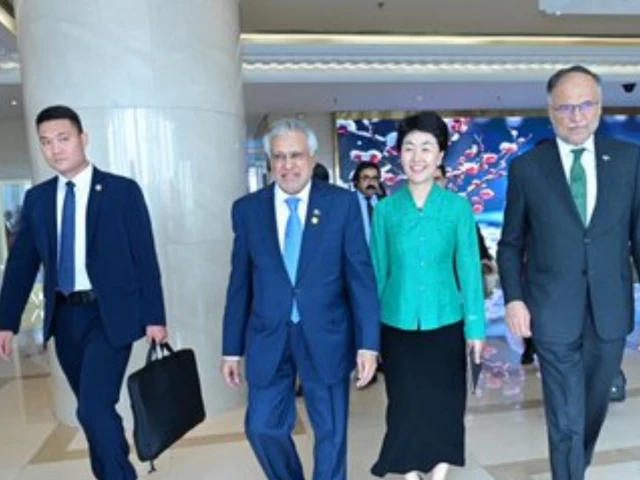
Deputy Prime Minister and Foreign Minister Ishaq Dar said Pakistan was “open for business” as he addressed the Pakistan-China B2B Investment Conference in Hangzhou, highlighting deepening economic cooperation between Islamabad and Beijing during Prime Minister Shehbaz Sharif’s official visit to China.
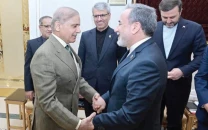
He arrived in Beijing along with Planning Minister Ahsan Iqbal for a series of high-level political and diplomatic engagements.
Addressing Chinese and Pakistani business leaders at the conference focused on information technology, telecom, battery energy storage systems and agriculture, Dar described the selected sectors as central to Pakistan’s “economic transformation and industrial modernisation”.
“Pakistan is open for business. Pakistan is reforming. Pakistan is rising,” he added.
Delighted to have arrived in Beijing, China, accompanied by Minister for Planning, Development & Special Initiatives, brother Ahsan Iqbal @betterPakistan.
— Ishaq Dar (@MIshaqDar50) May 24, 2026
We were warmly received at Beijing airport by Vice Minister of the International Department of the CPC Central Committee… pic.twitter.com/yStL12gQTC
Dar said more than 500 companies from both countries were participating in the conference, which he described as a reflection of the growing Pakistan-China business partnership.
The deputy prime minister said the government under Prime Minister Shehbaz had pursued a programme focused on economic revival, industrial expansion and sustainable growth, adding that Pakistan had achieved economic stabilisation over the past four years despite external challenges.
He further said the Ministry of Foreign Affairs had “fundamentally redefined its role” by placing economic diplomacy at the centre of Pakistan’s foreign policy. “Expanding B2B engagement with China is a powerful example of this new direction,” he said.
Highlighting progress in bilateral economic cooperation, Dar said Pakistan and China had organised two business-to-business conferences in China and two in Pakistan.
“Cumulatively, more than 300 MoUs and nearly three dozen joint ventures have been signed, with a total value exceeding 13 billion US dollars,” he said. “And we have obtained nearly 30% conversion rate from MoUs to agreements and contracts.”
He said the achievements were “not merely statistics” but reflected “trust, confidence, and shared ambition”.
Referring to recent developments in bilateral investment, Dar said the IBI Pakistan Digital Economy Headquarters had been established in Islamabad within eight months of discussions held in Beijing.
“Within less than eight months after Chairman Qian’s meeting with the prime minister in Beijing, IBI has established and started its operations,” he said, adding that the initiative had already resulted in MoUs worth more than $1 billion.
Deputy Prime Minister/ Foreign Minister Senator Mohammad Ishaq Dar @MIshaqDar50 delivered welcome remarks at the Pakistan–China B2B Investment Conference in Hangzhou, led by Hon’ble Prime Minister Muhammad Shehbaz Sharif @CMShehbaz and attended by the Governor of Zhejiang… pic.twitter.com/Rulyove8p2
— Ministry of Foreign Affairs - Pakistan (@ForeignOfficePk) May 24, 2026
Dar also highlighted an upcoming joint venture between Pakistan’s Servis Group and China’s Longstar Group, saying the Chinese company was preparing to establish a billion-dollar company in Pakistan.
“These achievements are the result of coordinated efforts across multiple Pakistani institutions under the guidance of the prime minister,” he said.
The foreign minister praised Pakistan’s Ambassador to China Khalil Hashmi and officials involved in organising the conference for their efforts in coordinating business matchmaking initiatives across Chinese cities and consulates.
Referring to Hashmi receiving the Chinese Government Friendship Award, Dar described it as recognition of the diplomat’s “invaluable contributions to strengthening Pakistan-China relations”.
The deputy prime minister said Pakistan viewed China’s economic diplomacy model as an example for its own institutions.
“What our Missions in China are doing is economic diplomacy in action,” he said, adding that the approach combined engagement, targeted outreach, strategic partnerships and measurable outcomes.
Read: PM Shehbaz arrives in Hangzhou on four-day official visit to China
Marking the 75th anniversary of diplomatic ties between Pakistan and China, Dar said the relationship had “stood the test of time, changing global realities, and regional challenges”. “Our iron brotherhood is growing stronger with each passing year,” he said.
He added that traditional government-to-government relations were now being reinforced by expanding business-to-business cooperation.
Quoting a Chinese proverb, Dar said: “A journey of a thousand miles begins with a single step.” “I must say the Chinese economic model of learning by doing, induction, and two years offers lessons for Pakistan. I am glad that we took that first step in Shenzhen two years ago,” he said. “And now, there is no looking back, only forward and upward.”
Meanwhile, PM Shehbaz is scheduled to meet Chinese President Xi Jinping and Premier Li Qiang during his four-day visit from May 23-26.
The prime minister is also expected to attend an event marking 75 years of diplomatic relations between Pakistan and China, meet executives of leading Chinese companies and visit the China Academy of Agricultural Sciences.
The Foreign Office said the visit would add “new dimensions” to Pakistan-China relations, particularly through enhanced cooperation between Pakistani and Chinese firms under Phase II of the China-Pakistan Economic Corridor (CPEC).
Read More: Shehbaz praises visionary leadership of China's Xi
Last month, President Asif Ali Zardari also completed a five-day visit to China, during which both countries signed multiple MoUs aimed at strengthening bilateral cooperation in desalination, agricultural technology, and the tea industry. This move is expected to boost investment, technology transfer, and economic ties between the two countries.
Earlier in January, Pakistan and China agreed to align their development strategies and build an upgraded version of the China-Pakistan Economic Corridor, known as CPEC 2.0, during wide-ranging talks in Beijing that also covered political ties, security cooperation and regional and international issues.
As part of their economic engagement, Pakistan and China agreed to develop an upgraded CPEC, a pioneering project of the Belt and Road Initiative.
The two sides said the new phase would focus on the key sectors of industry, agriculture and mining, promote the building and operation of Gwadar Port, ensure the smooth passage of the Karakoram Highway, and enhance Pakistan’s capacity for sustainable development.
They also agreed to deepen cooperation in trade and investment, information technology, science and technology, cybersecurity, technical and vocational training and education, and people-to-people and cultural exchanges.
The two sides stated that the year-round opening of the Khunjerab Pass would facilitate two-way trade and further strengthen people-to-people contacts. They also welcomed third-party participation in CPEC cooperation in accordance with the modalities agreed by both countries.







This material may not be published, broadcast, rewritten, redistributed or derived from. Unless otherwise stated, all content is copyrighted © 2026 The Express Tribune.








COMMENTS
Comments are moderated and generally will be posted if they are on-topic and not abusive.
For more information, please see our Comments FAQ