Chanel returns to growth as Blazy's designs attract shoppers
Updated 1 hour ago

At NAPA Repertory Festival, Kashif Hussain's play deeply touches audience, leaves it visibly unsettled
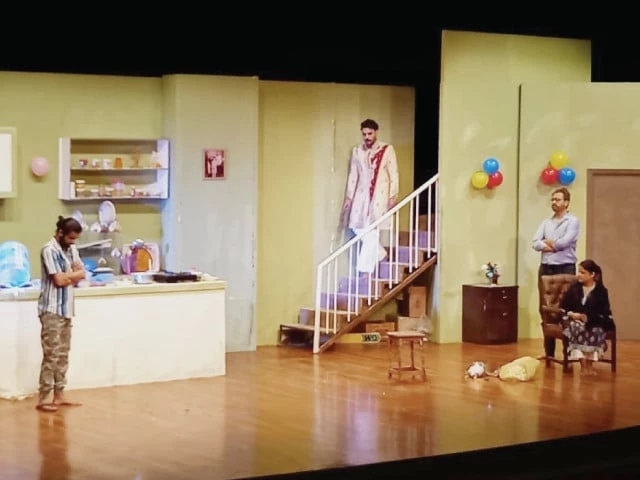
At the ongoing National Academy of Performing Arts Repertory Festival, one play in particular left audiences not only emotional, but visibly unsettled.
On the festival's 11th day, Zeest written and directed by Kashif Hussain was staged at the Zia Mohyeddin Theatre before a sizeable audience that responded with silence, tears and nervous laughter throughout the performance.
Unlike adaptations and revivals featured in the festival, Zeest stood out as the only original script in this year's repertory line-up.
The drama revolves around a couple trying to survive the emotional aftermath of their 15-year-old son's suicide. What initially appears to be a tragedy linked to teenage heartbreak slowly unfolds into a deeper commentary on emotional neglect, generational silence and the invisible psychological burden carried by young people.
Speaking with Express Tribune about the inspiration behind the play, Kashif Hussain said he had long wanted to understand why children as young as 13 or 14 choose to end their lives.
"I always wanted to talk about why 13, 14, 19-year-old kids commit suicide. What is happening in their lives that pushes them towards it?" he said.
According to Hussain, the story emerged from a real-life conversation with a neighbour, who once described a man in his locality that looked decades older than his age because of personal tragedy.
The neighbour later revealed that the man's 15-year-old son had died by suicide.
Hussain said the incident stayed with him deeply. The very next day, he wrote an initial draft inspired by the story and shared it with his collaborator.
What followed was a layered theatrical work that avoids easy blame. While the play hints at a romantic trigger behind the teenager's death, Hussain insists the real issue lies elsewhere.
"I did not want to show that the child committed suicide because of a girl alone. That can be a trigger point, but the real problem is the emotional pile-up inside the child."
Yet Zeest does not portray parents as villains either. Instead, it presents adults who are exhausted, emotionally unequipped and trapped within their own struggles.
"The father is helpless. The mother is helpless. Even the neighbour wants to help, but he is helpless too," Hussain explained. "Life is very absurd for me, and that is why I wrote it this way."
That absurdity appears repeatedly in the play through moments of uncomfortable comedy. One of the most talked-about characters, Murtaza, represents a familiar social figure someone casually discussing digestive issues or power outages while attending a funeral.
Hussain believes such behaviour reflects society's emotional contradictions.
"People laugh during tragedy. They continue with weddings, songs, daily routines. That is how life is," he said.
The director added that these comic moments were intentionally inserted so audiences could recognise themselves on stage.
"If you laugh at these moments, then perhaps you are laughing at yourself. I think that is healthy."
What makes Zeest particularly affecting is that it never turns into a lecture. Instead, it quietly exposes how silence inside homes can become dangerous, especially for teenagers struggling with emotions they cannot articulate.
Featuring performances by Kiran Siddiqui, Farhan Alam, Jibran Khan and Akthar Abbas, the play balances grief with dark humour a contrast that becomes central to its emotional impact.
By the end of the performance, the audience is left confronting a difficult question: when a young person breaks down completely, is the tragedy sudden or has it been building unnoticed for years?













This material may not be published, broadcast, rewritten, redistributed or derived from. Unless otherwise stated, all content is copyrighted © 2026 The Express Tribune.






COMMENTS
Comments are moderated and generally will be posted if they are on-topic and not abusive.
For more information, please see our Comments FAQ