Govt explores AIIB financing
Updated 1 hour ago

Sindh assigned Rs200b provincial target; Punjab, K-P, Balochistan to contribute rest

The centre on Monday urged all provincial governments to collect more than Rs400 billion in additional taxes in the new fiscal year, mainly from agriculture, services and real estate sectors, to meet a major condition of the International Monetary Fund (IMF).
With the provincial contribution, the total additional tax burden on the population under five different budgets would amount to more than Rs1.1 trillion. Of this, nearly Rs700 billion will come from the federal government through tax measures, enforcement actions and the petroleum levy. Finance Minister Muhammad Aurangzeb held a virtual meeting with provincial governments and shared their new net additional revenue targets for fiscal year 2026-27, according to government officials.
Almost half of the additional provincial target of Rs200 billion has been assigned to Sindh, followed by about Rs175 billion to Punjab, Rs45 billion to Khyber-Pakhtunkhwa (K-P) and nearly Rs20 billion to Balochistan. Sindh's target is higher than Punjab's because of revenue collected at seaports. The new targets are part of commitments with the IMF requiring the four federating units to generate extra taxes equal to 0.3% of GDP (about Rs430 billion). A similar amount will be generated separately by the federal government, excluding additional collection from the petroleum levy.
Cumulatively, all five governments will need to make additional revenue efforts of Rs1.1 trillion for FY2026-27, starting from July. The Federal Board of Revenue (FBR) is expected to contribute about Rs430 billion in extra tax efforts, the petroleum levy will add Rs260 billion in extra revenue, and the provinces will contribute more than Rs400 billion. The sources said that to facilitate the provinces, the FBR has begun sharing income tax and sales tax return information with them. The information will be extracted from the income tax returns and the sale tax returns.
For the current fiscal year, the IMF expects the provinces to generate at least Rs1.2 trillion in revenues, which must increase to at least Rs1.65 trillion under the new targets. However, the IMF's third staff?level report shows next fiscal year's provincial collection at nearly Rs1.95 trillion.
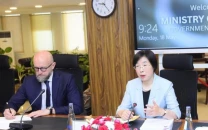
After the meeting, the finance ministry released pictures of"Federal Minister for Finance, Senator Muhammad Aurangzeb, holding a virtual meeting with provincial finance ministers to discuss economic and fiscal matters". The centre urged the Sindh government to improve its collection from the real estate and agriculture sectors. During the first nine months of this fiscal year, Sindh collected Rs21.4 billion in stamp duties, while Punjab collected Rs38 billion. The centre also pointed out low tax collection by Punjab from agricultural income tax. Punjab informed that it would expand the GST on services to 40 major cities, having collected Rs244 billion from services sales tax in the first nine months.
The IMF has noted that provincial tax revenues have been increasing well above nominal GDP growth rates, largely because of tax base expansion of GST on services and stronger enforcement. However, revenues from agricultural income tax fell short of expectations because of delays in applying revised rates and other implementation challenges, it added.
The IMF aims for higher provincial collection from sales tax on services, stamp duties, property tax, agricultural income tax and registration fees. Provinces will mobilise revenue by steadily expanding GST on services enforcement to gradually cover all sectors of the economy. New agricultural income tax rates will apply to this fiscal year's agricultural income, with the revenue impact materialising in the next fiscal year. The IMF report stated that analysis based on input?output tables suggests agriculture is the single largest undertaxed sector. Despite contributing 24.6% of value added, its effective tax rate is just 0.3%. In 2025, agricultural income tax rates were increased significantly to align with other income, but revenues remained below expectations due to implementation delays and enforcement challenges.
Where the effective tax rate on agriculture is 0.3%, the IMF said the effective tax rate on petroleum products is a staggering 166%. For the next fiscal year, the IMF has targeted petroleum levy collection at Rs1.727 trillion, about Rs260 billion higher than this year's target.
The finance minister also urged the provinces to work closely with the IMF to finalise their new budgets. Pakistan has assured the IMF that all provinces agree not to introduce any policy or action that could undermine any commitments or policies agreed with the lender. The finance minister further assured that his ministry would closely monitor economic developments and performance and stand ready to take additional measures as necessary to achieve programme objectives.
The provinces were informed that for the next fiscal year, the federal government has agreed with the IMF to deliver a primary budget surplus of Rs2.8 trillion, or 2% of GDP. The primary surplus is calculated after excluding interest payments, which are estimated at more than Rs7.8 trillion for the next fiscal year.
The government faces a huge revenue shortfall of about Rs1 trillion due to the FBR's poor performance. It is making up the shortfall through enforcement measures, higher petroleum levy collection and cuts in federal development spending. It is also seeking higher provincial cash surpluses to offset the impact of the FBR shortfall on the primary budget surplus.












This material may not be published, broadcast, rewritten, redistributed or derived from. Unless otherwise stated, all content is copyrighted © 2026 The Express Tribune.







COMMENTS
Comments are moderated and generally will be posted if they are on-topic and not abusive.
For more information, please see our Comments FAQ