Marka-e-Haq shattered Indian arrogance: Bhat
Updated 5 minutes ago

Strikes down respondent's Peshawar plot claim
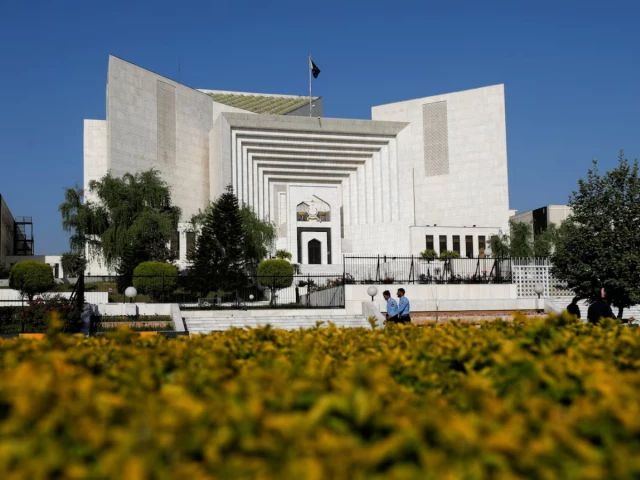
The Supreme Court has declared that property owned by a third person cannot be included as part of dower without the owner's clear consent.
The judgment came in a civil petition for leave to appeal against a March 22, 2024 decision of the Peshawar High Court (PHC). An SC three-member bench converted the petition into an appeal and partially allowed it.
The PHC had upheld concurrent findings of the family and appellate courts in favour of respondent Fozia Tabassum Afridi, in a case arising from a family dispute over a plot in Peshawar.
The lower courts had decreed her suit for recovery of dower, including Rs500,000 in cash, gold ornaments, and a one-kanal plot located in Peshawar. The controversy before the SC centered on whether the plot could validly be treated as part of dower.
The property was claimed by the petitionerFozai's father-in-lawwho claimed that he was the owner of the plot and had neither signed the Nikahnama nor consented to its inclusion in the dower.
According to the record, the marriage between Fozia and Sahibzada Muhammad Ali was solemnized on January 27, 2009, followed by rukhsati on April 25, 2009.
A document described as a "Kabeen Nama," allegedly executed on February 24, 2009, mentioned the disputed plot as part of the dower. The respondent relied on this document to support her claim. However, the petitioner categorically denied executing the Kabeen Nama and his alleged signatures as a witness.
The SC, in the verdict authored by Justice Musarrat Hilali, observed that once such denial was made, the burden of proof shifted to the respondent to establish the document's authenticity through cogent and legally admissible evidence.
The court found that the respondent had not discharged this burden. It noted that the Kabeen Nama was neither proved through direct evidence nor were the disputed signatures subjected to forensic examination.
The SC further highlighted a key inconsistency regarding the plot's ownership. While the Kabeen Nama suggested the husband owned the property based on a mutation entry, no documentary evidence supported this claim.
In contrast, revenue records presented through official testimony showed the petitioner as the recorded owner. The court reaffirmed the settled legal principle: a property owned by a third party cannot be made part of dower unless there is clear, unequivocal, and proven consent from the owner.
In this case, the court found that the petitioner was not a signatory to the Nikahnama, and the alleged subsequent consent through the Kabeen Nama also remained unproven.
It also noted legal infirmities in the lower courts' judgments, observing that they failed to properly appreciate material evidence and relied on assumptions rather than legally sound reasoning.









This material may not be published, broadcast, rewritten, redistributed or derived from. Unless otherwise stated, all content is copyrighted © 2026 The Express Tribune.















COMMENTS
Comments are moderated and generally will be posted if they are on-topic and not abusive.
For more information, please see our Comments FAQ