BLA’s nexus with Al-Qaeda, TTP fuelling terrorism and women exploitation in Balochistan
Updated 2 hours ago

Participants turn event into protest against marital rape, domestic violence, and the wider structures of patriarchy
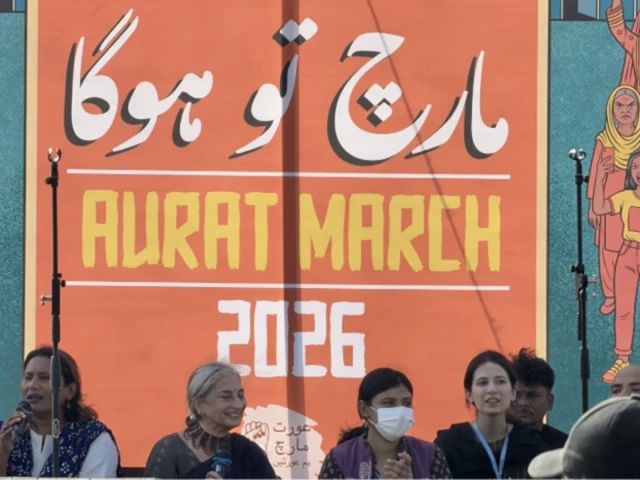
Aurat March returned to Karachi’s Sea View on Sunday despite state restrictions and political backlash, with participants turning the Mother’s Day gathering into a protest against marital rape, domestic violence, gendered violence, and the patriarchal expectations that continue to shape women’s lives both inside and outside the home, insisting their right to march “will not stop.”
Held on Mother’s Day under the theme “Good Girls”, this year’s march focused on generational trauma, motherhood, domestic labour, and the patriarchal expectations imposed on women from childhood.
Placards, speeches, chants, and performances transformed the beachside gathering into both a protest and a deeply personal reckoning with the roles women are expected to perform in Pakistani society.
The event came days after the Karachi district administration issued a 28-condition no-objection certificate (NOC) for the gathering, banning “objectionable clothing”, anti-state slogans, LGBTQ content, and speeches deemed against the “ideology of Pakistan.”
Organisers had condemned the conditions as an attempt to “control and dilute the politics of the march.” Earlier in the week, organiser Sheema Kermani and several activists were briefly detained outside the Karachi Press Club while protesting restrictions surrounding the event.
Yet by Sunday evening, chants of “Insaan hai aurat” and “Meri nahi toh kiski marzi” echoed across Sea View as hundreds gathered under banners questioning the societal obsession with creating “achi betiyaan” — good daughters.
Speaking to participants throughout the event, a recurring theme emerged: the belief that Aurat March has moved far beyond social media controversy and become a space where conversations once considered taboo are now publicly confronted.
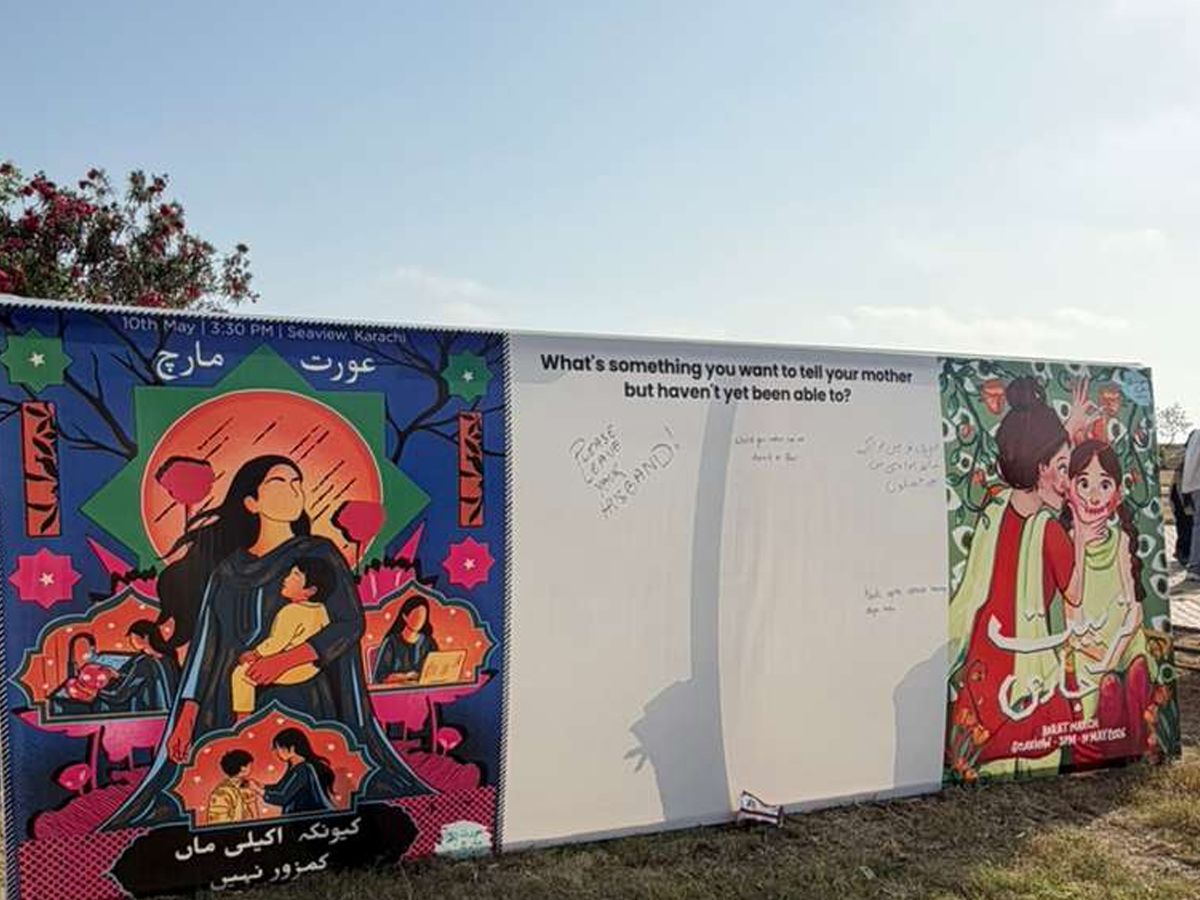
Photo: Author
One participant said the march had forced discussions around issues often ignored in mainstream discourse. “When we talk about the discussion of ‘good girls’ and the relationship of this title with motherhood, it’s in our patriarchal houses where we see this concept,” they said. “If a girl refuses to stay in those conditions, then suddenly she is no longer considered a ‘good girl’.”
Several participants also said the march had evolved over the years through growing youth participation, arguing that younger voices had helped push conversations beyond social media outrage and into public spaces.
“With growing time, we have seen young people joining us, and the importance of youth in politics is very important because we are the future,” one participant said. “Regarding this march, the media has always played a role in giving a narrative on the event because we make demands from the state and society, but people rarely highlight the actual speeches or discussions happening here.”
Also Read: Sindh govt suspends three police officers over Aurat March arrests
The participant added that motherhood itself remained heavily romanticised and imposed upon women. “Patriarchy has romanticised motherhood — that if you are a woman, you must become a mother. But what if a woman doesn’t want to give birth? What if she doesn’t want motherhood? That should also be an individual choice.”
Others pointed to violence against women as an issue that still received insufficient attention despite years of activism. One male participant attending the march said he joined because “there is no difference between women and men when it comes to basic humanity.”
“More than 7,500 women have been killed in the past four years, including around 1,500 honour killings,” he said, citing violence statistics discussed at the event. “If we talk about harassment, workplace abuse, domestic violence — these numbers are everywhere, but society still normalises them.”
Another attendee said witnessing the experiences of his sisters motivated him to participate. “I personally believe that I have four sisters and I know the sorrow they go through every day,” he said. “Women face backlash constantly for simply existing. Speaking up for women is basic empathy.”
“The march will continue.”
The slogan became the defining refrain of the evening after organiser Sheema addressed the crowd from the main stage.
“At first we thought: should we not do the march?” she said. “Then we thought — why not? It is our right.”
Referencing the mounting criticism and restrictions placed on the gathering, Kermani declared that the movement would continue regardless of pressure.
“For eight years of struggle, where we have reached today, we will keep going forward,” she said. “We will not stop. Just like our slogan says: the march will continue.”
Sheema repeatedly framed the gathering not as an organisational campaign but as a grassroots movement born from women’s everyday frustrations.
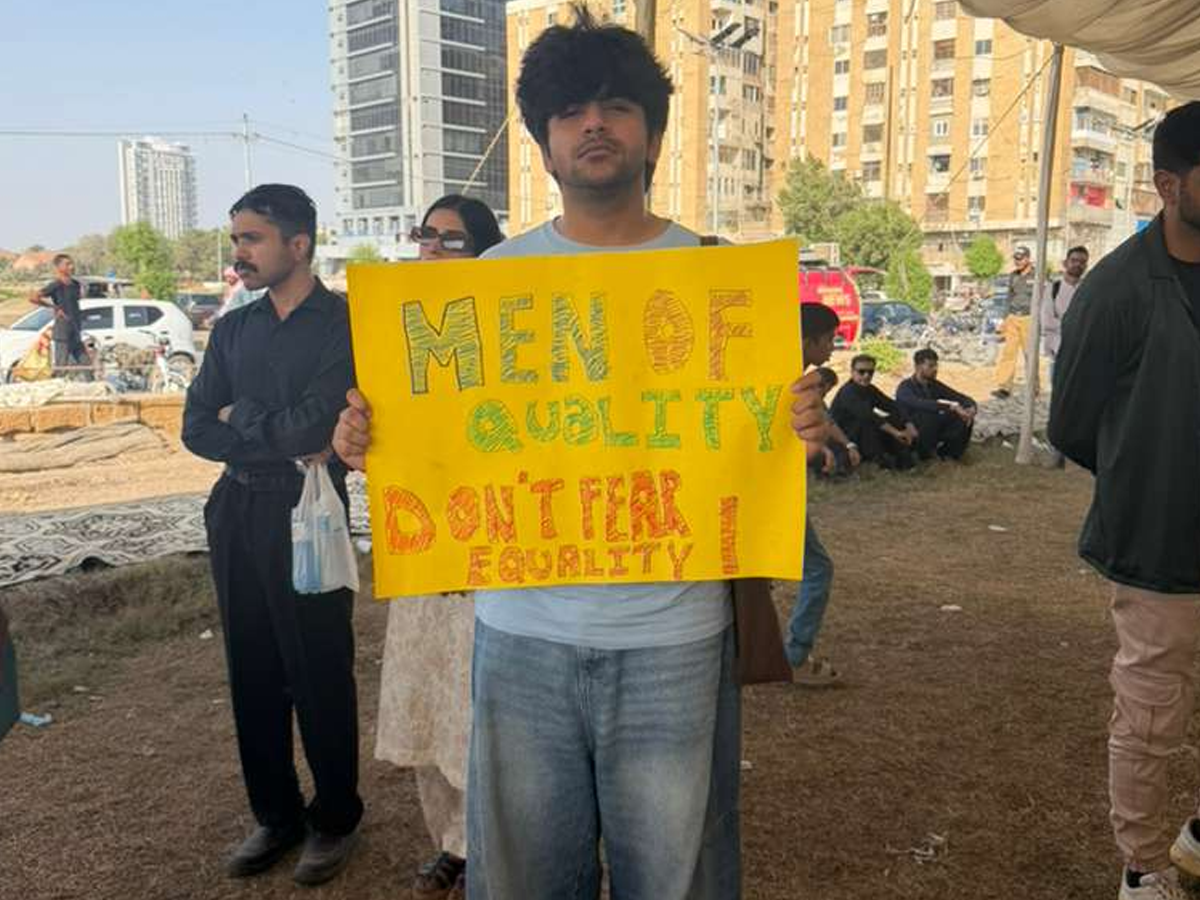
Photo: Author
“We are not an NGO. We are not a registered organisation,” she said. “We are an organic movement. Some women got together and said we are tired of the struggles we face daily — what happens to me, my sister, my loved one, women in my neighbourhood. We do not accept this.”
She also directly responded to narratives surrounding foreign funding and accusations frequently levelled against the march.
“Standing here in front of the sea, I am telling you these are lies,” she said. “We get no outside funding. We simply came together because women have had enough!”
Her speech also addressed the recent police action against organisers.
“My first demand from this state and government is to give women safety and security,” she said. “We were legally going to the press club for a conference, and we demand a public apology.”
Beyond speeches, the march’s visual symbolism reflected the theme of invisible labour and violence inside homes.
One participant held a placard reading “Apna khana khud banao” — cook your own food, referencing cases where women have been assaulted or killed over domestic expectations.
“People make fun of this slogan, but it’s not funny,” the participant said. “A simple search shows countless stories of women being killed because food was late, cold, or not prepared on time.”
The participant described domestic labour as one of the most overlooked forms of gendered exploitation in Pakistan.
“Women are expected to perform labour for free, 24/7, without rest,” they said. “And when they refuse or cannot do it, it can put their lives at risk.”
Read More: Aurat March organiser, activists briefly detained outside KPC
Another emotional speech came from the sister-in-law of Shanti, a woman who was married young, raped, and later died from the violence of her husband.
“If this is happening with Shanti, it will continue happening to all mothers,” she told the crowd. “We teach our daughters that after marriage, they cannot say no, that they must keep the household together even if it destroys them.”
For many attendees, the event also represented resistance against fear itself.
Several participants acknowledged that religious, political, and social backlash had affected who chooses to publicly attend Aurat March. But many insisted the criticism had not weakened participation so much as intensified conviction among those who continue to show up.
“The fear has always existed,” one attendee said. “But if we want to stand for something, we have to leave our comfort zone. We are not crossing religious boundaries. Marching and demanding rights is constitutional.”
Participants also spoke about the constant misinterpretation of Aurat March slogans, particularly “Mera jism, meri marzi.”
“As a gender minority, I’ve always been told what to do with my body,” one attendee said. “If it’s my body, then it should be my choice.”
They linked the slogan directly to recent police handling of activists. “Our bodies were mishandled without our consent during the press conference incident,” they said. “That itself proves why these slogans matter.”
Others argued that social media had distorted the public perception of the movement by reducing complex conversations into viral outrage.
“The media often ignores the actual speeches and demands,” one participant said. “People only focus on controversy.”
Read: Aurat March announces Karachi event on May 10 at Seaview
Still, by sunset, the atmosphere at Sea View remained positive as participants sang songs, shared emotional stories, and raised slogans beside the sea, reclaiming both public space and political voice.
For organisers and attendees alike, this year’s Aurat March was not only about protest, but about refusing silence in a climate increasingly hostile to dissent.
And as chants carried, the message repeated throughout the evening remained clear: the march, despite everything, would continue.









This material may not be published, broadcast, rewritten, redistributed or derived from. Unless otherwise stated, all content is copyrighted © 2026 The Express Tribune.






COMMENTS (2)
Comments are moderated and generally will be posted if they are on-topic and not abusive.
For more information, please see our Comments FAQ