Fed holds rates steady amid sharp divide
Updated 1 hour ago

DG calls $6tr in minerals claim exaggerated, Barrick pauses review until mid-2027
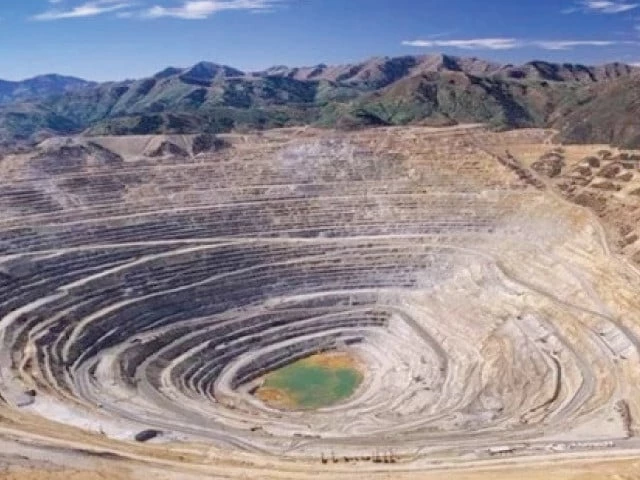
The European Investment Bank (EIB) on Wednesday showed interest in the multibillion-dollar Reko Diq mining project in return for securing a share of critical resources, as Pakistan's director general of minerals said the claim of having $6 trillion in mineral reserves was "highly exaggerated".
"The $6 trillion is a highly exaggerated figure, which is not based on proper exploration studies but we have vast minerals," said Dr Nawaz Ahmed Virk, Director General (DG) of Minerals at the Ministry of Energy.
Virk was speaking at a session on mining and responsible resource partnerships for Europe and Pakistan during the second day of the EU-Pakistan Business Forum. The $6 trillion worth of mineral reserves have been pitched by the country's leadership as a long-term solution to Pakistan's debt and economic problems.
Dr Virk further said that contractors are also raising the issue of imposition of sales tax and withholding tax during the development phase of the Reko Diq project. Pakistan has exempted the income of the Reko Diq project from any types of taxes to make it attractive for foreign investors. In his remarks, the DG said his ministry was working with the Finance Division on the general sales tax and withholding tax issues and was hopeful that the Finance Division would agree to defer these taxes until production begins.
Marco Arena, an official of the EIB, said his institution was keen to invest in the enabling infrastructure of the Reko Diq mines. But he also said that the European Union should also get a share of the supplies. "Of course, we don't expect that the entire off?take goes to Europe, that's unthinkable in an interconnected world. But having a strong connection to the European market is key, and the European Investment Bank supports critical minerals, which would enable Europe to secure critical mineral supplies for their green transition and digital transition, which are ultimately very important for European competitiveness," said Arena.
The EIB has recently finalised 160 million agreements with Pakistan to fund water and housing projects – its first in over a decade. Arena said the EIB's commitment in Pakistan goes back a long way, but there was a bit of a hiatus since 2015. "There is a real interest in this region, from the European Commission and the EIB, to engage with Pakistan, including in the mineral sector," he added.
The EIB official further said that engineering was the easiest part in mining, but often the greater risks are around policies, regulation and stability. "In terms of regulation, we see that regulation should be predictable, and a lot of steps have been taken by Pakistan and other countries in that direction. Also, counter?enforceability is very important, as are currency risks," he added. The evidence from mines and critical materials projects around the world shows that when these risks are actually tackled, not just on paper, but in reality, the project becomes successful, said Arena. "We try actually to invest in projects that do take all these issues into consideration," he added.
Despite the country's top priority, Barrick Gold this month paused the implementation of the Reko Diq mining project. In a statement issued early this month, Barrick Gold said that on February 5, 2026, the company announced that it was reviewing all aspects of the project in light of the escalation of security risks and increased security incidents.
"Following the preliminary findings of the review and the further escalation of security issues in Pakistan and the region, the company considers it necessary to slow the development activity and continue the project review until mid?2027," according to Barrick Gold. It added that the continued review will allow the company to assess in a comprehensive manner the evolving security situation, capital requirements, project financing, project scope and timeline. While development activity will be slowed, the project will remain under active management with a reduced capital spend. Development of Phase 1 of the Reko Diq project was approved on this basis, according to the announcement. Barrick Gold said it was anticipating that there could be significant increases to the previously disclosed total estimated capital budget and timeline for the project.
The previously disclosed total estimated capital cost of Phase 1 was between $5.6 billion and $6 billion, exclusive of capitalisation of financing costs. The second phase cost had been estimated between $3.3 billion and $3.6 billion, exclusive of capitalisation of financing costs, with first production targeted by the end of 2028.
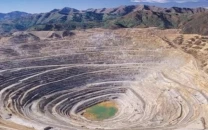
One of the largest undeveloped copper?gold projects in the world, Reko Diq is owned 50% by Barrick, 25% by three federal state?owned enterprises, and 25% by the government of Balochistan.










This material may not be published, broadcast, rewritten, redistributed or derived from. Unless otherwise stated, all content is copyrighted © 2026 The Express Tribune.




COMMENTS
Comments are moderated and generally will be posted if they are on-topic and not abusive.
For more information, please see our Comments FAQ