Iranian Nobel laureate Narges Mohammadi discharged from hospital and sent home, family say
Updated 2 hours ago

US no longer in a position to dictate policy to independent nations: Iranian deputy defence minister
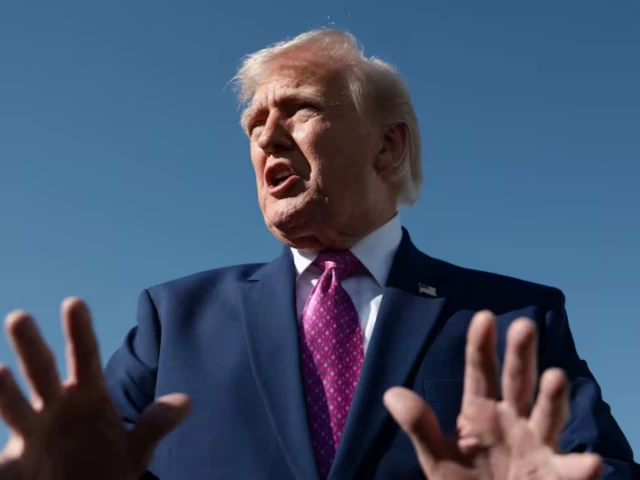
United States President Donald Trump on Tuesday said Iran has informed the US that it was in a “state of collapse” and had asked for the “opening of the Hormuz Strait as soon as possible”.
In a post on his Truth Social platform, Trump claimed that Iran made the request as it sought to address its leadership situation, adding that he believed it would be able to do so.
Qatar supports Pakistani mediation, calls for diplomatic end to regional crisis
According to Al Jazeera, Qatar’s Foreign Ministry spokesperson Dr Majed Mohammed al-Ansari said that their position has been "clear from day one" that "any conflict in the region should be solved on the negotiation table," and supported Pakistan's role in mediation efforts.
"We do not need to expand the circle of negotiations. We support Pakistani mediation,” he said. He added that they are engaging with all their respondents over reopening the Strait of Hormuz in a press briefing, according to Al Jazeera.
“We believe it should have never been closed and it should be opened immediately regardless of other considerations going on in the region,” he said. “We are, as I said, supportive of this and has always been in coordination with all its partners regionally and beyond over that issue. We remain in full solidarity with Pakistan in their goal as mediator."
The spokesperson added that Doha would favour a “comprehensive deal” to end the conflict, following a question about reports that Iran wants to decouple the Strait of Hormuz talks from nuclear discussions.
Al-Ansari stressed that Qatar’s main concern was regional security, as Iran’s attacks on regional US bases have called regional stability in question.
The Strait of Hormuz should not be used as a pressure card, he said, adding that the act of blocking navigation cannot be justified.
BREAKING: Qatar's foreign ministry spokesman Majed Al Ansari says the Strait of Hormuz should not be used as a pressure card, and the act of blocking navigation cannot be justified.
— Al Jazeera English (@AJEnglish) April 28, 2026
🔴 LIVE updates: https://t.co/1QqkVEVfFS pic.twitter.com/9zfosHbvnk
US no longer in a position to dictate policy to independent nations
Iran’s deputy defence minister said the US can no longer “dictate” what other countries do as Washington reviews Tehran’s new proposal.
“The US is no longer in a position to dictate its policy to independent nations,” Reza Talaei-Nik was quoted as saying by state TV, according to Al Jazeera.
Talaei-Nik said Washington would have to “accept that it must abandon its illegal and irrational demands”.
Al Jazeera reported that the spokesperson also said that Iran was ready to share its defensive weapons capabilities with “independent countries, especially members of the Shanghai Cooperation Organisation (SCO)”, Iran’s Deputy Defence Minister Reza Talaei-Nik was quoted as saying by state media.
“We are ready to share the experiences of America’s defeat with other members of the organisation,” Talaei-Nik said during a meeting of SCO defence ministers held in Kyrgyzstan, according to Al Jazeera.
The Iranian official recently held talks with Russian and Belarusian defence personnel, who stressed their willingness to continue cooperating with Tehran
Iran has right to control Strait of Hormuz: Russian ambassador to UN
Iran has "every right" to limit traffic and control the Strait of Hormuz, Russia’s ambassador to the UN Vassily Nebenzia said, while also accusing Western countries of hypocrisy and piracy.
“There was an attempt to pin full responsibility on Iran as if it was Iran which attacked its neighbours,” he said, according to Al Jazeera.
“In times of war, a coastal state that is under attack may limit navigation in its territorial waters for security.”
Nebenzia then compared Western states to pirates, calling out the European countries supporting Ukrainian strikes on Russian trade vessels in the Black Sea, according to Al Jazeera.
“Unlike pirates who raise their black flags with a skull and crossbones in their vessels, Western countries are attempting to conceal their lawless actions with references to unilateral coercive measures.”
Gulf leaders to meet in Saudi Arabia to discuss response to Iranian strikes
Saudi Arabia will host a meeting of the Gulf Cooperation Council in Jeddah on Tuesday, the first in-person meeting of Gulf leaders since their states became a front in the US-Israeli war on Iran two months ago.
A Gulf official, speaking on condition of anonymity, said the meeting aimed to craft a response to the thousands of Iranian missile and drone attacks Gulf states have faced due to their countries harbouring US military bases.
The war has seen key energy infrastructure in all six GCC states damaged, with US-linked firms and other civilian infrastructure, as well as military installations, also targeted.
Attacks have subsided since the US and Iran entered a ceasefire on April 8, though Gulf capitals remain wary of resumed conflict, with US-Iran talks for a permanent deal to end the conflict so far inconclusive.
Qatar's emir, Kuwait's crown prince, Bahrain's king and the United Arab Emirates' foreign minister arrived in Jeddah to attend the summit, Saudi state media reported. It was unclear who would represent Oman, the remaining member of the GCC, along with Saudi Arabia, which hosts the council's headquarters.
The GCC has faced some criticism from the UAE over what it said has been an inadequate response to the war.
"It is true that, logistically, the GCC countries supported each other, but politically and militarily, I think their position was the weakest in history," senior UAE official Anwar Gargash told a conference in the UAE on Monday.
"I expected such a weak position from the Arab League, and I am not surprised by it, but I have not expected it from the GCC, and I am surprised by it."
Trump not happy with latest Iran proposal to end the war, US official says
US President Donald Trump is unhappy with the latest Iranian proposal on resolving the two-month US-Israeli war on Iran, a US official said, dampening hopes for a resolution to the conflict that has disrupted energy supplies, fuelled inflation, and killed thousands.
Iran's latest proposal would set aside discussion of Iran's nuclear program until the war is ended and disputes over shipping from the Gulf are resolved.
That is unlikely to satisfy the US, which says nuclear issues must be dealt with from the outset, and Trump was unhappy with Iran's proposal for that reason, a US official briefed on the president's Monday meeting with his advisers said, speaking on condition of anonymity.
White House spokeswoman Olivia Wales said the US "will not negotiate through the press" and has "been clear about our red lines" as the Trump administration looks to end the war on Iran, which began when US-Israeli strikes hit military and civilian centres, killing around 168 schoolchildren in a strike on a school.
A previous agreement in 2015 between Iran and multiple other countries, including the US, sharply curtailed Iran's nuclear program, which it has long maintained is for peaceful, civilian purposes. But Trump unilaterally withdrew from it in his first term in office.
Hopes of reviving peace efforts have receded since the US president scrapped a visit to Islamabad last weekend by his special envoy, Steve Witkoff, and son-in-law, Jared Kushner. In this Pakistani capital, Iranian Foreign Minister Abbas Araghchi shuttled in and out twice during the weekend.
Read: Trump dents peace talks, but truce may hold
Araghchi also visited Oman and on Monday went to Russia, where he met President Vladimir Putin and received words of support from a longstanding ally.
Oil prices rise again
With the warring sides still seemingly far apart, oil prices resumed their upward march, extending gains in early Asia trade on Tuesday.
"For oil traders, it's not the rhetoric that matters any more, but the actual physical flow of crude oil through the Strait of Hormuz, and right now, that flow remains constrained," Fawad Razaqzada, market analyst at City Index and FOREX.com, said in a note.
At least six tankers loaded with Iranian oil have been forced back to Iran by the US blockade in recent days, ship-tracking data showed, underscoring the war's impact on traffic.
Iran's foreign ministry condemned US seizures of Iran-linked tankers as "outright legalisation of piracy and armed robbery on the high seas", in a social media post.
Between 125 and 140 ships usually crossed in and out of the strait daily before the war, but only seven have done so in the past day, according to Kpler ship-tracking data and satellite analysis from SynMax, and none of them was carrying oil bound for the global market.
Read more: Iran signals cautious openness to dialogue
With his approval ratings falling, Trump faces domestic pressure to end a war for which he has given the US public shifting rationales.
Araghchi told reporters in Russia that Trump had requested negotiations because the US has not achieved any of its objectives.
Senior Iranian officials, speaking on condition of anonymity, told Reuters the proposal carried by Araghchi to Islamabad over the weekend envisioned talks in stages, with the nuclear issue to be set aside at the start.
A first step would require ending the US-Israeli war on Iran and providing guarantees that the US cannot start it up again. Then negotiators would resolve the US Navy's blockade of Iran's trade by sea and the fate of the Strait of Hormuz, which Iran aims to reopen under its control.
Only then would talks look at other issues, including the current dispute over Iran's "nuclear program", with Iran still seeking US acknowledgement of its right to enrich uranium.










This material may not be published, broadcast, rewritten, redistributed or derived from. Unless otherwise stated, all content is copyrighted © 2026 The Express Tribune.






COMMENTS (2)
Comments are moderated and generally will be posted if they are on-topic and not abusive.
For more information, please see our Comments FAQ