Storm leaves boy dead, five injured
Updated 18 hours ago

Three-coach e-vehicles to traverse busiest Lahore route
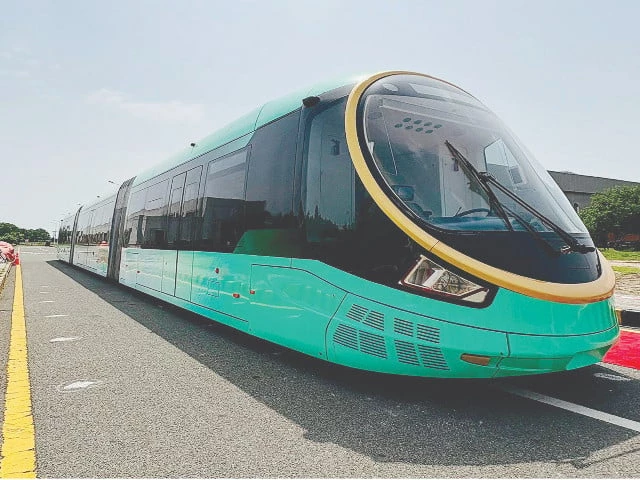
The Punjab government has approved the rollout of an Automated Rapid Transit (ART) system in Lahore, marking the revival of the project that has faced delays since its announcement last year.
Officials said the decision, cleared by Chief Minister Maryam Nawaz Sharif, sets the stage for the system to become operational by June at an estimated cost of around Rs6 billion.
The move comes months after authorities unveiled plans for trackless electric transit as part of a broader five-year mobility strategy.
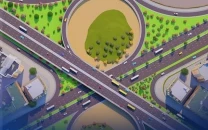
The ART corridor will run from Central Business District (CBD) Kalma Chowk to Istanbul Chowk, traversing some of the city's busiest arteries, including Gulberg Main Boulevard and Jail Road and canal route. Transport planners describe the alignment as a high-demand urban spine, where congestion and travel delays have long been a concern for commuters.
At its core, the system will deploy three-coach electric vehicles capable of carrying up to 270 passengers per trip. Services are expected to operate at intervals of 15 to 20 minutes, with an estimated daily ridership of around 18,000 passengers in the initial phase.
Authorities confirmed that vehicles for the project will be supplied by the China Railway Rolling Stock Corporation (CRRC), while operations will be handled by a local transport company under a public-private framework. The trains are designed to function without conventional rail tracks, relying instead on guided, rubber-tired technology - an approach already in use in parts of Asia.
The latest development follows earlier efforts to introduce a similar system under a pilot electric tram project.
In July last year, Punjab officials showcased a Chinese-imported, three-compartment tram assembled in Lahore, capable of carrying more than 200 passengers and running fully on electric power. That initiative, tested along Canal Road and other corridors, laid the groundwork for the ART system now moving toward execution.
Officials say the ART network will build on those trials but with a more structured route, higher passenger capacity, and integrated station infrastructure. The system is expected to run on a fully electrified model supported by solar-powered charging stations, helping reduce dependence on fossil fuels and emissions.
"The project is designed to deliver faster, cleaner and more efficient travel," a senior transport official said, adding that it could also ease pressure on existing systems such as the Metro Bus and Orange Line.
The rollout is part of a provincial plan to expand modern transit solutions. Authorities have indicated that ART services could eventually be extended to Faisalabad and Gujranwala, though timelines remain contingent on the success of the initial phase.
Authorities appear focused on meeting the approaching deadline as urban centres grapple with rising population density and worsening traffic congestion.
The system would mark the country's first large-scale deployment of trackless electric mass transit - positioning Lahore alongside cities in the United Arab Emirates, Malaysia and Qatar that have adopted similar technologies.






This material may not be published, broadcast, rewritten, redistributed or derived from. Unless otherwise stated, all content is copyrighted © 2026 The Express Tribune.



COMMENTS (3)
Comments are moderated and generally will be posted if they are on-topic and not abusive.
For more information, please see our Comments FAQ