EU says Ebola infection risk in bloc remains 'very low' despite Africa outbreak concerns
Updated 1 hour ago

'I spoke with Bibi and he’s going to low-key it. I just think we have to be sort of a little more low-key,' he says
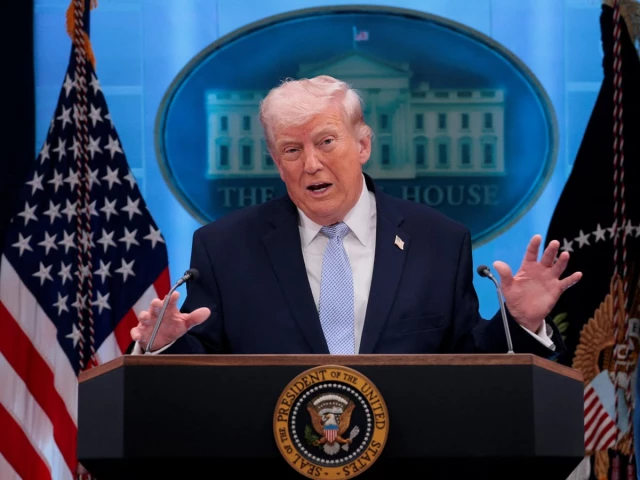
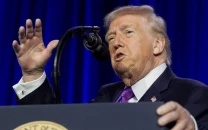
United States President Donald Trump said on Thursday that he asked Israeli Prime Minister Benjamin Netanyahu to reduce strikes on Lebanon, and was assured that Israel would be "scaling back" operations.
"I spoke with Bibi and he’s going to low-key it. I just think we have to be sort of a little more low-key,” Trump said during a brief telephone interview with NBC News.
The president announced a two-week ceasefire on Tuesday with Iran after more than one month of war that rapidly spread across the region. Delegations from the US and Iran are slated to convene Saturday for negotiations in Islamabad that seek to broker a definitive end to the conflict.
Trump said he is “very optimistic” that a peace deal will be struck.
The president struck an upbeat note ahead of the meeting, saying Iran's leaders “talk much differently when you’re at a meeting than they do to the press. They’re much more reasonable".
“They’re agreeing to all the things that they have to agree to. Remember, they’ve been conquered. They have no military," he told NBC. “If they don’t make a deal, it’s going to be very painful."
The Israeli military escalated attacks across Lebanon despite the two-week Washington-Tehran ceasefire brokered by Pakistan.
Israel carried out one of its largest strikes in Lebanon on Wednesday since launching a military offensive against Hezbollah early last month. The attacks have killed at least 254 people and wounded 1,165, according to Lebanon’s Civil Defence.
The escalation has raised concerns about a potential renewed Israeli occupation of southern Lebanon, possibly extending to the Litani River.
Israel wants to start peace talks with Lebanon 'as soon as possible'
Meanwhile, Netanyahu said that he has instructed to begin peace talks with Lebanon that would also include the disarmament of Hezbollah.
"In light of Lebanon's repeated requests to open direct negotiations with Israel, I instructed the cabinet yesterday to start direct negotiations with Lebanon as soon as possible," Netanyahu said in a statement. "The negotiations will focus on disarming Hezbollah and establishing peaceful relations between Israel and Lebanon."
There was no immediate response from the Lebanese government to Netanyahu's remarks.
An hour before Netanyahu’s statement, Lebanese President Joseph Aoun said: “The only solution to the situation in Lebanon is to achieve a ceasefire between Israel and Lebanon, followed by direct negotiations between them.”
He said he was working on a diplomatic track on this matter that was starting to be seen “positively” by international actors.
Israel launched a renewed offensive against Hezbollah after the group began firing at Israel on March 2. Israeli strikes have killed around 1,700 people and uprooted more than a million people, according to Lebanese authorities.
At least 400 Hezbollah fighters have been killed, according to sources familiar with the group, which has fired hundreds of rockets and drones at Israel.
PM Shehbaz strongly condemns Israel’s ongoing aggression in call with Lebanese premier
Meanwhile, Prime Minister Shehbaz Sharif strongly condemned Israel's ongoing aggression against Lebanon that threatens the ceasefire between the United States and Iran.
In a statement on his X account, the premier said he spoke with Lebanon's PM Nawaf Salam.
"I strongly condemned Israel’s ongoing aggression against Lebanon and offered condolences over the loss of thousands of precious lives in Lebanon as a result of these hostilities.
"I reaffirmed Pakistan’s commitment to advance peace efforts, including facilitating dialogue through the upcoming Iran–US talks in Islamabad."
He said he was grateful to PM Salam, who expressed his "appreciation for Pakistan’s peace efforts and underscored the need for our continued support" in securing an immediate end to the attacks targeting Lebanon and its people.
I spoke with Prime Minister Nawaf Salam of Lebanon, this evening.
— Shehbaz Sharif (@CMShehbaz) April 9, 2026
I strongly condemned Israel’s ongoing aggression against Lebanon and offered condolences over the loss of thousands of precious lives in Lebanon as a result of these hostilities.
I reaffirmed…
Earlier, Iran's President Masoud Pezeshkian said that the Israeli strikes on Lebanon violated the ceasefire agreement and would render negotiations meaningless, adding Iran would not abandon the Lebanese people.
In a post on X, he strongly condemned Israel’s renewed military actions in Lebanon, calling them a “blatant violation” of the original ceasefire agreement and a “dangerous sign” of bad faith in diplomatic efforts.
تجاوز دوباره رژیم صهیونیستی به لبنان نقض آشکار توافق اولیه آتشبس است. این نشانه خطرناکی از فریب و عدم پایبندی به توافقات احتمالی است. تداوم این اقدامات، مذاکره را بیمعنا خواهد کرد. دستهای ما بر ماشه باقی است. ایران هرگز خواهران و برادران لبنانی را تنها نخواهد گذاشت. https://t.co/T3Wy3qBqcE
— Masoud Pezeshkian (@drpezeshkian) April 9, 2026
His comments come after Israel carried out its heaviest strikes on Lebanon since the conflict with Hezbollah broke out last month, killing more than 250 people on Wednesday.
Meanwhile, the Israeli prime minister says Israel would keep hitting Hezbollah “wherever necessary”, a day after deadly Israeli strikes pummelled Lebanon, according to Al Jazeera. “We are continuing to strike Hezbollah with force, precision, and determination,” Netanyahu said in a post on X
אנחנו ממשיכים להכות בחיזבאללה בעוצמה, בדיוק ובנחישות.
— Benjamin Netanyahu - בנימין נתניהו (@netanyahu) April 9, 2026
בביירות חיסלנו את עלי יוסף חרשי, מזכירו האישי של מזכ״ל ארגון הטרור חיזבאללה נעים קאסם ואחד האנשים הקרובים אליו ביותר.
במקביל, הלילה תקף צה״ל שורת תשתיות טרור בדרום לבנון: מעברים ששימשו להעברת אלפי אמצעי לחימה, רקטות… pic.twitter.com/tKGuRJKBIE
“Our message is clear: anyone who acts against Israeli civilians – we will strike them. We will continue to hit Hezbollah wherever necessary, until we fully restore security to the residents of the north" of Israel, he added.
Israel bombed more infrastructure in Lebanon on Thursday, putting the Middle East ceasefire in further jeopardy after its biggest attacks of the war on its neighbour killed more than 250 people and threatened to torpedo the Pakistan-brokered US-Iran truce from the outset.
Iranian negotiators were expected to set off later on Thursday for Pakistan for the first peace talks of the war, where they are due to meet a delegation led by US Vice President JD Vance on Saturday.
But there was no sign Iran had lifted its blockade of the Strait of Hormuz, which has caused the worst disruption to global energy supplies in history, and Tehran said there would be no deal as long as Israel was striking Lebanon.
The supply shortage drove the price that European and Asian refineries were paying for a physical barrel of oil to record levels near $150 a barrel, with even higher prices for some products such as jet fuel.
Read: Truce under strain as Israel plays spoiler
Israel, which invaded Lebanon last month in parallel with the war on Iran to root out the armed group Hezbollah, Tehran's ally, says its actions there are not covered by the ceasefire announced late on Tuesday by US President Donald Trump.
Washington has also said Lebanon is not covered by the truce, but Iran and Pakistan, which acted as mediators, say it was explicitly part of the deal.
A host of countries, including prominent US allies Britain and France, said the truce should extend to Lebanon and condemned Israel's attacks on the country.
A Pakistani source with knowledge of the discussions said Pakistan was working on ceasefires for Lebanon and Yemen: "It will be discussed during the (upcoming) talks and we will settle it."
Pakistan shares view that ceasefire must include Lebanon: Former ambassador
Pakistan’s former ambassador to the United Nations, Maleeha Lodhi, has told Al Jazeera that Pakistani understanding of the US-Iran ceasefire is the same as Iran’s – Lebanon is meant to be included.
“In the run-up to this ceasefire, Pakistani officials had specifically asked their American counterparts whether they would be able to rein in or restrain Israel, and we were given the assurance that the Americans would do that,” Lodhi said to Al Jazeera.
Israel’s latest deadly attacks in Lebanon have created even more concern in Islamabad about the ceasefire’s fate and how Iran will react, she added.
For now, an Iranian delegation is still expected in Islamabad later today for talks, although it is unclear who will lead it, according to Al Jazeera.
“I think there is a lot of uncertainty created by Israel’s actions,” Lodhi said.
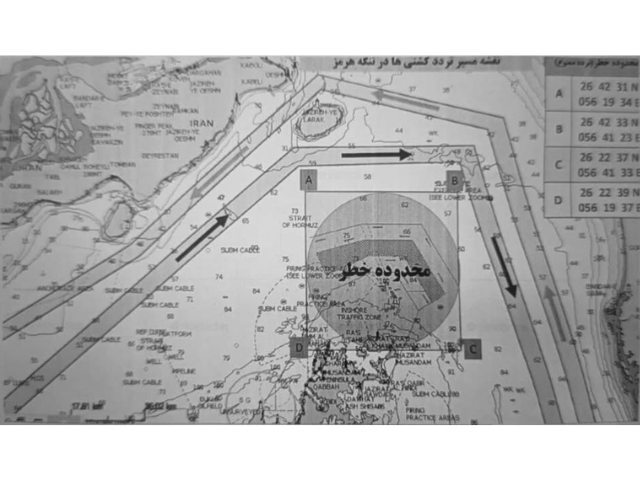
IRGC releases map to help ships avoid mines in Strait of Hormuz
The Iranian Revolutionary Guard Corps (IRGC) released a map showing alternate shipping routes in the Strait of Hormuz for ships to avoid naval mines, according to local media reports, Al Jazeera said.
The circle on the map below is labelled an “area of danger”. The IRGC Navy says ships must coordinate with them to avoid naval mines.
Al Jazeera stated that tankers that used to pass close to Oman, which is in the south of the Strait, are now being told to take a more northerly route, closer to the Iranian coast.
Israeli military says it has killed Hezbollah chief Naim Qassem's secretary
The Israeli military said on Thursday it had killed the nephew of Hezbollah's Secretary-General Naim Qassem, who had served as his personal secretary, and had struck river crossings used by the group overnight.
Israel struck Beirut's southern suburbs just before midnight and at dawn, and hit towns across the south on Thursday morning, Lebanese state media said.
For its part, Hezbollah, which had initially said it would pause attacks on Israel in line with the ceasefire, said it was resuming them on Thursday morning and had fired once across the border into Israel and twice at Israeli forces in southern Lebanon.
Rescuers across Lebanon were working through the night to try to save wounded people trapped under the rubble of destroyed buildings after the Israeli attacks, which hit heavily populated areas without customary warnings for civilians to flee.
Families gathered on Thursday at Beirut hospitals to identify slain loved ones, and rescuers worked through the night to try to save those trapped under rubble from attacks that hit populated areas without customary warnings to civilians.
"This is my place, this is my house, I've been living here for more than 51 years. So, everything destroyed. See?" said Naim Chebbo, sweeping shattered glass and debris from his home in Beirut after strikes destroyed the building next door.
Mourning for Khamenei
"What happened yesterday was a grave violation," Iranian deputy foreign minister Saeed Khatibzadeh told BBC Radio of Israel's attacks on Lebanon.
"It was a catastrophe, could actually end in more catastrophe, and this is the nature of this rogue behaviour that we are seeing from Israel in the whole Middle East."
Inside Iran, where the halt to six weeks of US and Iranian airstrikes has been portrayed as victory for the clerical rulers, huge crowds turned out for a commemoration to mark 40 days of mourning for Supreme Leader Ayatollah Ali Khamenei, killed on the war's first day.
State TV showed crowds in Tehran, Kermanshah, Yazd and Zahedan, with mourners in black carrying Iranian flags and portraits of Khamenei and his son and successor Mojtaba.
In Tehran, officials including atomic chief Mohammad Eslami and roads minister Farzaneh Sadeq attended. Large commemorative billboards were displayed and a large Lebanese Hezbollah flag was visible on one building, while crowds moved toward the compound where Khamenei was killed.
In Shiraz, a funeral procession was held for Revolutionary Guards' intelligence chief Majid Khademi, killed earlier this week in an Israeli strike in his home province of Fars.
Physical oil prices spike
The futures contracts for delivery of oil in May or June, typically used as benchmarks for global oil prices, have eased since Trump announced the ceasefire this week on expectations that deliveries of blocked Gulf oil would quickly resume.
But the price of physical oil for delivery now has shot up to record levels as refiners struggle to meet demand with a fifth of the global supply knocked out for a month and a half.
Trump, who announced the truce on Tuesday night just before a deadline he had set to destroy Iran's "whole civilisation" unless it unblocked the strait, threatened more attacks.
— Department of State (@StateDept) April 9, 2026
If Iran did not comply, then "the 'Shootin’ Starts,' bigger, and better, and stronger than anyone has ever seen before," he posted on social media. "In the meantime, our great Military is Loading Up and Resting, looking forward, actually, to its next Conquest. AMERICA IS BACK!"
Trump also claimed that Iran would no longer be pursuing nuclear enrichment for "weaponisation." However, the Supreme National Security Council of Iran, when speaking about their 10-point plan for peace on X, did not include any clause on nuclear materials or weapons
Full Statement of the Supreme National Security Council :
— True Promise - الوعد الصادق ✪🇮🇷 (@IRTruePromise) April 7, 2026
[PART-1]
Good news to the dear nation of Iran! Nearly all the objectives of the war have been achieved.
The noble people of Iran should know that, thanks to the sacrifices of their children and their historic presence on…
Additionally, Iran’s atomic energy chief Mohammad Eslami says enrichment won’t be "curtailed".
"The enemy won't succeed in restricting Iran's enrichment programme."
Though Trump has declared victory, Washington did not achieve the aims he had announced to justify the war at its outset: to eliminate Iran's ability to attack its neighbours, destroy its supposed nuclear programme and create conditions that would make it easier for Iranians to topple their government.
Additionally, more than 3,000 people have been killed throughout Iran during the war that began on February 28, Iran's forensic chief told state media on Thursday, adding that 40% of the dead needed forensic work to be identified and returned to families.
Iran has demonstrated their ability to exert control of the strait, despite a massive US military presence in the region built up over decades to protect Washington's economic interests and exert pressure over the region.
The core disputes remain unresolved, with each side sticking to competing demands for a deal that could shape the Middle East for generations.
Joint statement from world leaders welcomes ceasefire
In a joint statement on Thursday, the leaders of Canada, Japan, and many European nations welcomed the "two-week ceasefire concluded between the United States and Iran today."
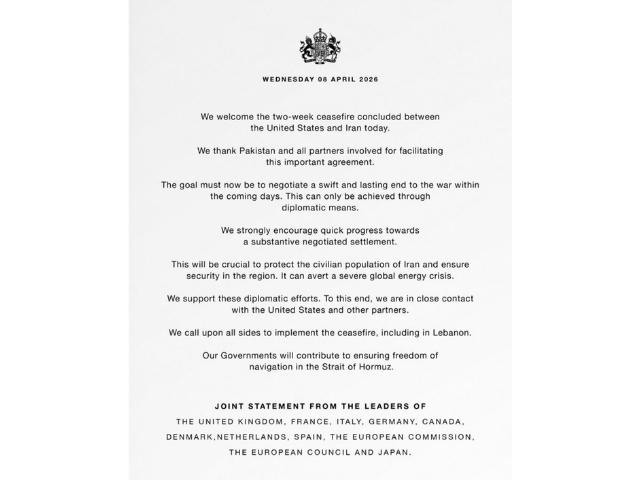
The release stated that they "thank Pakistan and all partners involved for facilitating this important agreement."
They also extended the ceasefire to Lebanon, saying that they "call upon all sides to implement the ceasefire, including in Lebanon."
Spain to reopen its embassy in Tehran
Spain is reopening its embassy in Tehran in hopes of achieving peace in the US-Israeli war on Iran, Foreign Minister Jose Manuel Albares told reporters on Thursday.
"I've instructed our ambassador in Tehran to return, to take up his post again and reopen our embassy, and for us to join in this effort for peace from every possible quarter, including from the Iranian capital itself," Albares said.
US Chargé d’Affaires in Pakistan reviewed arrangements with Ministry of Interior
The US Chargé d’Affaires in Pakistan visited the Ministry of Interior to review arrangements for the US Vice President's visit to Islamabad.
The Chargé d’Affaires of the United States in Pakistan visited the Ministry of Interior to review plans and arrangements for the visit of the U.S. Vice President to Islamabad.
— The STRATCOM Bureau (@OSPSF) April 9, 2026
The Government and Armed Forces of Pakistan have prepared a comprehensive plan to provide foolproof… pic.twitter.com/STRFDnZ5q2
Iran says talks 'unreasonable' amid Israeli strikes
Trump's latest post followed the largest attack of the war by Israel on Wednesday that killed more than 250 civilians, including women and children, in Lebanon, prompting a warning from Iran's lead negotiator that Israel's relentlessly attacking Lebanon and Washington's insistence on Tehran abandoning its "nuclear ambitions" could jeopardise talks to forge a permanent peace deal.
"In such a situation, a bilateral ceasefire or negotiations were unreasonable," Iran's parliament speaker, Mohammed Bager Qalibaf, said in a statement on Wednesday.
Oil prices climbed on Thursday with investors concerned about the fragility of the truce and elevated geopolitical risks over Middle East supply, with doubts that restrictions in the Strait of Hormuz would soon ease.
Brent crude futures were up $1.96, or 2.07%, at $96.71 a barrel at 0325 GMT, while US West Texas Intermediate crude rose $2.6, or 2.75%, to $97.01 a barrel, a day after both benchmarks had fallen sharply on the ceasefire announcement.
Brent crude and West Texas Intermediate remain far above the $70.75 and $65 a barrel before the joint US-Israel onslaught began.
Asian share markets were in a sober mood on Thursday amid unease about the ceasefire, with Japan's Nikkei lingering either side of flat, having jumped 5.4% the previous session and the MSCI's broadest index of Asia-Pacific shares outside Japan easing 0.7%.
On Wall Street, S&P 500 futures and Nasdaq futures were both off 0.2% as Wednesday's surge ended, and in Europe, the 50 futures eased 0.1%, DAX futures fell 0.5%, while FTSE futures were up 0.4%.
Contrasting agendas
Israel's slew of aerial bombardments on Wednesday threw a wrench in regional truce efforts, with conflicting messages from Tehran and Washington on the scope of the ceasefire and sharply contrasting agendas for peace talks set to start on Saturday in Pakistan.
The United States and Israel say Lebanon is not included in the agreement, while Iranian President Masoud Pezeshkian has said a halt in hostilities in Lebanon was an essential condition of Tehran's deal with Washington.
Hezbollah said it fired rockets early on Thursday at the small kibbutz of Manara, citing what it described as Israel's ceasefire violations, warning of more until there was a halt in "Israeli-American aggression".
Pakistan's foreign ministry condemned the Israeli operations on Thursday, which it said "undermine international efforts to establish peace and stability".
French President Emmanuel Macron earlier said Lebanon "must be fully covered" by the ceasefire.
Iran's delegation for the talks is due to arrive in Islamabad on Thursday night.
"Despite scepticism of Iranian public opinion due to repeated ceasefire violations by the Israeli regime ... Iranian delegation arrives tonight in Islamabad for serious talks based on 10 points proposed by Iran," Ambassador Reza Amiri Moghadam said in a post on X on Thursday.
Italy PM Meloni said reopening of Strait of Hormuz is vital
Italian Prime Minister Giorgia Meloni said on Thursday that restoring freedom of navigation in the Strait of Hormuz is a vital interest for her county and the whole of the European Union.
"We have come within a step of the point of no return, but we now face a fragile prospect of peace that must be pursued with determination,” Meloni told parliament, adding that Italy condemns any violation of the ceasefire and is calling for a permanent halt to hostilities.
Freedom of navigation means navigation must be free
There was scant sign that the Strait of Hormuz was open in any meaningful way since the truce agreement, with Iran still asserting its control over the conduit for a fifth of the world's oil and liquefied natural gas supply, and setting tolls for safe passage.
Read more: Strait of Hormuz 'Iran's nuke'
Tehran's newly demonstrated ability to cut off Gulf energy supplies through its grip on the strait, despite decades of massive US military investment in the region, shows how the conflict has already altered power dynamics in the Gulf.
Iran's Revolutionary Guards navy posted a map on Thursday showing alternative shipping routes in the Strait of Hormuz to help ships avoid naval mines, the semi-official Iranian news agency ISNA said.
British Foreign Secretary Yvette Cooper will say on Thursday that shipping through the Strait of Hormuz, must be toll-free, countering a push by Iran to control a channel long treated as an international waterway, despite
"The fundamental freedoms of the seas must not be unilaterally withdrawn or sold off to individual bidders. Nor can there be any place for tolls on an international waterway," Cooper will say in an annual foreign policy speech in London, according to advance extracts.
Hezbollah says it hit Israeli forces in southern Lebanon
Al Jazeera reported that Hezbollah said its drone strike targeted and hit an Israeli force inside a house in the Tayyiba Project in south of the country.
Earlier, the group said its missile also targeted and hit a Namer APC – an Israeli armoured personnel carrier – in the town of Al-Tayyiba, in southern Lebanon.
Lebanon
The deal's fractures emerged quickly as Israel carried out the heaviest strikes on its neighbour -- including in densely packed central Beirut, since the Iran-backed militant group Hezbollah joined the war in early March.
At least 182 people were killed and nearly 900 wounded on Wednesday, the Lebanese Health Ministry said.
Amnesty International’s regional director for the Middle East and North Africa, Heba Morayef, says that the “nightmare for civilians has become more terrifying” in Lebanon, “just hours after the world cautiously welcomed news of a US-Israeli ceasefire with Iran”.
“Civilians in Lebanon are already paying an unbearable price with children, health workers and journalists amongst those killed – the latest attacks will only escalate this devastating human toll,” Heba said.
Israel said its battle against Hezbollah was not part of the US-Iran truce agreed late Tuesday, an argument echoed by US Vice President JD Vance, days before he is due to lead talks with Tehran in Pakistan.
"If Iran wants to let this negotiation fall apart... over Lebanon, which has nothing to do with them, and which the United States never once said was part of the ceasefire, that's ultimately their choice," he said.
But Iran's parliament speaker Mohammad Bagher Ghalibaf appeared to threaten the ceasefire, posting on X that the "workable basis on which to negotiate" had already been violated, making further talks "unreasonable".
Read More: How Pakistan brokered a two-week ceasefire deal between US, Iran?
Adding to the fragility of the truce, agreed hours before a deadline set by US President Donald Trump, a senior US official said Iran's 10-point plan was not the same set of conditions the White House had agreed to to pause the war.
In Lebanon, where UN rights chief Volker Turk called the scale of killing "horrific", strikes across the capital, Beirut, without warning triggered scenes of horror and panic.
More than 1,700 people have been killed in Lebanon since Israel launched airstrikes and a ground invasion last month.






This material may not be published, broadcast, rewritten, redistributed or derived from. Unless otherwise stated, all content is copyrighted © 2026 The Express Tribune.





COMMENTS (6)
Comments are moderated and generally will be posted if they are on-topic and not abusive.
For more information, please see our Comments FAQ