22 terrorists killed during sanitisation operation in K-P's North Waziristan: ISPR
Updated 39 minutes ago

Strikes kill hundreds in Lebanon; Tehran shuts Hormuz, warns of direct response
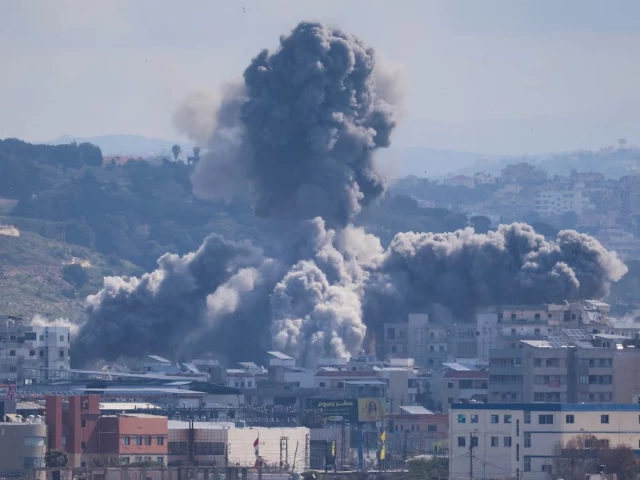
Just hours after Pakistan successfully brokered a two-week ceasefire between the United States and Iran, the fragile truce was already under strain as Israel launched its heaviest strikes on Lebanon since the conflict erupted last month.
The attacks targeted Hezbollah positions in Beirut and surrounding regions, resulting in the deadliest day for Lebanon in the current hostilities, with at least 254 reported killed and hundreds more wounded, according to the Lebanese civil defence.
Reports said Israel struck over 100 sites "within 10 minutes" in Lebanon after the US-Iran ceasefire was announced in the early hours of Wednesday. The Israeli army said it targeted multiple areas in Beirut, Beqaa, and southern Lebanon.
Local residents and witnesses described towering columns of smoke over the capital and buildings crumbling under precision airstrikes, with some strikes reportedly occurring without prior civilian warnings. Israeli airstrikes also killed four people, including a journalist in Gaza.
Israeli Prime Minister Benjamin Netanyahu said that Iran is weaker than ever and Israel is stronger than ever, adding that Israel still has goals to accomplish. "This is not the end of the campaign".
Iran immediately condemned Israel's actions, linking the assaults on Hezbollah to threats against its own security. The Islamic Revolutionary Guards Corps (IRGC) warned that continued attacks would prompt "a heavy retaliation against the Israeli regime."
While halting oil tanker traffic in the Strait of Hormuza critical global chokepoint and a key US condition in the ceasefireIran signalled its readiness for a direct response if hostilities persist. "An attack on Hezbollah is an attack on Iran," Brigadier General Majid Mousavi said.
Iranian Foreign Minister Abbas Araghchi, who is expected to travel to Pakistan for the talks with the US in Islamabad over the weekend, underscored that the ceasefire's terms were "clear and explicit," urging the United States to act to prevent further violations.
"The U.S. must chooseceasefire or continued war via Israel. It cannot have both. The world sees the massacres in Lebanon. The ball is in the U.S. court, and the world is watching whether it will act on its commitments," he wrote on X.
Contrasting sharply with Iran's position, US officials insisted that Lebanon was not part of the temporary ceasefire. White House Press Secretary Karoline Leavitt reiterated that the US-Iran truce did not apply to Israeli operations in Lebanon.
In Iran, domestic reactions were fierce. State media and social platforms carried urgent warnings that the ceasefire could collapse unless Israeli strikes ceased immediately. IRGC statements accused Washington of tacitly supporting its ally's violations.
Meanwhile, air defences in Iran were activated in cities including Tehran, Kerman, and Isfahan, responding to unknown drone incursions. Iran, which had allowed ships to pass through the strait, closed it again.
Iran's Supreme National Security Council and state media confirmed that only limited and conditional openings of the Strait of Hormuz had occurred, with vessels requiring explicit Iranian permission to transit. Shipping sources reported Greek and Chinese vessels navigating the strait.
Within hours of the ceasefire agreement, the IRGC said Tehran was preparing a heavy retaliation. "In response to Israel's violation of the ceasefire in Lebanon, Iran is preparing a heavy retaliation against the Israeli regime," the IRGC said.
Iran's Tasnim news agency reported that Tehran could withdraw from the US ceasefire agreement if Israel continued to violate it by attacking Lebanon. Iranian diplomats said Foreign Minister Araghchi raised this issue in a phone call to Pakistan's army chief.
The Gulf states, while generally supportive of peace efforts, expressed concern over Iran's post-ceasefire actions. The UAE Foreign Ministry highlighted that it had exerted "intensive diplomatic efforts to prevent the war," emphasising that the country was not directly involved.
A spokesperson stressed that any response to Iranian threats must be "comprehensive and complete, including nuclear and military capabilities and its proxies in the region," underscoring regional anxieties over a wider escalation despite the temporary US-Iran truce.








This material may not be published, broadcast, rewritten, redistributed or derived from. Unless otherwise stated, all content is copyrighted © 2026 The Express Tribune.






COMMENTS
Comments are moderated and generally will be posted if they are on-topic and not abusive.
For more information, please see our Comments FAQ