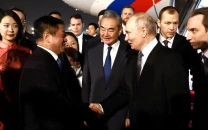
Putin lands in China for trip that aims to show unshakeable ties after Trump pomp
Updated 2 hours ago

Says US will work closely with Iran, warns countries supplying military weapons to Iran of immediate 50% tariffs
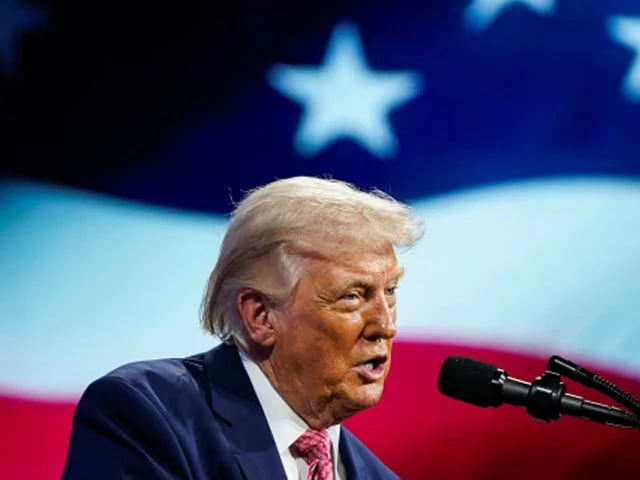
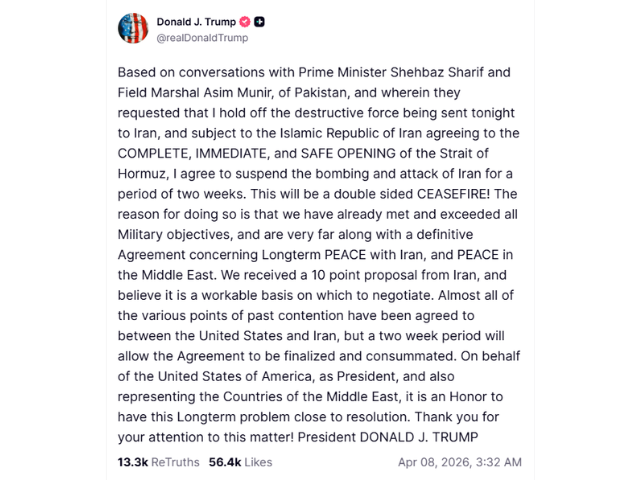
The United States will work closely with Iran and the two countries are discussing tariff and sanctions relief, President Donald Trump said on Wednesday, following the announcement of a two-week ceasefire.
Trump pulled back from the brink of a threatened full-on assault on Iran on Tuesday night, two hours before a deadline he had set for Tehran to open the blockaded Strait of Hormuz.
"We are, and will be, talking tariff and sanctions relief with Iran," Trump said in a social media post.
Despite his ebullient comments and widespread relief on Iran's streets and in global financial markets over the ceasefire, the main disagreements between Washington and Tehran remain unresolved and the two sides are sticking to competing demands for a potential peace deal.
Trump also said in a post on Truth Social that his administration would work closely with Iran, following the announcement of a two-week ceasefire brokered by Pakistan.
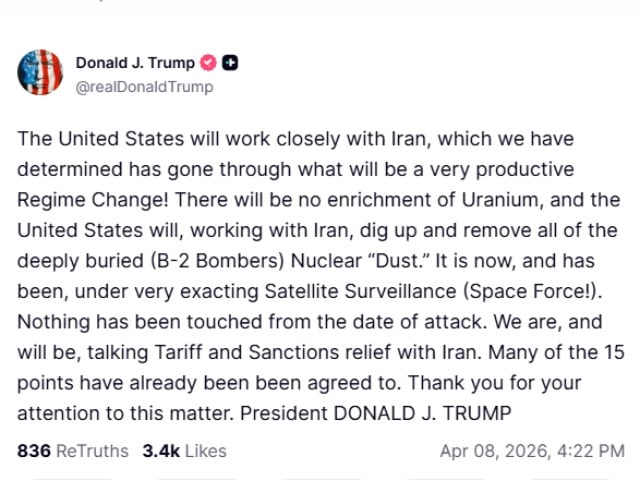
"The United States will work closely with Iran, which we have determined has gone through what will be a very productive Regime Change!" Trump wrote. He added, "There will be no enrichment of Uranium, and the United States will, working with Iran, dig up and remove all of the deeply buried (B-2 Bombers) nuclear 'dust'.
"It is now, and has been, under very exacting Satellite Surveillance (Space Force!)," the president said, noting, "Nothing has been touched from the date of attack."
He added that the US was and would continue to discuss tariffs and sanctions with Iran. "Many of the 15 points have already been been agreed to," Trump said.
In a separate post, Trump wrote: "A Country supplying Military Weapons to Iran will be immediately tariffed, on any and all goods sold to the United States of America, 50%, effective immediately."
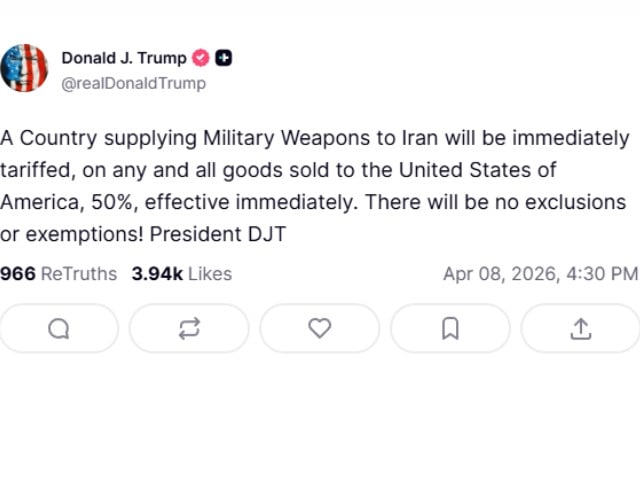
He added that there would be no exclusions or exemptions in this regard.
Prime Minister Shehbaz Sharif announced earlier today that Iran and the US "along with their allies have agreed to an immediate ceasefire everywhere, including Lebanon and elsewhere, EFFECTIVE IMMEDIATELY".
In a post on X, PM Shehbaz further invited the US and Iran's "delegations to Islamabad on Friday, April 10 2026, to further negotiate for a conclusive agreement to settle all disputes".
With the greatest humility, I am pleased to announce that the Islamic Republic of Iran and the United States of America, along with their allies, have agreed to an immediate ceasefire everywhere including Lebanon and elsewhere, EFFECTIVE IMMEDIATELY.
— Shehbaz Sharif (@CMShehbaz) April 7, 2026
I warmly welcome the…
Trump agreed to the two-week ceasefire with less than two hours before his deadline for Tehran to reopen the Strait of Hormuz or face devastating attacks on its civilian infrastructure.
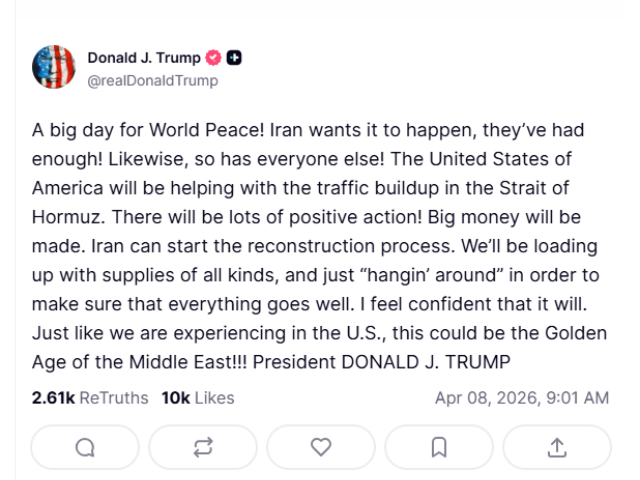
"A big day for World Peace! Iran wants it to happen, they’ve had enough! Likewise, so has everyone else!" he said on Truth Social. The post added that "The United States of America will be helping with the traffic buildup in the Strait of Hormuz."
Trump's announcement represented an abrupt turnaround from an earlier claim, when he issued a warning that "a whole civilisation will die tonight" if his demands were not met.
Trump said the last-minute deal was subject to Iran's agreement to pause its blockade of oil and gas supplies through the strait, which typically handles about one-fifth of global oil shipments. Iran's Foreign Minister Abbas Araghchi said in a statement that Tehran would stop counter-attacks and provide safe passage through the waterway.
"This will be a double-sided CEASEFIRE!" Trump wrote on his Truth Social platform. "The reason for doing so is that we have already met and exceeded all Military objectives, and are very far along with a definitive Agreement concerning Longterm PEACE with Iran, and PEACE in the Middle East."
The war, now in its sixth week, has claimed more than 5,000 lives in nearly a dozen countries, including more than 1,600 civilians in Iran and over 1,000 civilians in Lebanon, according to tallies from government sources and human rights groups.
Trump issued an initial deadline to Iran to reopen the Strait of Hormuz, followed by repeated extensions and retaliatory strikes targeting key infrastructure and military assets.
On March 21, the president gave Iran 48 hours to reopen the strait, warning that US forces would strike the country’s energy facilities if it failed to comply. Two days later, on March 23, Trump said, "Very good and productive talks" had taken place, and postponed the planned strike by five days. On March 27, he extended the deadline further to April 6.
Hostilities escalated on March 29, when a US E-3 Sentry early warning aircraft was damaged on the ground during an airstrike at Prince Sultan Air Base in Saudi Arabia. Between April 3 and 4, US F-15E and A-10 Warthog aircraft were also downed, while two C-130 aircraft were destroyed during a rescue operation for a downed pilot.
Meanwhile, attacks continued across Tehran and the Kharg Island, while energy infrastructure was also struck. On April 5, Trump extended the deadline for an agreement with Iran to Tuesday, 8pm EDT (0000 GMT, Wednesday).





This material may not be published, broadcast, rewritten, redistributed or derived from. Unless otherwise stated, all content is copyrighted © 2026 The Express Tribune.





COMMENTS (5)
Comments are moderated and generally will be posted if they are on-topic and not abusive.
For more information, please see our Comments FAQ