Shehbaz hails Pakistan's role in US-Iran talks
Updated 3 hours ago

Warns that if military escalation and disruptions in Hormuz persist, the suffering will extend far beyond the region
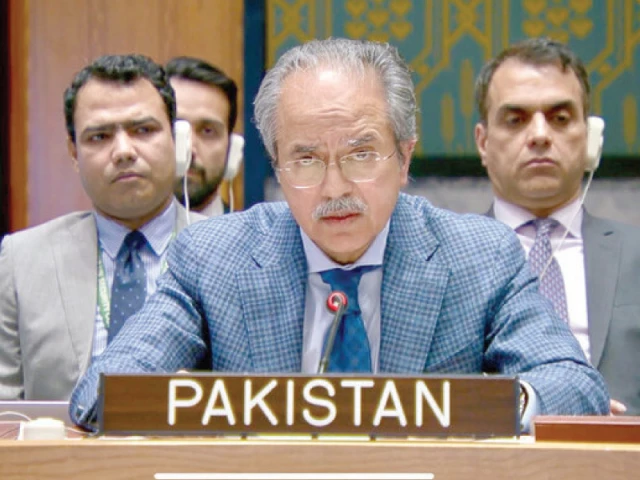
Amid escalating tensions in the Middle East and a breakdown in dialogue between the United States and Iran, Pakistan on Tuesday called for restraint, diplomacy and dialogue while demanding a permanent end to hostilities to prevent further expansion of the conflict.
Addressing the United Nations Security Council, Pakistan’s Permanent Representative to the United Nations, Asim Iftikhar, expressed concern over the widening scope of the conflict, warning that it risked engulfing the entire region.
His remarks came during a meeting in which China and Russia vetoed a Bahraini resolution aimed at protecting commercial shipping in the Strait of Hormuz.
Also Read: China, Russia veto UNSC resolution to open Strait of Hormuz
Condemning the attacks, the envoy reaffirmed Pakistan’s “unwavering support and complete solidarity” with Bahrain and other Gulf Cooperation Council countries — Saudi Arabia, Qatar, Kuwait, United Arab Emirates and Oman — as well as Jordan, noting that these countries were not parties to the conflict but were directly affected by its consequences.
“Pakistan supports the sovereignty, territorial integrity, political independence and security of all brotherly countries in the region,” Iftikhar said.
Explanation of Vote by Ambassador Asim Iftikhar Ahmad,
— Permanent Mission of Pakistan to the UN (@PakistanUN_NY) April 7, 2026
Permanent Representative of Pakistan to the UN,
After the Security Council Vote on Draft Resolution on the Strait of Hormuz
(7 April 2026)
********
President,
At the outset, let me reiterate Pakistan’s continued and… pic.twitter.com/jsnOTHGXNI
He stressed the need to ensure the safety of ships and crew members, calling for the swift and secure passage of civilian vessels and the restoration of normal navigation through the Strait of Hormuz, which has remained closed since the onset of the conflict in February.
“The Strait of Hormuz is an important international shipping route for goods and energy. The situation in the Strait of Hormuz is adversely impacting countries around the world, including Pakistan,” he said, adding that the consequences for the regional and global economy were severe and that ordinary Pakistanis were being affected.
Highlighting the broader impact of the disruption, the envoy warned that continued escalation would have far-reaching consequences, particularly for vulnerable populations.
“If the military escalation and disruptions persist, the suffering will extend far beyond the region, translating into widespread economic hardship,” he added.
Read: Iran calls off talks with US, has informed Pakistan: NYT
Iftikhar also acknowledged Bahrain’s mediation efforts to reopen the strait, while highlighting Pakistan’s diplomatic engagement led by Deputy Prime Minister and Foreign Minister Mohammad Ishaq Dar.
“The Deputy Prime Minister and Foreign Minister of Pakistan, Senator Ishaq Dar, hosted the foreign ministers of Egypt, Saudi Arabia and Türkiye in Islamabad last week to advance the pursuit of a peaceful resolution of the ongoing crisis through intensified diplomatic engagement,” he said.
He further referred to his meeting with Wang Yi in Beijing, where Pakistan and China announced a five-point initiative outlining a roadmap to end the conflict.
“These efforts have been widely acknowledged and appreciated, including by the UN Secretary-General and members of this Council,” he said, adding that time and space must be allowed for ongoing diplomatic efforts to facilitate a return to dialogue.
The envoy reiterated Pakistan’s commitment to pursuing a durable diplomatic solution and continuing its constructive role in promoting peace.
“This is the fundamental foundation of our ongoing diplomatic efforts, which we are determined to continue to pursue,” he said.
Emphasising Pakistan’s position, Iftikhar said restraint, diplomacy and dialogue must prevail. “Our objective is clear — a permanent end to hostilities, containing the expansion of this conflict and preventing any further loss of civilian life or destruction of critical infrastructure,” he concluded.
The vote comes just hours before Donald Trump's 8 PM (midnight GMT) deadline for Iran to make a deal or face the US military destroying its power plants and bridges.
Oil prices have surged since the US and Israel struck Iran at the end of February, unleashing a conflict that has run for more than five weeks while Tehran has largely closed the strait that was previously the route for about a fifth of global oil and liquefied natural gas.
Bahrain, with the backing of the United States and other oil-exporting Gulf countries, launched negotiations two weeks ago on a draft that would have given a clear UN mandate to any state wishing to use force to unblock the strait.
But Russia and China said the resolution was biased against Iran, while China’s UN envoy Fu Cong said adopting such a draft when the US was threatening the survival of “a civilisation” would have sent the wrong message.
Iran's UN ambassador Amir Saeid Iravani praised the Chinese and Russian moves, saying "their action today prevented the Security Council from being misused to legitimize aggression."
The Strait's closure and the resulting surge in global oil prices have handed financial windfalls to Iran, Oman and Saudi Arabia, while other states that lack alternative shipment routes have lost billions of dollars, a Reuters analysis found.
While much of the world faces a surge in inflation and economic damage from the energy price rise, for the Middle Eastern oil producers, the impact has depended on their geography.
The International Energy Agency described the conflict as the world's biggest energy supply shock yet, citing more than 12 million barrels per day of regional shut-ins and damage to about 40 energy facilities.









This material may not be published, broadcast, rewritten, redistributed or derived from. Unless otherwise stated, all content is copyrighted © 2026 The Express Tribune.










COMMENTS
Comments are moderated and generally will be posted if they are on-topic and not abusive.
For more information, please see our Comments FAQ