Shehbaz hails Pakistan's role in US-Iran talks
Updated 1 hour ago

Givt absorbed the shock for two to three weeks, bearing burden internally while ensuring uninterrupted availability
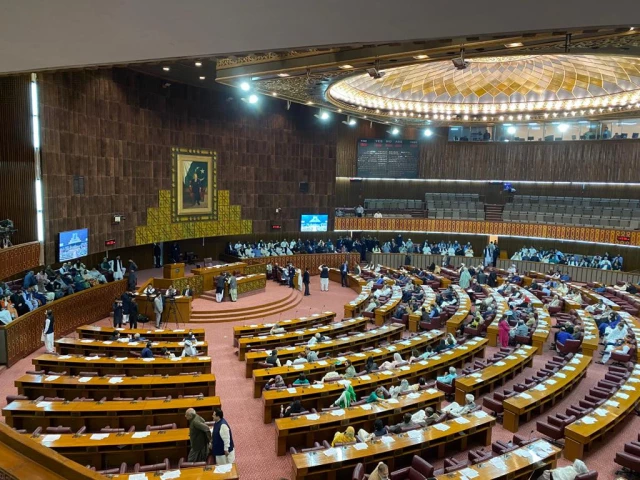
The government on Monday defended its handling of the fuel price surge, telling the National Assembly that emergency measures, including subsidies exceeding Rs100 billion, were rolled out to shield consumers after global oil markets were jolted by the Iran crisis and disruptions to key supply routes.
Delivering a policy statement on the floor of the House, Petroleum Minister Ali Pervaiz Malik said the situation took a dramatic turn following the February 28 attack on Iran, which disrupted global energy flows, particularly through the Strait of Hormuz, which carries 25 to 30 per cent of the world's oil supply.
He said crude prices, which had hovered around $70 per barrel, surged to as high as $170, while diesel prices spiked to $280 in global markets.
"No one had prepared for such conditions," the minister said, adding that the government had to rapidly devise a response plan after the crisis unfolded.
He said authorities opted against allowing shortages or chaos in fuel supply, noting that one option had been to freeze prices at the cost of long queues and public distress.
Instead, the government absorbed the shock for two to three weeks, bearing the burden internally while ensuring uninterrupted availability.
He said alternative supply routes were arranged after disruptions in Hormuz, with Prime Minister Shehbaz Sharif, the deputy prime minister and the army chief engaging Gulf countries to secure supplies.
Malik thanked Saudi Arabia, the UAE and Oman for facilitating oil deliveries through special arrangements, while also acknowledging Iran for allowing Pakistani vessels to pass through the Strait of Hormuz despite tensions.
The minister said Pakistan, which relies on Hormuz for around 90 per cent of its oil imports, faced cascading challenges as LNG supplies were also affected, rendering a long-term gas agreement ineffective.
He said the government convened a broad national consultation, involving the president, prime minister, chief ministers of all four provinces, the prime minister of Azad Kashmir and the caretaker chief minister of Gilgit-Baltistan, to formulate a unified response.
"All of us collectively ensured that people were not forced into queues," he said, adding that targeted relief mechanisms were designed for all segments, from motorcyclists to farmers.
Detailing relief measures, Malik said subsidies were being delivered through a transparent, technology-driven system developed by the IT Ministry, with funds already reaching millions.
A Rs100 per litre subsidy for motorcyclists has been introduced for three months, while intercity transport has also been subsidised.
Bus owners are being provided Rs100,000 per month, and railway fares for the general public have not been increased.
He added that government-run intercity transport services had been made free in some cases.
Farmers are receiving support through Kisan Cards and other digital platforms, while uninterrupted gas supply has been ensured to 10 fertiliser plants to prevent a fertiliser crisis, keeping prices below Rs4,500.
The minister said a committee of ministers is reviewing oil and fertiliser availability and pricing on a daily basis, while domestic gas supplies have been managed to ensure availability during peak cooking hours.
He acknowledged that while consumers were facing price pressures, the government had prioritised uninterrupted supply over shortages.
However, the opposition sharply criticised the government's approach.
Speaking during the debate, Barrister Gohar Ali Khan questioned the rationale behind the price increases, saying the government had raised fuel prices more sharply than regional countries.
He alleged that while global prices rose by around three per cent, Pakistan increased prices by up to 20 per cent, later raising them further from 42 to 54 per cent.
He also criticised the imposition of higher levies and questioned why the government had not asked oil companies to reduce profits, as done in India.
Gohar said the government had first increased the petroleum levy to Rs160 per litre before reducing it to Rs80, and called for the debate to continue in the next session.
He also pointed to economic hardships, citing a case of a woman allegedly dying of hunger despite allocations under the Benazir Income Support Programme.
He criticised the prime minister for not attending parliament, contrasting it with the previous PTI government.
Responding to the criticism, Minister Malik said the opposition's concerns were not based on full information, suggesting that details had not been conveyed properly at the provincial level.
He maintained that fuel prices had increased globally by as much as 80 per cent in some cases, and that Pakistan's response had focused on cushioning the public while ensuring supply continuity.




This material may not be published, broadcast, rewritten, redistributed or derived from. Unless otherwise stated, all content is copyrighted © 2026 The Express Tribune.




COMMENTS
Comments are moderated and generally will be posted if they are on-topic and not abusive.
For more information, please see our Comments FAQ