Jimmy Kimmel mocks Donald Trump over Don Jr. wedding absence
Updated 14 hours ago

Experts caution the public to stay at least 150 feet away from the whale carcass citing safety hazard
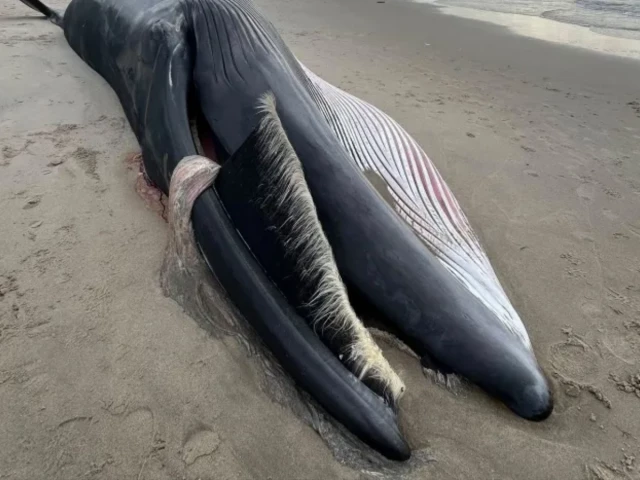
A massive whale carcass washed up on a New York City beach this week, drawing attention to a recent increase in marine mammal strandings along the US East Coast.
According to marine experts, the roughly 40‑foot sei whale was first spotted drifting offshore on March 24 before it was confirmed ashore on March 26 near Rockaway Beach in Queens. The sighting was reported by the Atlantic Marine Conservation Society (AMSEAS), which is working with local and federal agencies to investigate the death and gather data.
Authorities from the New York City Department of Parks and Recreation, New York State Department of Environmental Conservation, and NOAA Fisheries are coordinating with AMSEAS to secure the site and perform a necropsy, an animal autopsy, to determine the whale’s cause of death and collect scientific information.
Experts caution the public to stay at least 150 feet away from the whale carcass, explaining that even dead whales can pose safety hazards and that protected marine mammals must be handled by trained responders under the Marine Mammal Protection Act.
This incident comes amid concerns among scientists and conservationists about a noticeable uptick in whale strandings and deaths along the Atlantic seaboard in recent years. While whales washing up on shore is not unheard of, strandings, when an animal floats ashore after death, have been tracked more closely due to ongoing marine environmental changes.
Marine biologists note that large whale strandings have been elevated along the East Coast for several years. NOAA and other agencies have previously declared “Unusual Mortality Events” when clusters of strandings occur, particularly in winter months. Causes can range from natural factors to human‑related threats like boat strikes or fishing gear entanglement, though scientists say it’s often difficult to pinpoint a single reason for any individual death.
As investigations continue into this most recent whale death, responders will examine the carcass for evidence of injury or environmental stressors. The new data may offer insight into broader patterns affecting marine mammals along the East Coast.















This material may not be published, broadcast, rewritten, redistributed or derived from. Unless otherwise stated, all content is copyrighted © 2026 The Express Tribune.





COMMENTS
Comments are moderated and generally will be posted if they are on-topic and not abusive.
For more information, please see our Comments FAQ