One attacker dead, two injured in gunfight outside Israeli consulate in Istanbul
Updated 53 minutes ago

Abbas Araghchi says Iran’s political structure can absorb shocks despite senior leaders’ assassinations
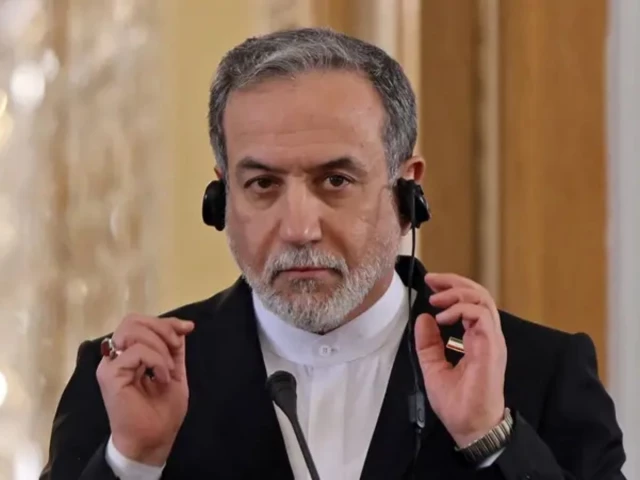
Iran's stance against the development of nuclear weapons will not significantly change, Foreign Minister Abbas Araghchi told Al Jazeera in remarks relayed by Iranian media on Wednesday, cautioning that the new supreme leader is yet to publicly express his view on the matter.
Araghchi said fatwas depend on the Islamic jurist issuing them and added he was not yet in a position to judge the jurisprudential or political views of Mojtaba Khamenei, Iran's new supreme leader.
Iran's foreign minister said he believed that after the war comes to an end, countries that border the Gulf should draft a new protocol for the Strait of Hormuz to ensure that safe passage through the narrow waterway is carried out under certain conditions aligned with Iranian and regional interests.
Iran shut the vital energy gateway, through which a fifth of global oil and liquefied gas passes, saying it "won't even allow a litre of oil" to reach the US, Israel and their partners. On Tuesday, Iran's parliament speaker tweeted that the Strait of Hormuz' situation won't return to its pre-war conditions.
The US has sought to build a naval coalition to escort vessels navigating the strait, with most NATO allies saying they don't want to get involved in military operations against Iran. NATO-member France said it would only consider a joint international coalition to secure passage through the strait following a ceasefire and prior negotiations with Tehran.
Araghchi said an end to the war was only conceivable if the conflict was permanently over throughout the region and Iran received compensation for damages incurred.
When asked about Iranian strikes in the Gulf not only targeting US military bases but also impacting residential or commercial areas, Iran's foreign minister said this was because US forces relocated to urban areas. "Wherever there were American forces gathering, wherever there were facilities belonging to them, they were targeted. It is possible some of these places were near urban areas," the top Iranian diplomat said.
Araghchi acknowledged that regional countries are "upset and their people have been harmed or bothered" by Iranian strikes, but added that the blame lay entirely with the US for starting the war on February 28.
FM says Larijani killing will not weaken system as tensions rise after targeted strike
Araghchi said the assassination of senior Iranian official Ali Larijani would not deal a fatal blow to the country’s leadership, stressing that the Islamic Republic’s political system was designed to withstand such losses.
In an interview with Al Jazeera aired after Larijani’s assassination, Araghchi dismissed suggestions that the killing could destabilise Iran’s governing structure.
"I do not know why the Americans and the Israelis still have not understood this point," Araghchi said. "The Islamic Republic of Iran has a strong political structure with established political, economic, and social institutions. The presence or absence of a single individual does not affect this structure."
Iranian state media confirmed late Tuesday that Larijani had been killed, following earlier claims by Israeli Prime Minister Benjamin Netanyahu that Israel carried out a targeted strike against the senior Iranian figure. Activity on Larijani’s official X account also appeared to acknowledge developments surrounding his death.
Larijani was regarded as a key political figure within Iran’s leadership and often served as a mediator between the country’s clerical establishment and government institutions.
During negotiations leading to the 2015 Joint Comprehensive Plan of Action (JCPOA), former European Union foreign policy chief Federica Mogherini described him as "a sophisticated and highly intellectual negotiator who understands the cost of isolation better than anyone in the Iranian establishment."
Read: Iran hits Tel Aviv with cluster missiles after security chief's assassination
Journalist Osama bin Javaid, who met Larijani ahead of recent nuclear talks with the United States, said in an interview with Al Jazeera that Tehran sent him to negotiations because of the political weight he carried.
While analysts say Larijani’s death may not topple the Iranian regime – similar to how the system continued after the killing of Supreme Leader Ayatollah Ali Khamenei – they expect its impact to be felt politically. Araghchi argued, however, that institutional continuity remains central to Iran’s governance.
"Of course, individuals are influential, and each person plays their role. Some better, some worse, some less. But what matters is that the political system in Iran is a very solid structure," he said. "We have not had anyone more important than the leader himself. And even the leader was martyred. Yet the system continued to work and immediately provided a replacement."
Araghchi added that even if other senior figures – including the foreign minister – were killed, replacements would quickly fill any power vacuum.
Separately, Iran’s paramilitary Basij force commander Gholamreza Soleimani was also assassinated in what Tehran described as US-Israel attacks, according to the Fars News Agency.
In a post on X, the Islamic Revolutionary Guard Corps described Soleimani as a “devoted and sincere fighter” and a “dear martyr”.
In Iranian political culture, martyrdom has often been framed as reinforcing leadership legitimacy and public mobilisation. Javaid said, "Ali Larijani was killed while he was not in hiding. This is a regime which processes martyrdom as a strategy of maintaining control. The person who comes after him, the popular support for him, and for the regime, grows."




This material may not be published, broadcast, rewritten, redistributed or derived from. Unless otherwise stated, all content is copyrighted © 2026 The Express Tribune.



COMMENTS
Comments are moderated and generally will be posted if they are on-topic and not abusive.
For more information, please see our Comments FAQ