Court sentences accused to death in Sana Yousaf murder case
Updated 20 minutes ago

Kabul told to declare TTP terror outfit, dismantle it and prove it
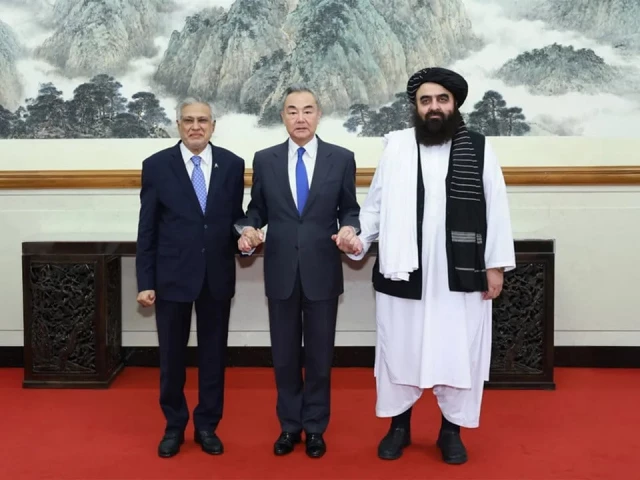
Pakistan has conveyed three core demands to the Afghan Taliban during the talks that have been under way in Urumqi, as China, which brokered the latest round, is trying to convince both sides to agree on a five-point framework to resolve issues.
The three demands put forward by Islamabad at the outset, include Kabul formally declare the Tehreek-e-Taliban Pakistan (TTP) a terrorist organisation, dismantle its infrastructure, and provide verifiable proof of the action.
These demands form the basis of Pakistan's negotiating position, which sources say has hardened amid persistent security concerns.
The Foreign Office has so far only issued an initial statement confirming that talks are taking place in Urumqi, without offering further details on the agenda or progress.
At the last weekly briefing, Foreign Office spokesperson Tahir Andrabi said Pakistan's participation in the talks being held in Urumqi should not be construed as any shift in policy, particularly regarding ongoing security operations.
"There is no material change to ongoing Operation Ghazab Lil Haq that I mentioned last week," the spokesperson added.
On Sunday Afghan Foreign Minister Amir Khan Muttaqi acknowledged the dialogue was still under way and that the Taliban regime wanted to resolve issues with Pakistan through talks.
Sources said China has been playing a quiet but active role through sustained shuttle diplomacy, with its Special Envoy for Afghanistan Yue Xiaoyong engaging both Islamabad and Kabul in recent months to narrow differences and bring them to the negotiating table.
Pakistan has also made it clear that the scope of the talks will remain limited to counterterrorism and border security, ruling out any broader political engagement at this stage. The sources say the focus is on addressing Islamabad's concerns over terrorist groups operating from Afghan territory and ensuring mechanisms to prevent cross-border attacks.
It is believed that a framework is under discussion that could pave the way for a possible understanding between the two sides. The proposed roadmap includes a ceasefire arrangement, counterterrorism assurances from the Afghan Taliban, dismantling of terror sanctuaries inside Afghanistan, and measures to facilitate secure trade routes.
It also envisages the establishment of a more structured and institutionalised dialogue mechanism between Islamabad and Kabul.
Both sides have sent technical-level delegations to Urumqi, reflecting the operational nature of the discussions.
Pakistan's team is led by Syed Ali Asad Gilani, Additional Secretary at the Foreign Office responsible for Afghanistan and West Asia, and includes officials from defence and intelligence agencies.
The Afghan Taliban delegation is headed by Mohibullah Waseq, Chief of Staff to Amir Khan Muttaqi, and includes representatives from the foreign ministry, interior ministry, defence ministry, and intelligence directorate.
Although preliminary engagements have begun, the sources said Chinese officials are holding separate meetings with each side to bridge gaps before moving towards direct, structured negotiations.
The choice of Urumqi as the venue is seen as significant, given its location in China's Xinjiang region, where Beijing has longstanding concerns about militancy linked to groups such as the East Turkestan Islamic Movement (ETIM), whose fighters are believed to have a presence in Afghanistan.
Diplomatic observers say the talks represent a cautious but important effort to stabilise Pakistan-Afghanistan ties, though major differences remain and any breakthrough would depend on Kabul's willingness to address Islamabad's core security demands.






This material may not be published, broadcast, rewritten, redistributed or derived from. Unless otherwise stated, all content is copyrighted © 2026 The Express Tribune.





COMMENTS (1)
Comments are moderated and generally will be posted if they are on-topic and not abusive.
For more information, please see our Comments FAQ