RCCI, minister discuss US trade prospects
Updated 20 hours ago

Oil surges up to 30% in one of biggest daily jumps on record, European shares tumble to lowest in over two months
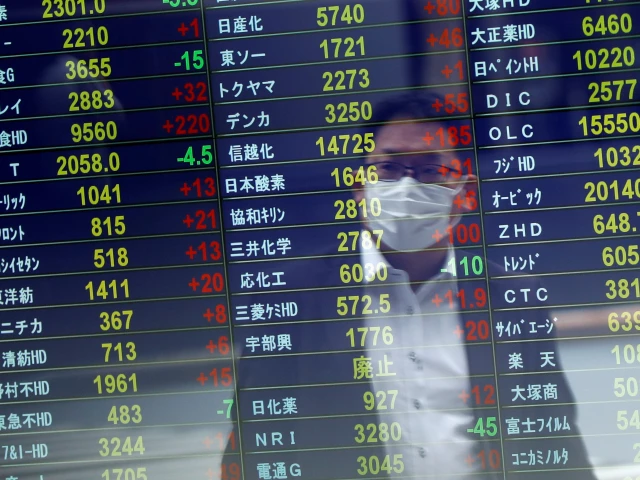
Share markets fell on Monday as the inflationary jolt from surging oil prices threatened to raise living costs and interest rates around the globe, while investors desperate for liquidity fled to the United States dollar.
Crude oil futures soared almost 30% to nearly $120 a barrel, one of its biggest one-day jumps on record, threatening to raise costs of products from gasoline to jet fuel. Brent crude futures LCOc1 were last up nearly 13% at $104.5 a barrel, while US futures were up 12% at $101.8 CLc1.
Iran named Mojtaba Khamenei to succeed his father Ali Khamenei as Supreme Leader, signalling that hardliners remained firmly in charge a week into the war with the US and Israel. That was unlikely to be welcomed by US President Donald Trump, who had declared the son "unacceptable."
Read: Who is Iran's new supreme leader, Mojtaba Khamenei?
With hostilities continuing in the Middle East and tankers unable to cross the Strait of Hormuz amid the threat of Iranian drone attacks, investors were bracing for a long stretch of higher energy costs.
Investors await Washington's response, said Helima Croft, head of global commodity strategy at RBC Capital Markets. "With no clear definition of what winning looks like, it is hard to forecast whether this will be a multi-week or multi-month conflict."
Asian markets sink
The news was sobering for Japan, a major importer of oil and gas, with the Nikkei N225 closing down 5.2% after a 5.5% drop last week.
China, another big oil importer albeit with a huge stockpile of crude saw its blue-chip index CSI300 fall roughly 1%. China on Monday said inflation had already picked up in February before the current oil spike, with consumer prices rising 1.3% on the year. This is not necessarily a negative development, given the country has long struggled with disinflation.
The wave of market selling swept over Wall Street as S&P 500 futures ESc1 shed 1%, while Nasdaq futures NQc1 were down over 1%.
Read More: Hong Kong, China stocks tumble as Iran war knocks Asian markets
European shares tumbled to their lowest in more than two months on Monday, with the pan-European STOXX 600 down 1.63% in a third session of losses. The benchmark index shed 5.5% last week, its worst weekly performance in nearly a year.
In bond markets, the risk of rising inflation outweighed safe-haven considerations to shove yields higher globally. Yields on 10-year Treasury notes US10YT=RR rose 5 basis points to 4.175%, up from a trough of 3.926% just a week ago.
Central banks face inflation conundrum
Interest rate futures 0#FF slipped as investors feared the risk of higher inflation would make it harder for the Federal Reserve to ease policy, though disappointing jobs numbers seemed to argue for stimulus.
Data on US consumer prices due on Wednesday is forecast to show the annual rate holding at 2.4% in February.
The Fed's preferred measure of core inflation due on Friday is forecast to hold at 3.0%, well above the central bank's 2% target, and analysts see a risk of an even higher number. The danger of energy-driven inflation has led markets to wager the next move in rates from the European Central Bank could be up, possibly as early as June.
Also Read: Gulf war risks global economic shock
For the Bank of England, markets have shifted to pricing just a 40% chance of one more easing, compared with two cuts or more before the Middle East conflict started.
Nervous investors sought the liquidity of dollars while shunning currencies from countries that are net energy importers, including Japan and much of Europe.
The dollar strengthened 0.4% to trade at 158.385 yen JPY=EBS, outweighing safe-haven demand and pushing gold down 1.2% to $5,106 an ounce XAU=. The euro slipped 0.5% to $1.1557 EUR=EBS.














This material may not be published, broadcast, rewritten, redistributed or derived from. Unless otherwise stated, all content is copyrighted © 2026 The Express Tribune.










COMMENTS
Comments are moderated and generally will be posted if they are on-topic and not abusive.
For more information, please see our Comments FAQ